The question “how long does private label beauty tool production take?” sounds like a request for one number. For an e-commerce brand, private label beauty tool production time is really a launch-control question: when can the product be approved, packed, handed to the carrier and released for sale? The answer depends on which product decisions are already fixed, whether the supplier is working from an existing model or a new development, when artwork and packaging are ready, and which event starts the production clock.
OLIMOR’s public process is organised around product requirements, samples, branding, packaging, manufacturing and quality review rather than one universal lead-time promise. That is the useful starting point for a buyer: build the schedule around decision gates, then ask the supplier to confirm the date for the selected model, quantity, finish, logo, packaging and destination. This guide shows how to turn that discussion into a launch plan an e-commerce team can actually manage.
Review the Beauty-Tool Buying Guides
What is the realistic answer to private label beauty tool production time?
Short answer: there is no responsible single number for every private-label beauty tool project. A catalogue-based tool with confirmed branding and straightforward retail packaging may move through the project faster than a modified structure, a new component, several finish rounds or a packaging format that still needs fit work. The production stage is only one part of the calendar; sample approval, artwork, packaging supply, inspection and transport can sit on the critical path before or after it.
For planning, separate the project into four clocks. Keep the first three visible even when the supplier gives a production figure, because a “30-day production time” is not the same as a 30-day launch date.
| Clock | What it covers | Question for the supplier |
|---|---|---|
| Decision clock | Brief, quotation, product selection, sample rounds, logo and finish approval. | What information is needed before a date can be confirmed? |
| Production clock | Making, finishing, assembling, branding and checking the ordered tools. | Does the clock start at deposit, artwork approval, sample approval or another event? |
| Pack-out clock | Printing or receiving packaging, fitting inserts, packing units, carton marking and final checks. | Are packaging components available when the tools are ready? |
| Delivery clock | Handover, transport, customs or import handling, warehouse receipt and e-commerce fulfilment. | Is the quoted date ready-to-ship, ex works, port handover or delivered? |
This four-clock model is a buyer-side recommendation, not an OLIMOR published lead-time standard. It prevents the most common planning mistake: placing a supplier’s production estimate directly into a product-launch calendar without adding the decisions and logistics around it.
When should the production clock start?
Ask this question in writing before comparing quotations. “Lead time after order” is incomplete unless the order is defined. For one supplier, the clock may begin after deposit; for another, it may begin only after the approved sample, final artwork and packaging files are available. If the trigger is unclear, two apparently similar quotes may describe different calendars.
Clock-start question to copy into an RFQ
“Please state the event that starts the production lead time for each SKU. Confirm whether the quoted production period begins after (1) quotation acceptance, (2) deposit, (3) product sample approval, (4) decorated sample approval, (5) final packaging artwork approval, (6) receipt of packaging components, or another defined milestone.”
“Please also state whether the quoted date means production completion, packed goods ready for collection, handover to the carrier, or delivery to our warehouse.”
If a supplier cannot identify the trigger, mark the date Hold: timing basis unclear. Do not reject the supplier automatically; request a revised timeline with named dependencies. The aim is to compare like with like, not to reward the shortest unqualified promise.
Which project model is fastest to plan?
The fastest route is usually the one with the fewest unresolved decisions, not simply the one with the shortest advertised production figure. A buyer should classify the brief before asking for a date.
| Project position | Typical open decisions | Timing risk to examine |
|---|---|---|
| Existing model, new brand | Logo location, marking method, finish choice, retail pack, language and quantity. | Sample and artwork approval; availability of the chosen pack components. |
| Existing model with changes | Dimensions, handle or working-end changes, finish adjustment, new component or adapted packaging. | Feasibility review, sample revisions, tooling or component sourcing. |
| New product direction | Product brief, engineering decisions, material wording, working performance and development scope. | The development path is not yet defined, so a production date would be premature. |
| Coordinated multi-SKU range | Several models, shared brand rules, different working parts, packaging versions and SKU quantities. | The slowest SKU, pack dependency or late approval can control the launch. |
OLIMOR’s private-label route is relevant when the brand starts from selected products and adds its own identity and presentation. When the brief includes substantial product changes, the product-development route may be the more useful discussion. The route does not itself establish a fixed date; it helps define what must be resolved before a date can be quoted.
What actually controls an e-commerce launch date?
For an e-commerce brand, the launch date is controlled by the latest unfinished critical item. A tool can be physically complete while the product page is waiting for an approved dimension, the carton is waiting for a barcode, or the packaging is waiting for a final fit check. Build the schedule around dependencies rather than assuming that all work happens in one factory queue.
| Dependency | Buyer must have ready | What to record |
|---|---|---|
| Product direction | Model reference, intended use, required working details and any reference sample or drawing. | Open technical questions and who approves them. |
| Branding | Final logo artwork, marking position, finish direction and acceptable appearance. | Artwork revision, decorated sample status and approval date. |
| Packaging | Pack format, dimensions, copy, barcode, language, insert and protection requirements. | Artwork proof, physical fit, component availability and packed sample. |
| Quality release | Product-specific checks, visual standard, packaging checks and inspection responsibility. | Approved reference, inspection status and unresolved exceptions. |
| Logistics | Destination, shipping basis, warehouse receiving window and import requirements. | Ready date, handover date, transit estimate and contingency owner. |
The e-commerce planning route is useful because product presentation, content and fulfilment are connected. A factory production date should be treated as one milestone inside the launch plan, not the launch plan itself.
How should an e-commerce brand plan backwards from launch?
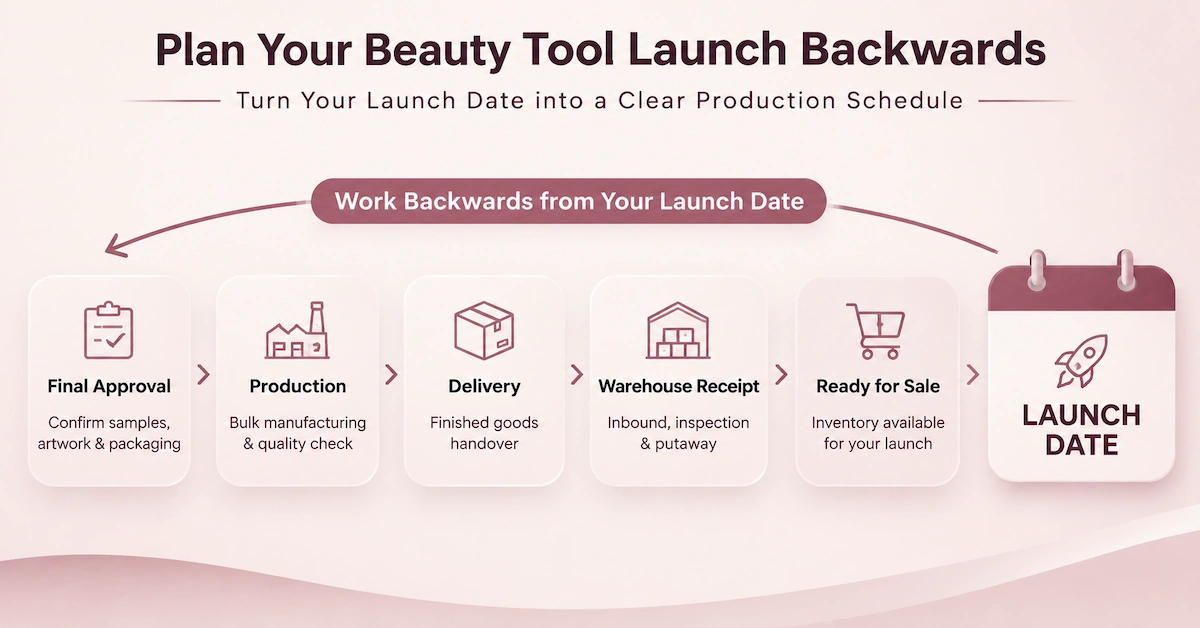
Start with the date the inventory must be available for sale, then work backwards through warehouse receipt, transport, final inspection, pack-out, production, sample approval and briefing. Add an owner and a decision condition to each step. This turns a vague request for “fast production” into a schedule that can be checked every week.
| Reverse-planning gate | Decision that must be complete | Owner |
|---|---|---|
| Sellable inventory date | Stock is received, counted, checked and matched to the approved SKU and packaging. | E-commerce operations |
| Warehouse receipt | Transport, customs handling and receiving time are allowed for the selected destination. | Logistics / 3PL |
| Ready-to-ship handover | Packed cartons, carton marks, quantities and release checks are complete. | Supplier / buyer QC |
| Production completion | Tools are made, finished, branded and available for pack-out. | Supplier production |
| Last approval | Product, decorated unit and packed presentation are approved by the named buyer. | Brand product owner |
Use a date range until the supplier confirms the trigger and dependencies. A launch plan that shows “TBC after sample approval” is more honest and more useful than a precise date built on an unapproved product.
Which sample decisions can delay production?
Samples are not only a product-quality step; they are a timing gate. A brand can shorten the calendar by giving each sample a defined decision purpose and by avoiding a late change that reopens an already completed stage.
Product sample
Check the selected model, working end, movement, dimensions, surface appearance and handling. Record what is approved and what remains open. Do not approve a logo or package while the underlying tool is still changing.
Decorated sample
Check the actual mark on the actual surface. A digital artwork file cannot prove the final size, contrast, position or appearance after the chosen finish. If the logo changes at this point, the artwork and inspection record should receive a new revision.
Packed sample
Check product fit, retention, protection, label information, barcode placement and the way the pack presents online and in fulfilment. The sampling route can support a discussion of the details that need to be resolved before bulk production, but the actual number of sample rounds and timing must be confirmed for the project.
Discuss a Sample Approval Sequence
How do packaging and artwork affect the schedule?
Packaging can become the critical path even when the tool itself is ready. Retail boxes, cards, sleeves, pouches, inserts and cartons each require a defined format, artwork revision and physical fit. If packaging is treated as a design task that starts after production, the brand may have finished goods that cannot be packed or released.
- Confirm the package type, product dimensions and protection method before finalising the dieline.
- Keep product name, barcode, language, care wording and warning copy under one revision owner.
- Request a physical or packed sample when fit, movement or tip protection affects the result.
- Ask whether the packaging supplier’s production time is included in the quoted production period.
- Confirm carton quantity, carton marks and outer dimensions before arranging freight.
OLIMOR’s custom packaging route frames packaging as part of the product conversation. It does not mean every format is immediately available or that a packaging date can be assumed. Request the actual dependency list for the chosen tool and retail format.
What is a useful buyer-side planning allowance?
When a launch team needs a working calendar before the supplier has confirmed dates, use an allowance model rather than a promise. The following is an illustrative buyer-side planning example for an existing beauty-tool model with private-label branding and retail packaging. It is not an OLIMOR quotation, standard or guarantee.
| Planning block | Illustrative allowance | Condition for using the allowance |
|---|---|---|
| Brief and quotation | 1–2 weeks | The brand sends model references, quantities, market, branding and pack expectations together. |
| Sample and approval | 2–5 weeks | The sample scope is clear, feedback is consolidated and no structural change is introduced late. |
| Artwork and packaging | 2–5 weeks, partly parallel | Pack format, copy, barcode and fit are decided early; printing and component availability are confirmed. |
| Bulk production and pack-out | Project-specific | Supplier confirms the model, quantity, finish, branding, packaging receipt and start trigger. |
| Transport and receiving | Project-specific | Destination, shipping mode, customs handling, warehouse appointment and inspection plan are known. |
The table is deliberately not converted into one total promise. The first three blocks may overlap; production cannot be scheduled responsibly until its own trigger and inputs are confirmed; transport varies by destination and service. Use this model to protect the launch plan, then replace each allowance with the supplier’s written project dates.
Which delays are preventable by the brand?
Many delays are not caused by factory speed. They happen because the brand sends incomplete information, gives split feedback, changes a previously approved detail or waits to define packaging until the tool is finished. Treat these as controllable schedule risks.
| Delay pattern | Operational effect | Buyer control |
|---|---|---|
| Unclear model reference | Supplier quotes a different structure or must reopen product selection. | Send a product URL, image, drawing or physical reference for each SKU. |
| Scattered feedback | Different revisions reach the supplier and sample decisions restart. | Nominate one approver and return one consolidated comment file. |
| Late packaging change | Dieline, insert, barcode and carton assumptions no longer match the tool. | Approve product-to-pack fit before final artwork and printing. |
| Unstated market copy | Labels or product pages require changes after packing materials are prepared. | Confirm language, claims, care text and barcode ownership at the brief stage. |
| No receiving plan | Goods arrive before the 3PL can receive, count or inspect them. | Reserve a warehouse window and define the release check before dispatch. |
How should a buyer compare supplier timelines?
Compare the evidence behind each date, not only the number of days. The following is an illustrative buyer-side example; it does not describe real supplier quotations.
| Response | What is stated | Buyer decision | Next action |
|---|---|---|---|
| A: “30 days after order” | No trigger, sample status, packaging scope or delivery meaning. | Hold | Ask for clock start, ready date, pack-out and transport assumptions. |
| B: 35 days after sample approval | Product trigger is clear; packaging receipt and handover point remain open. | Request evidence | Confirm packaging dependency, inspection date and shipping basis. |
| C: milestone schedule | Sample, artwork, packaging receipt, production, pack-out and handover are separately dated. | Proceed to approval | Freeze the approved reference and assign owners for every open gate. |
A longer, transparent schedule may be more useful than a shorter undefined one. The manufacturing process page can help a buyer frame the questions, but the selected product and order must still determine the confirmed dates.
What should be written into the quotation?
Ask for a timeline that can be audited after the order is placed. A useful quotation does not need to predict every future event, but it should show the assumptions that make the estimate valid.
Timeline fields for a private-label beauty tool quotation
SKU and model: [internal SKU, supplier reference, product link or drawing]
Quantity basis: [units by model, finish, logo, packaging version and order batch]
Sample gate: [product, decorated and packed sample status; approval owner]
Clock start: [named event that starts production]
Production period: [supplier-confirmed project value, not a generic promise]
Packaging dependency: [artwork approval, component receipt, fit check and pack-out]
Quality release: [inspection point, approved reference and exception handling]
Handover meaning: [ready to collect, carrier handover, port, or delivered]
Change rule: [which product, finish, logo, packaging or quantity changes reset the date]
This format helps the brand separate a confirmed date from a planning assumption. It also gives the supplier a fair opportunity to explain which variables must be resolved before the date becomes firm.
How do quality checks fit into the timeline?
Quality is a release gate, not an activity to add after the launch date. For beauty tools, the relevant checks depend on the product. A nail clipper, nipper, tweezer, eyelash curler or nail file will not share the same working-end evaluation. The buyer should agree the product-specific checks before production so that a late inspection does not become an unplanned rework loop.
A practical release record should identify the SKU, approved sample revision, visual finish, logo artwork, packaging reference, inspection responsibility, result and any accepted exception. If a result is not acceptable, the status should be Hold, Request evidence or Re-sample, rather than silently moving the date forward.
Use OLIMOR’s quality discussion to frame the inspection questions. The exact inspection plan, sampling basis, acceptance criteria and records remain project-specific and should be confirmed for the selected products.
What should an e-commerce team do when the date moves?
A moving date needs a decision, not only an updated spreadsheet. First identify which gate moved and whether the change affects the critical path. Then choose one of three practical responses: protect the original launch with a smaller or simpler first range, move the launch communication, or hold the order until the product and packaging reference is correct.
- Proceed: the delay is inside available contingency and the approved references remain unchanged.
- Request evidence: the date changed because a dependency is unclear; ask for a revised milestone and owner.
- Re-plan: the last approval, packaging receipt or transport window moves beyond the launch constraint.
- Hold: the proposed recovery requires an unapproved substitution, skipped sample or unverified quality claim.
Do not solve a schedule problem by accepting a different finish, component, package or inspection scope without written approval. A faster shipment that creates a mismatch in the product listing, customer experience or repeat order is not a successful launch.
Private label beauty tool production time FAQ
How long does private label beauty tool production take?
There is no single confirmed duration for every project. The time depends on the model, product changes, branding, packaging, quantity, sample approvals, production trigger, quality release and destination. Ask the supplier to separate sample, production, pack-out and delivery milestones instead of giving one unexplained total.
What is usually faster: private label or OEM development?
A project based on an existing model may have fewer development decisions than a new or substantially modified product. That does not guarantee a fixed date. The sample, finish, logo, packaging and order requirements still need confirmation for the selected tool.
Does production time include packaging?
Do not assume it does. Ask whether packaging procurement, printing, component receipt, insert fit, packing and carton checks are included in the stated production period or scheduled separately.
When should an e-commerce brand place the order?
Place the order only after the product reference, sample status, branding, packaging scope, quantity basis, quality release and clock-start event are clear enough for the supplier to confirm the project schedule. Work backwards from the required inventory date and include transport and receiving time.
Can packaging artwork be completed while samples are being made?
Some artwork work can run in parallel, but final packaging approval should reflect the confirmed product dimensions, fit and protection. Parallel work reduces time only when the brand controls revisions and does not print before the physical pack relationship is approved.
What should a supplier confirm before giving a lead time?
The supplier should have the product model, quantity by SKU, finish, logo, packaging format, sample requirement, destination and quality expectations. The quotation should state the clock trigger and whether the date means production completion, packed goods, carrier handover or delivery.
Does a faster quoted date always mean a better supplier?
No. A short date without a trigger, scope or evidence is not comparable with a detailed milestone schedule. Prefer a response that makes assumptions, approval gates and responsibilities visible so your team can manage the launch.
How can a brand reduce avoidable production delays?
Send complete model references and quantities, nominate one approver, consolidate feedback, start packaging early, control artwork revisions, approve product and packed samples separately, and reserve the receiving window before shipment.
Conclusion
Private label beauty tool production time should be planned as a chain of decisions, not copied from a single production estimate. Separate the decision, production, pack-out and delivery clocks; define what starts the clock; classify the project as existing-model, modified or new development; and work backwards from the date your e-commerce inventory must be sellable.
The most useful supplier conversation is specific: model and quantity by SKU, sample gates, logo and finish, packaging dependencies, quality release, handover meaning and change rules. OLIMOR’s buying guides, private-label, sampling, packaging, manufacturing-process and quality resources can support that discussion. Final MOQ, lead time, product options, packaging configuration, inspection records and delivery assumptions must be confirmed for the actual project.