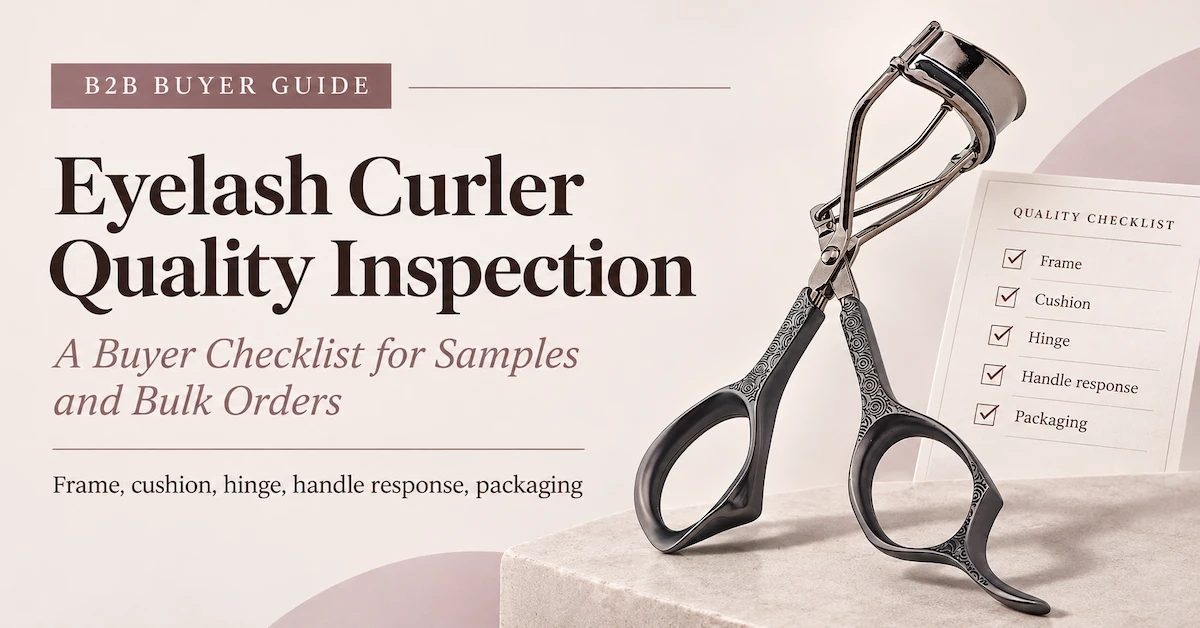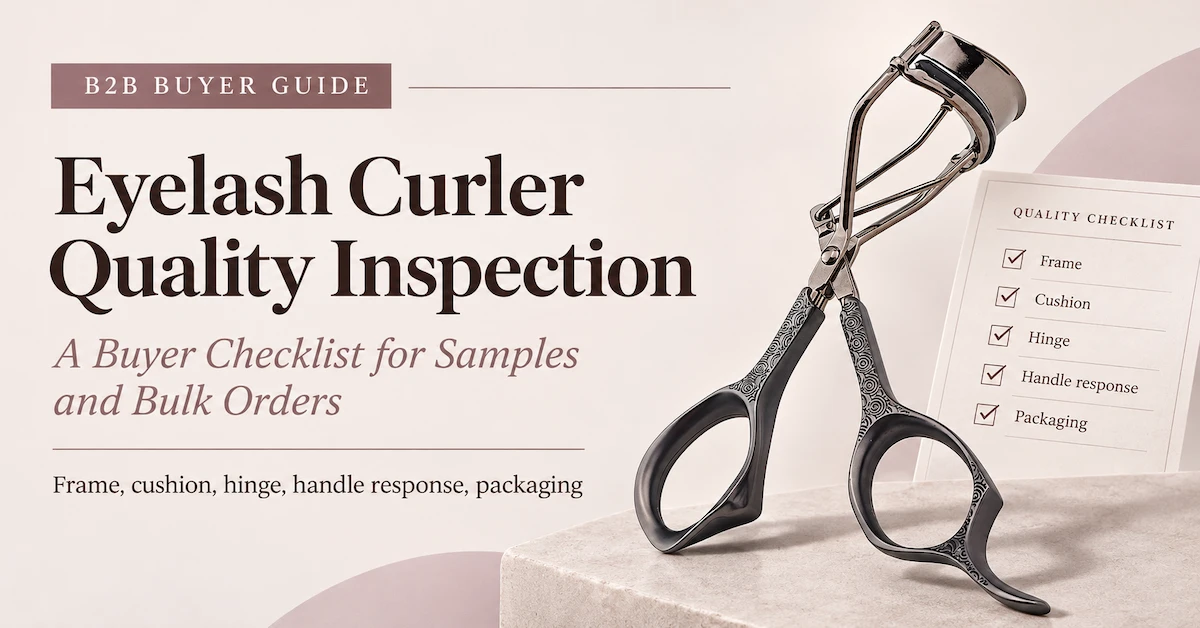
An eyelash curler private label project is not finished when a logo is printed on an existing tool. A brand team still has to define the working shape, cushion relationship, handle action, surface direction, marking area, retail package, evidence and repeat-order reference. Those decisions affect how the product feels in the hand, how it is presented online, what the package protects and whether the next production run can match the approved version.
This guide is for beauty brands and e-commerce teams that want to turn an eyelash curler into a controlled branded SKU. It explains what to decide before requesting a quotation, which product and brand details should be sampled together, how to read a supplier response, and when a project should proceed, pause, request evidence, or return for a revised sample. Exact material, MOQ, price, lead time, testing and packaging details remain project-specific and must be confirmed for the selected model and order.
What does an eyelash curler private label project actually include?
Direct answer: it includes a defined curler model, agreed working details, brand marking, surface direction, retail or professional packaging, a sample approval record and commercial assumptions that can be repeated for the order. Private label describes the market presentation under your brand; it does not automatically mean that every part of the tool is newly engineered.
A project can start in three practical ways:
- Existing model with brand presentation: the tool direction is largely selected, while logo, finish, colour direction and packaging are coordinated for your range.
- Adapted model: the starting tool is known, but the brand wants a change to the working geometry, handle, cushion relationship, surface or package.
- New development: the brief is open enough to require a broader product-development discussion before a production route can be quoted.
The commercial label should follow the actual decisions. Calling a catalogue item "custom" does not make its material, curve, cushion or performance claims confirmed. Conversely, a project that begins with an existing model can still require meaningful sample work when the logo, finish and retail unit need to be approved together. Start with the eyelash curler product family when you need a product direction, then use OLIMOR's private-label route to connect product selection, branding, finish and retail presentation; use the selected model and order brief to define the scope.
What should a brand decide before asking for an eyelash curler quotation?
Start with the customer and the selling context, then describe the tool. A private-label curler sold as a compact e-commerce accessory may need a different package and information set from a premium kit or a professional beauty range. A useful brief lets the supplier separate fixed requirements from recommendations and open fields.
Define the customer promise without making a technical claim
Write the intended customer outcome in practical language: controlled lash styling, a compact tool for a travel set, a coordinated accessory for a makeup range, or a professional-use product that needs clear handling and care information. Avoid promises such as "fits every eye," "damage-free," "sterilizable" or "long-lasting curl" unless the selected product and market requirements support the wording. A customer promise guides product selection; it is not evidence by itself.
State the product reference and the open decisions
Attach a model reference, image, drawing or sample when available. List the elements that must stay unchanged, such as overall silhouette or package size, and the elements that can be recommended. For an eyelash curler, the open list may include curve profile, contact surface, cushion version, handle feel, surface colour, marking location, replacement discussion and retail format. The final material specification and any applicable documentation should be listed as confirmation items rather than inferred from a photograph.
Give the supplier a quantity and launch context
Share the expected quantity by SKU, the launch quantity, whether a repeat order is planned and whether multiple colours or packages may be combined. Do not assume that one MOQ applies to every finish, logo method or package. Ask the supplier to state the calculation unit and which assumptions change the quote. The final MOQ, production timing and delivery terms should be confirmed for the model, quantity, destination and approved artwork.
The procurement toolkit is a useful place to organize product, market, branding, packaging and sampling inputs before sending a brief. The purpose is not to fill every field mechanically; it is to make the next supplier response easier to compare.
Which eyelash curler details need product-level review?
A private-label product can look correct in a catalogue and still fail during sample approval because its working parts, finish or package were never defined together. Review the tool as a small system rather than as a logo carrier.
Frame, curve and contact line
Inspect the frame from the front, side and top. Record visible symmetry, curve direction, head alignment and the relationship between the working opening and the cushion. Use the approved reference or sample as the comparison point. Do not turn one sample into a universal fit statement for every eye shape. If the brand has a target user or use context, record that context and ask what the sample can and cannot demonstrate.
Cushion, pad and replacement discussion
The cushion is part of the branded product experience, not an invisible accessory. Check its position, seating, visible condition and protection inside the package. Ask which cushion version belongs to the selected model, whether replacement parts are available for the project, and how the package prevents displacement. Do not infer cushion material, hardness, service life or chemical resistance from its colour or appearance. If a replacement claim matters to your customers, add it to the supplier response fields and packaging copy review.
Hinge and handle action
Open and close the tool slowly, then repeat the action. Record looseness, scraping, uneven resistance, side movement, handle comfort and whether the return action changes across cycles. These are buyer-side observations, not a factory test result. If the brand needs a numerical force, movement or cycle requirement, state it as a project requirement and request the applicable method and evidence before printing a performance claim.
Material statement and surface finish
A metallic appearance does not establish a steel grade, and a rose or black surface does not identify the coating or treatment. Ask for component-level material wording, surface description and any applicable document for the selected model and finish. Compare the actual sample at the edges, curves, hinge area, contact surfaces and logo zone. Keep three statements separate: what the sample visibly shows, what the supplier documents, and what the brand is allowed to publish for the intended market.
OLIMOR public fact: OLIMOR's materials and finishes route presents material, surface, colour and product-use considerations as connected project questions. Project-specific confirmation: the precise alloy, coating, finish process, documentation and claim wording for an eyelash curler must be confirmed for the selected order.
How should logo placement and finish be approved?
Treat the mark and the surface as one decision. A logo that works on a flat handle may not read clearly on a curve, brushed area, hinge-adjacent zone or moving component. Before approving artwork, confirm the usable marking area, logo size, orientation, contrast, method, surface compatibility and the reference sample on which the decision is based.
Ask the supplier to show the mark on the same finish direction proposed for the retail unit. A digital artwork proof can confirm layout but cannot replace a physical review of contrast, edge definition, placement and visual balance. Check whether the logo is close to a contact area, hinge or package pressure point. If the mark may be affected by handling or cleaning, request the applicable durability information instead of promising permanent print.
Keep brand choices in a controlled record: artwork file name, revision, finish reference, logo method, position, sample date and approval owner. A colour name such as "gold" or "soft pink" is not precise enough to control a repeat order by itself. Use a reference sample, image or agreed description, and mark any element still open for confirmation. OLIMOR's logo and finish route is the relevant page for connecting marking method, placement and surface review.
What should private-label packaging prove before launch?
A retail package must protect the working head and cushion while making the SKU identifiable and easy to receive, display and ship. Packaging should be reviewed with the actual branded curler inside, not approved from a dieline alone.
- Retention: the curler, pad and any accessory stay in the intended position when the package is handled.
- Clearance: the frame, contact area, hinge and logo are not pressed or rubbed by the insert or carton.
- Identification: model reference, barcode area, pack quantity and version information match the purchasing record.
- Customer access: the customer can understand the product and open the pack without damaging the working parts.
- Carton control: inner packs, carton marks and shipping arrangement are checked for the actual order configuration.
Do not place unsupported material, safety, sterilization or performance language on the package simply to make the product sound more premium. Align the package copy with the confirmed specification and the market review. The custom packaging route can support the product-to-pack conversation, while the exact insert, carton and artwork requirements remain project-specific.
What evidence should a private-label supplier return with the quote?
A strong response connects the exact model, sample version, brand scope and package assumptions. "Professional quality" or "custom logo available" is not enough to release a branded product. Request the information that lets purchasing, design and quality teams make the same decision.
Minimum evidence fields: model or SKU, revision, component or working part, material statement, finish reference, logo method and location, sample status, packaging version, document ID if a report is supplied, issuing party, date, test method or inspection basis where applicable, acceptance criterion, claim wording and the person responsible for the next action.
The table below is an illustrative buyer-side example, not an OLIMOR quotation or a comparison of named suppliers. Its purpose is to show how response completeness changes the buyer's next step.
| Illustrative response | What is actually stated | Buyer decision | Next action |
|---|---|---|---|
| Supplier A | Names the model, shows a branded sample, identifies the package version and separates confirmed fields from open material and quantity items. | Proceed to commercial comparison, with open items recorded. | Request the missing model-specific documents and confirm the quotation basis. |
| Supplier B | Provides a catalogue image, a unit price and the phrase "custom logo," but no sample revision, cushion reference or package scope. | Hold; the offer is not comparable with a defined branded unit. | Ask for the exact model, sample plan, logo method, package format and quantity assumptions. |
| Supplier C | States a material name and "long-lasting finish," but the document is not linked to the selected model, finish state or test method. | Request evidence; do not publish the claim or approve the artwork yet. | Request the applicable document, issuing party, date, method, sample state and permitted claim wording. |
This comparison shows why a cheaper headline price is not automatically a better private-label offer. The buyer is purchasing a controlled product-and-presentation unit, not just an unbranded metal object.
How should a brand release or hold an eyelash curler sample?
Use a decision gate with an owner and a written reason. The status should tell the supplier what must happen next, not simply describe a feeling about the sample. The following buyer-side framework can be adapted to the selected model.
| Status | Trigger | Evidence on file | Decision and owner |
|---|---|---|---|
| Proceed | Product, logo and package match the approved direction; open commercial fields are clearly listed. | Approved sample, artwork revision, package sample and written quotation scope. | Purchasing releases the next commercial step; quality retains the reference. |
| Hold | The sample is acceptable visually, but model identity, package scope, quantity basis or claim wording is unclear. | Partial quotation or incomplete specification record. | Buyer requests clarification before artwork release or purchase order. |
| Request evidence | A material, finish, durability, care or compliance statement is stronger than the available document supports. | Generic certificate, unreferenced report or catalogue wording. | Quality or regulatory owner requests model-specific evidence and permitted copy. |
| Re-sample | Curve, cushion position, hinge action, logo appearance or package retention differs from the brief. | Recorded sample notes, photographs and requested revision list. | Product or development owner confirms the revision scope and new sample reference. |
| Reject claim | The supplier cannot connect a required claim to the selected model, finish, test method or market requirement. | No applicable evidence after a documented request. | Brand owner removes the claim or changes the product requirement before launch. |
OLIMOR's sampling route describes a similar buyer-facing logic: confirm requirements, prepare samples, review details and confirm the next step. The selected product still needs its own inspection criteria and approval record.
How do MOQ, timing and mixed SKUs affect a private-label launch?
Private-label teams often plan a launch around one hero curler and later add colours, finishes, replacement pads or coordinated tools. The commercial basis can change when the product, logo method, finish, package and quantity change. Ask the supplier to show which quantity unit applies to each SKU and whether an assortment can share a production or packaging route.
Separate the schedule into clarification, sample preparation, artwork, packaging development, approval, production, inspection, packing and freight. A catalogue estimate is not a confirmed project schedule. Artwork revisions, package changes, document requests and re-sampling can alter the sequence. Record the event that starts each stage and the approval needed to move forward.
When comparing offers, include the cost and effort of sample work, logo setup, packaging preparation, inspection, freight and the inventory risk of multiple variants. Do not write a fixed MOQ, price or lead time into brand copy unless the supplier has confirmed it for the actual model and order. OLIMOR's OEM/ODM route can be used to discuss the product, branding, packaging, sampling and production questions as one project; commercial terms remain order-specific.
How can a brand protect repeat-order consistency?
Keep one controlled reference for the branded unit. It should contain the model or SKU, sample revision, dimensions or agreed working details, cushion reference, material statement, finish description, logo artwork, logo position, package files, inspection photographs, approval date and open items. Store the physical approved sample where the purchasing and quality teams can identify it.
Ask the supplier to identify a proposed substitution before production. A change to the cushion, hinge component, surface treatment, marking method, package insert or carton arrangement can affect function, appearance, protection or the customer promise. The product name staying the same does not prove that the branded unit is unchanged.
After the first shipment, record receiving feedback: package damage, displaced cushion, unclear model labels, logo variation, customer questions and replenishment delays. This record belongs beside the supplier's quality discussion, not instead of it. OLIMOR's quality route identifies working alignment, appearance, marking and packaging as practical checkpoints; convert those checkpoints into the acceptance record for your selected curler.
What belongs in the brand-to-supplier handoff?
Send one controlled package rather than separate messages with conflicting instructions. Include the product reference, intended customer and channel, approved sample photographs, logo artwork and revision, finish direction, package artwork, quantity by SKU, destination, open technical questions and the requested decision date. Mark each field as fixed, recommended or awaiting confirmation. This lets the supplier quote the same version that the design team reviewed.
The handoff should also identify who can approve a change. A packaging designer may approve print layout but not a material claim; a buyer may approve quantity but not a new cushion; a quality reviewer may hold a sample that marketing wants to launch. Assigning ownership keeps a late change from being treated as an informal preference and gives the private-label team a clear record when the project moves from sampling to production.
Frequently asked questions about eyelash curler private label projects
What is an eyelash curler private label product?
It is an eyelash curler sold under a brand owner's name and presentation. The project may use an existing model, an adapted model or a new development. Confirm the product scope instead of treating private label as proof that the tool is fully custom.
Can a private-label project start from an existing curler?
Yes. A brand can start from an existing product direction and coordinate logo, finish, packaging or selected changes. The exact model, cushion, material wording and sample revision should be recorded before the quotation is approved.
What should I request before approving the logo?
Request the usable marking area, artwork size, method, orientation, contrast, finish compatibility and a physical sample or production-representative proof. Review the mark on the actual surface and keep the artwork revision with the product reference.
Does private label include retail packaging?
It can, but packaging must be stated in the quotation and project brief. Confirm the insert, cushion clearance, product retention, barcode area, copy, pack quantity and carton arrangement with the actual branded tool inside.
Can I describe the curler as stainless steel from its appearance?
No. Appearance does not establish a precise material grade or component-level specification. Request the applicable material statement or documentation for the selected model and keep any public claim aligned with what is confirmed.
How should I compare two private-label quotations?
Normalize the model, cushion, finish, logo method, package scope, quantity unit, sample work, inspection responsibility, delivery basis and open fields before comparing price. A lower product-only quote may not cover the same branded unit.
How are MOQ and lead time confirmed?
They depend on the model, finish, logo, packaging, quantity, destination and approval sequence. Ask for the MOQ unit and stage-based timing in writing. Do not use a general catalogue number as the confirmed basis for your launch plan.
What should be kept for a repeat order?
Keep the approved sample, model reference, finish and logo records, material wording, packaging files, inspection notes, approval date and change history. Require review before a component, surface or package substitution becomes part of a reorder.
Conclusion
A successful eyelash curler private label launch is a controlled product-and-presentation decision. Define the customer promise, identify the model route, review the frame, curve, cushion, hinge and surface, approve the logo on the actual finish, test the package with the tool inside, and keep the quotation and evidence tied to the same SKU and revision.
The strongest supplier conversation distinguishes public product facts, buyer-side recommendations and project-specific confirmation. It does not invent a material grade, MOQ, lead time, certification or performance claim. Send the product direction, brand artwork, target channel, quantity assumptions, packaging needs and approval questions so the next step can be scoped around the actual branded curler.