Choosing an eyebrow tweezers manufacturer for retail is not a catalogue exercise. A retailer is approving a small precision tool that must work in the hand, look consistent on a shelf or product page, survive handling and arrive in a package that protects its working end. The supplier therefore needs to answer more than "Can you add our logo?" The useful questions are whether the manufacturer can define the tip, control the closing action, document the approved version, coordinate packaging and repeat the result across a bulk order.
This guide is written for a beauty retailer comparing manufacturers before a branded eyebrow-tweezer order. It separates what can be reviewed from a public product family, what must be tested on a physical sample and what should remain a project-specific confirmation in the quotation. It also gives a retailer a practical way to compare responses without treating the lowest unit price or the most confident claim as proof of manufacturing fit.
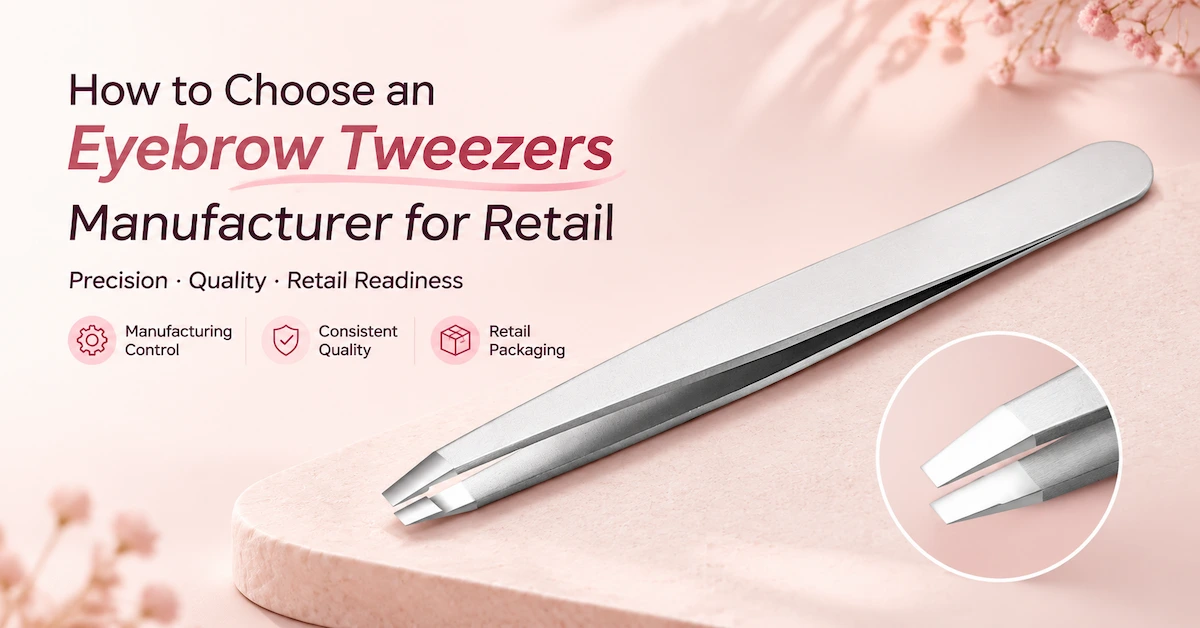
Review the Tweezer Product Family
What should a retail buyer expect from an eyebrow tweezers manufacturer?
Direct answer: a suitable manufacturer should be able to connect five records for the selected SKU: the product reference, the functional sample, the branding and finish specification, the retail package reference and the bulk inspection plan. If one of these is missing, the buyer may be comparing a product idea rather than a controlled supply route.
The manufacturer does not need to publish every technical detail on a website. It does need to explain which details can be confirmed from a sample, which require a written specification, which documents are available for the actual model and which commercial items depend on quantity or packaging. That distinction is more useful than a generic statement about being a "professional factory."
| Capability to verify | Evidence a retailer can request | Why it affects the order |
|---|---|---|
| Product definition | Model reference, tip style, dimensions, component wording and intended use. | Prevents a quote or sample from being based on an ambiguous catalogue image. |
| Functional control | Tip-contact check, closing action, tension review and sample approval record. | A cosmetic match cannot prove that the tweezer grips consistently. |
| Branding and finish | Marking method, position, artwork revision, finish reference and decorated sample. | A logo can look correct digitally but fail on a curved or coated surface. |
| Retail packaging | Pack format, tip protection, insert fit, barcode, language and carton information. | The package must protect the tip and support the retailer's selling channel. |
| Repeat-order control | Approved sample revision, change-control rule, inspection points and SKU records. | The second order should not depend on memory or a low-resolution photograph. |
Buyer-side recommendation: score a supplier only after it responds to the same evidence request for every candidate model. A manufacturer may be capable of a service in general, but the order decision concerns one selected tweezer, one finish, one package and one market.
What retail risk does a weak manufacturer response create?
The reason to request evidence is not paperwork for its own sake. A small ambiguity in the product brief can become a customer-facing problem after the order has shipped. Use four risk links when reviewing a response:
- Unrecorded tip contact: a sample can look correct in a photograph but fail to grip short hairs consistently. Keep the sample reference, observed contact condition, review method and decision owner.
- Colour-only finish wording: the product photograph, logo area and later replenishment may not match the first unit. Keep an approved physical or documented finish reference and revision.
- Separate package and tool checks: tip impact, wrong orientation or barcode errors can appear during warehouse handling. Keep a packed sample, insert or guard reference, barcode proof and carton configuration.
- Informal reorder changes: a second batch can drift from the product page or approved photography. Require a revision-controlled SKU record and written approval for substitutions.
These are buyer-side risk links, not a statement that every project will experience each problem. They help a retailer decide which open question must be closed before artwork, listing or bulk release.
Retail teams can also review OLIMOR's retailer-focused route when the product decision needs to be connected to packaging, replenishment and channel requirements.
How should a retailer define the eyebrow tweezer before asking for a quote?
Start with the customer task and retail role, then specify the tool. "Eyebrow tweezers" describes a category, not a complete production requirement. A general brow-maintenance product, a precision detail tool and a premium gift-set item may need different tip geometry, body feel, surface treatment and packaging.
Choose the working tip for the intended task
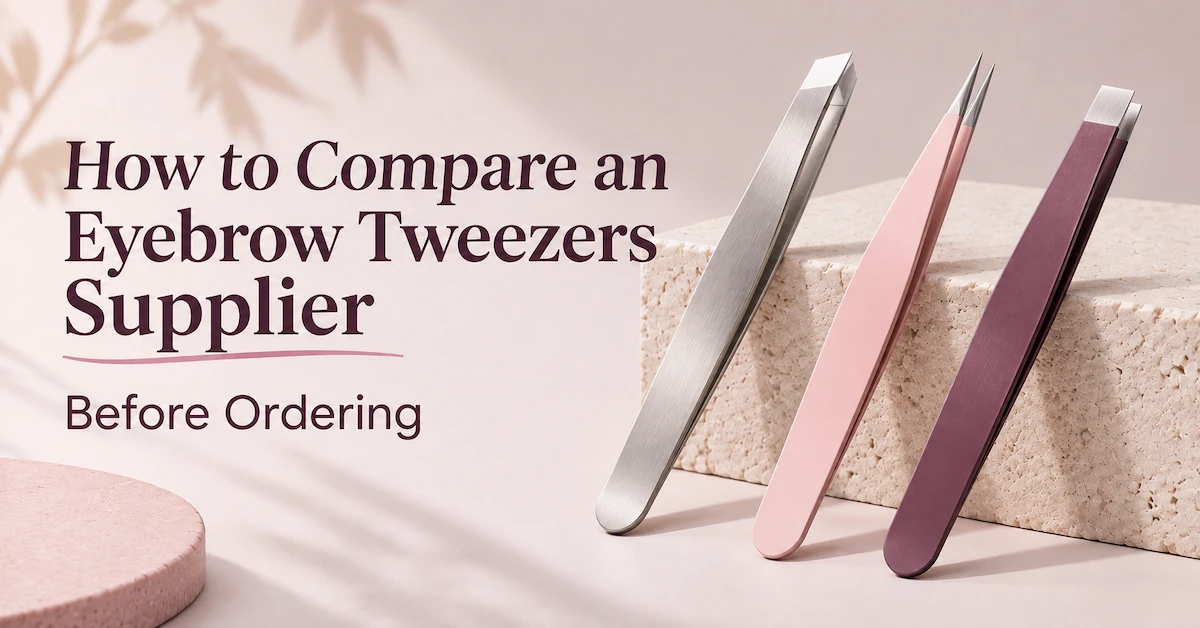
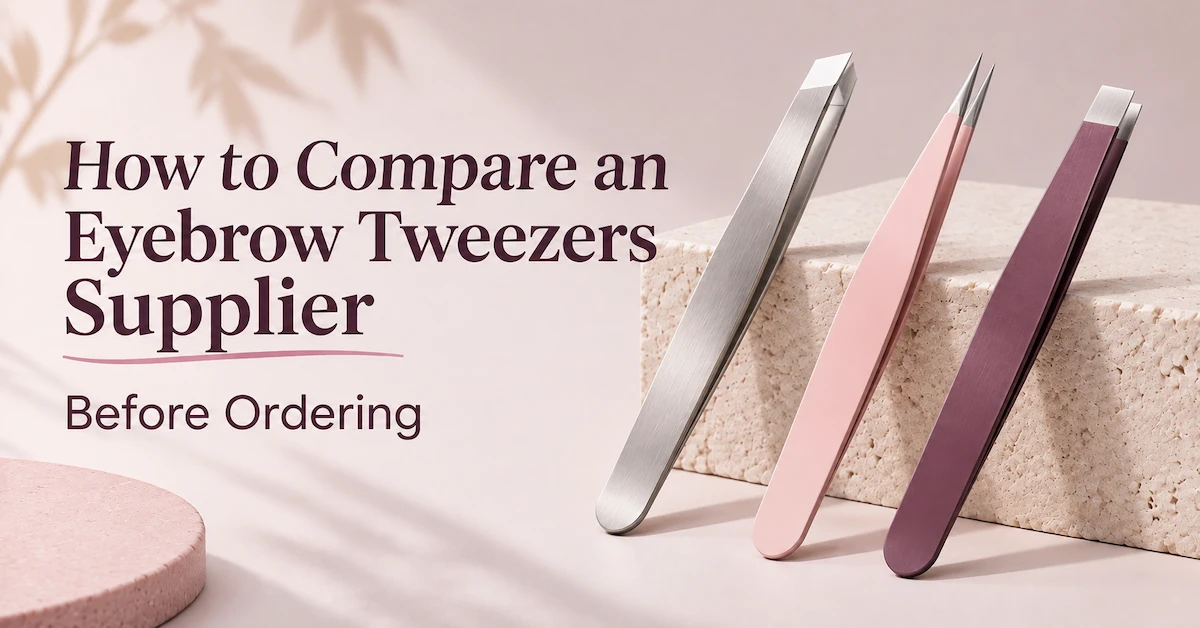
A slant tip can present a broader angled contact area for general brow shaping. A pointed tip can suit more detailed work. Flat or other available configurations may support a different handling preference. These are selection directions, not universal performance claims. The supplier should confirm which tip styles are available for the selected model and the retailer should evaluate the actual closing contact on a sample.
Define the body and hand feel
Record overall length, width, thickness, handle profile, edge comfort and the force needed to close the arms. Public product pages may show a shape or family direction, but the final dimensions and material wording should come from the selected model's specification or approved sample. Do not infer a steel grade or wall thickness from a photograph.
Separate product finish from brand colour
A polished, matte, satin or coloured appearance affects how the item is photographed, handled and matched with other products. "Rose gold" or "black" is not enough to define a finish. Ask whether the colour is produced by the base material, coating or another treatment, which surfaces receive it and how the working tips are treated. The approved physical sample should become the visual reference.
OLIMOR's public tweezer product family is a starting point for comparing working shape, alignment, grip, finish and branding questions. It does not establish one universal material, MOQ, price, packaging format or lead time for every model.
Which tip and construction details deserve a sample check?
The most useful sample review follows the path from the hand to the working end. Inspect the arms, the closing point, the edge finish and the response during repeated opening and closing. This is different from the dedicated alignment tutorial already available on the OLIMOR Blog: the manufacturer decision requires you to connect the observed result to a repeatable control and an approved reference.
- Tip profile: confirm the agreed slant, point, flat or other profile and its transition into the body.
- Contact area: observe whether the intended contact closes evenly without an obvious offset, burr or unintended sharp edge.
- Arm response: record opening resistance, closing control, return feel and consistency across repeated cycles.
- Edges, surface and protection: note rough edges, scratches, coating breaks, hand comfort and whether a guard or insert prevents tip impact.
For each observation, keep the model code, reference image, qualitative acceptance description and action if the condition is not met. This is enough to make the sample review useful without inventing a numerical tolerance.
Do not turn a buyer-side visual check into an invented tolerance. If a retailer needs a numerical gap, closing force or repeatability criterion, ask the manufacturer whether it can be measured for the model and how the value should be recorded. A number without a defined instrument, condition and sample basis is not useful evidence.
What material and finish evidence should a manufacturer provide?
Material language must be separated from appearance language. "Stainless look," "premium steel" or "professional finish" describes marketing or appearance, not a verified composition. For a retail product, ask for a component-level statement that identifies what is covered and what remains to be confirmed.
- Main body: material family or grade wording supplied for the selected model.
- Working tips: whether the tips are the same material, treated separately or otherwise defined.
- Surface treatment: polishing, coating, plating or colour process, if applicable.
- Care language: instructions that match the confirmed construction and intended retail use.
- Evidence boundary: which claims require a test report, supplier declaration or project document before publication.
OLIMOR public fact: the site presents materials and finishes as a discussion area for the selected beauty tool, while exact composition, treatment and order details may require confirmation. Project-specific confirmation: the retailer should not publish a steel grade, corrosion claim, sterilization claim or medical-use statement until the selected SKU and applicable evidence have been reviewed.
This boundary protects both the product listing and the supplier comparison. A manufacturer that answers "material available" has not answered "which component, which revision, which document and which claim can our retail team use?" Mark incomplete evidence as Request evidence, not as a failed product.
What counts as enough evidence for a retail claim?
Buyer-side rule: a claim is ready for listing or packaging only when four links are visible: the exact component covered, the approved product or finish revision, the supporting document or sample record, and the wording the retailer is actually allowed to publish. A supplier statement can start the review, but it should not silently become a product claim.
- Use a component-level statement for the body, tips and any separately treated part.
- Match the statement to the same model and finish shown in the approved sample.
- Record whether the support is a specification, declaration, test record or visual approval, without calling one type equivalent to another.
- Remove or qualify corrosion, sterilization, safety or professional-use wording when the applicable evidence is not available.
How can a retailer verify manufacturing rather than marketing?
Ask the manufacturer to describe the route for the selected tweezer, not only the categories it lists. The useful discussion covers product preparation, forming or machining where applicable, tip finishing, surface treatment, assembly, inspection, packaging and repeat-order records. The process may differ between models, so avoid assuming that one factory statement applies identically to every item.
A useful manufacturing answer connects the operation to a check: how the selected tip is shaped and finished, how contact is reviewed, how the approved finish is referenced, and how the product is connected to its package. Ask what happens when a piece does not meet the agreed condition. The response does not need to expose proprietary process details, but it should identify the control point and the record that a buyer can review.
- Request a model-specific explanation, not a generic list of factory capabilities.
- Ask how the supplier distinguishes a functional defect from a cosmetic variation.
- Connect the approved finish and package reference to the same SKU revision.
- Record the inspection point and escalation route without assuming that one method applies to every model.
OLIMOR's quality discussion is relevant for framing these questions. The exact inspection method, sample size, acceptance criteria and production records must be confirmed for the chosen model and order.
What should a retailer include in a sample approval record?
A sample approval record should let a second reviewer understand what was accepted without holding the sample in their hand. Use one record per SKU and connect it to the product, decorated version and package. This prevents a common failure in retail sourcing: the buyer approves the tool, the artwork team approves a different version and the packing team receives no clear reference.
Retail eyebrow tweezer sample record
SKU / supplier model: [retailer SKU and manufacturer reference]
Tip and use: [slant, pointed, flat or other; intended customer task]
Dimensions and material wording: [confirmed specification or project-confirmation status]
Functional review: [contact, closing action, tension, grip and edge condition]
Cosmetic review: [finish, colour, scratches, coating boundary and logo]
Packaging review: [guard, insert, fit, barcode, copy and carton reference]
Evidence status: [OLIMOR public fact / buyer-side recommendation / project-specific confirmation]
Decision: [Proceed / Hold / Request evidence / Re-sample / Reject claim]
Approver and revision: [name, date, artwork revision, sample reference and next action]
Use Re-sample when the product or package changes, not only when the first sample looks imperfect. Use Reject claim when the supplier or sales copy makes a material, safety or performance statement that the available evidence does not support. This creates an auditable decision instead of a chain of informal messages.
Discuss a Retail Sample Approval Plan
How should retail packaging be evaluated without repeating a packaging-only article?
Packaging is included here only as a manufacturer-verification test. The question is not which carton style is fashionable; it is whether the supplier can connect the selected tweezer to a package that protects the tips, presents the product correctly and can be repeated in the quoted order.
- Ask whether the individual guard or insert prevents tip impact during ordinary handling and carton movement.
- Confirm the package dimensions from the physical tool, not only from the catalogue length.
- Check barcode, product name, language, care wording and any claim against the approved specification.
- Ask for the packed configuration, inner quantity and outer-carton information needed by the retailer's warehouse.
- Record whether packaging is included in the supplier's scope, sourced separately or dependent on buyer artwork approval.
The custom packaging route can support a product-to-pack discussion. The exact insert, protection, printing and carton configuration remain project-specific and should be confirmed before a retail order is released.
How should MOQ, lead time and repeat orders be verified?
Treat commercial terms as part of the manufacturer comparison, but do not use a generic number. Ask how quantity is calculated for the model, tip type, finish, logo, packaging version and production batch. A retailer may be able to combine products commercially, yet the manufacturer may still calculate minimums by configuration or package.
Ask the supplier to separate sample timing, production timing, pack-out and transport. Confirm what event starts the production clock and whether artwork, packaging receipt, deposit or sample approval is a prerequisite. The final MOQ, lead time, price, material specification and packaging details should be confirmed according to the selected product and order requirements.
For repeat orders, request a revision-controlled reference: model, tip profile, finish, logo position, package, carton data and critical checks. If the manufacturer proposes a component or finish substitution, require written approval before it becomes the new reference. A lower reorder price is not an advantage if the product no longer matches the listing or the first approved sample.
How should a retailer compare the quote beyond unit price?
A manufacturer comparison becomes unreliable when one supplier quotes only the metal tool and another includes branding or the retail pack. Ask every candidate to return the same cost scope. The figures below are comparison fields, not fixed OLIMOR prices or a universal commercial policy.
| Quote field | What the buyer should clarify | Why it changes the comparison |
|---|---|---|
| Tool and configuration | Model, tip style, dimensions, finish and whether the price is tied to one SKU or a family. | A lower figure may represent a different product or an unbranded base version. |
| Branding and setup | Logo method, artwork preparation, colour or finish work and any one-time setup item. | The decorated sample and repeat cost may differ from the base quote. |
| Retail packaging | Individual pack, insert or guard, printing, barcode handling, inner quantity and outer carton. | Packaging affects shelf presentation, protection, warehouse handling and shipment volume. |
| Sample and release | Sample stage, approval event, production start trigger and inspection scope. | A price is not comparable if one supplier has not included the same approval or pack-out work. |
| Delivery basis | Destination, packed quantity, carton data and the transport assumption used in the response. | The apparent unit advantage can disappear when packaging and delivery are added consistently. |
Do not invent a landed-cost formula when the delivery basis is unknown. Instead, keep the quote in comparable layers and ask the supplier to state what is included, excluded and conditional. This makes a later commercial decision auditable and gives the retailer a better question than "Can you match this price?"
How should a retailer decide the next step?
The comparison should end with a status for each manufacturer and SKU. A catalogue and unit price are not a production release. Use the following decision logic after reviewing the quote and evidence:
- Hold: the supplier has not identified the model, package scope or quantity basis clearly enough to compare the response.
- Request evidence: the model is plausible, but a sample record, component wording, finish reference or inspection point is still missing.
- Re-sample: the decorated or packed version changes the functional product, finish or protection compared with the earlier sample.
- Reject claim: a material, safety, corrosion, sterilization or performance statement is not supported by applicable evidence.
- Proceed to sample review: the scope is comparable, the open points are assigned and the supplier can identify what will be sampled and recorded next.
This logic rewards usable evidence, not polished sales language. A supplier can be capable and still need clarification; the important question is whether the open points are visible, assigned and capable of being closed before bulk production.
When is a retail sample ready for approval?
Use a release gate rather than a general impression. A sample is ready for approval only when the reviewer can identify the exact model and revision, operate the tool and record the tip result, compare the finish and logo with the intended artwork, inspect the packed unit, and list any open claim or commercial assumption. If one of these links is missing, the correct status is Hold or Request evidence, not Proceed.
This gate also protects the launch file. Product, brand, packaging and operations teams can each see what was approved and what still depends on the supplier's confirmation. It is especially useful when a retailer plans to reuse the same tool across several colourways or packaging versions.
What should a retailer send in the first RFQ?
A useful RFQ gives the manufacturer enough context to respond to the retail problem, not just the product name. Send the same brief to each candidate so the answers can be compared.
Retail eyebrow tweezers RFQ template
Retail channel: [online store, beauty chain, salon supply or other]
Target customer: [general brow care, precision user, gift buyer or professional segment]
Product: [tip style, reference model, dimensions and intended use]
Branding: [logo artwork, marking position, finish direction and colour reference]
Packaging: [individual card, box, pouch, case or set; tip protection and barcode requirements]
Quantity: [first order by SKU, possible repeat quantity and destination]
Sample request: [unbranded, decorated and packed sample requirements]
Quality focus: [tip contact, closing action, tension, grip, finish, logo and package fit]
Evidence request: [component material wording, finish description, care information and claim support]
Please return: [model reference, available options, MOQ basis, sample process, lead-time trigger, inspection scope and repeat-order controls]
The procurement toolkit can help organize the information before the supplier conversation. When you contact a manufacturer, send the selected tip direction, target quantity, finish direction, packaging format and sample requirement together; this gives the supplier a usable brief without turning the template into an assumed commercial policy.
Which OLIMOR route fits a retail eyebrow tweezer project?
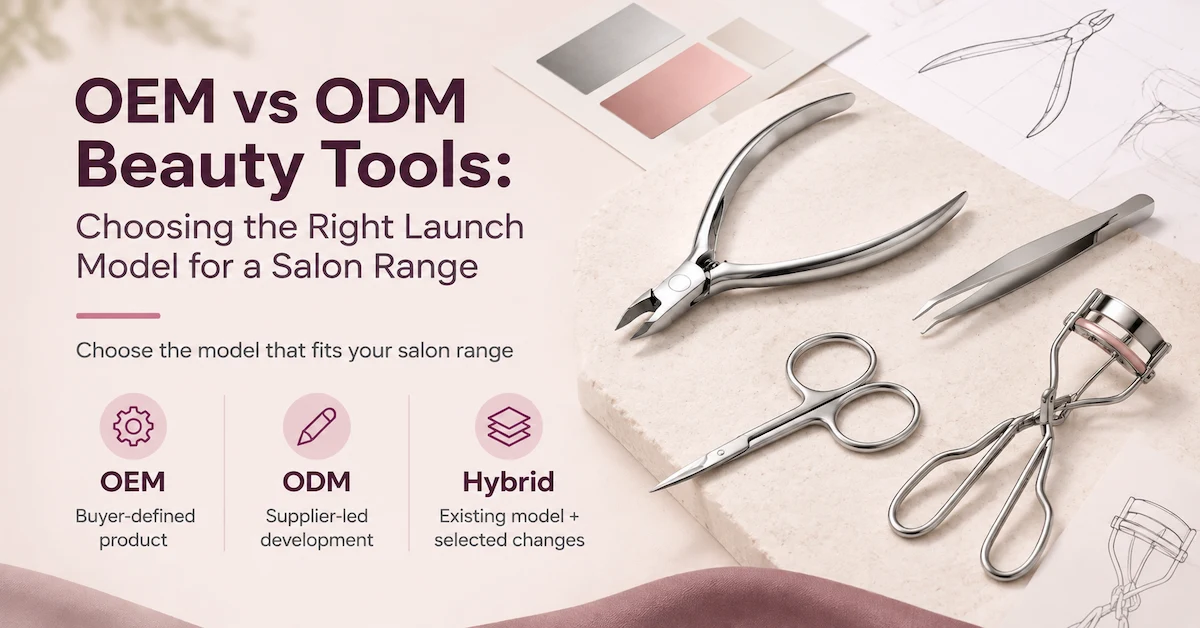
The right route depends on whether the retailer is selecting an existing product, coordinating branding and packaging, or asking for a deeper product change. OLIMOR's OEM/ODM route is the recommended commercial starting point for a discussion that combines product requirements, private-label branding, sampling, packaging and production questions.
OLIMOR public fact: the current product and manufacturing routes present tweezers, product selection, sample review, branding, packaging and quality as connected decisions. Project-specific confirmation: exact tip configuration, material, finish, logo method, MOQ, lead time, packaging and inspection records must be agreed for the selected model and order.
This distinction lets a retailer ask for technical support without assuming that every option is available across every model. It also gives the supplier a clear brief for deciding whether the project belongs to an existing product route, a coordinated private-label range or a more substantial development discussion.
Eyebrow tweezers manufacturer FAQ
How do I choose an eyebrow tweezers manufacturer?
Compare the manufacturer's model-specific product definition, sample process, tip and closing checks, material and finish evidence, branding, retail packaging, MOQ basis, lead-time trigger and repeat-order controls. A catalogue and unit price are only the starting point.
What should I check in an eyebrow tweezer sample?
Check the tip profile, contact area, closing action, tension, grip, edges, finish, logo and package fit. Record the model and revision, then decide Proceed, Hold, Request evidence, Re-sample or Reject claim.
Does stainless steel wording prove the product material?
No. The retailer should ask which component the wording covers, whether a grade is being stated, what surface treatment is applied and which document supports the statement. The final material wording must be confirmed for the selected SKU.
Can an eyebrow tweezers manufacturer provide private-label packaging?
Packaging can be discussed when the supplier supports the required project scope, but the format, insert, tip protection, artwork, barcode, quantities and carton details must be confirmed for the selected model and retail channel.
Should retailers request an unbranded or decorated sample first?
A staged approach is usually clearer: review the functional product, then the decorated version, then the packed unit when packaging affects protection or presentation. The exact sample sequence and timing should be agreed with the manufacturer.
How should MOQ be compared between manufacturers?
Ask whether the minimum is calculated by model, tip type, finish, logo, packaging version, component or batch. Do not assume that a total range quantity automatically satisfies every configuration.
What makes a manufacturer suitable for repeat retail orders?
The supplier should be able to retain an approved product and packed reference, identify revisions, repeat the agreed branding and finish, inspect the working tip and communicate any proposed substitution before production.
What should I ask before approving a retail listing?
Confirm that the product listing, packaging copy, barcode, dimensions, material wording, finish, accessories and photographs match the approved sample and the evidence available for the selected SKU.
Conclusion
A reliable eyebrow tweezers manufacturer should help a retailer control the complete product decision: tip and hand feel, material and finish wording, logo, retail packaging, quality checks, commercial assumptions and repeat-order reference. The strongest supplier response is not necessarily the longest catalogue or the lowest quote; it is the one that makes the selected SKU, evidence and next decision visible.
Use the product family to identify a direction, request a physical sample, document the functional and cosmetic review, approve the packed presentation and keep unresolved claims on hold. OLIMOR's OEM/ODM, tweezer product, sampling, quality, packaging and procurement resources can support the next discussion. Exact options, MOQ, pricing, lead time, material documentation and packaging configuration should be confirmed for the actual retail project.
For a useful first conversation, include the model or tip direction, expected quantity by SKU, finish or logo requirements, retail pack format, destination market and the evidence you need before listing approval. That information allows the manufacturer to separate what can be sampled now from what requires project confirmation.