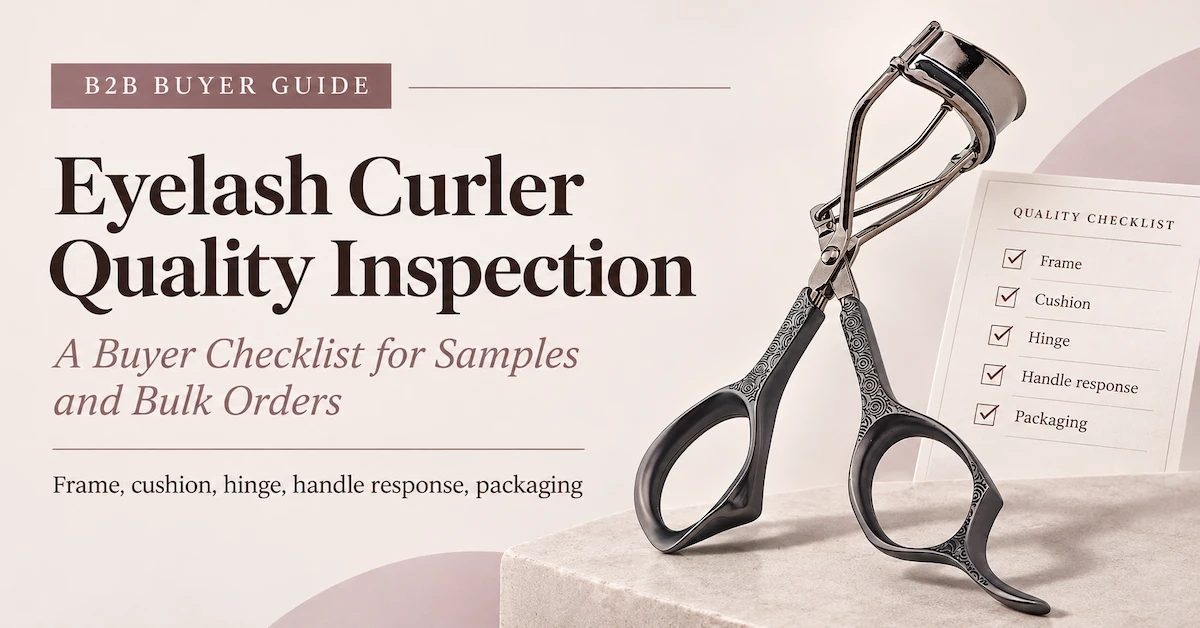
Effective eyelash curler quality inspection is a controlled comparison between the approved product reference and the pieces received at each production stage. It should confirm the frame and curve, cushion position, hinge movement, handle feel, surface, branding and packed presentation, then record whether the item is released, held, revised or rejected. A visual look at one finished curler is not a quality system, and a supplier statement such as "good quality" is not an acceptance criterion.
For a beauty brand, retailer, distributor or professional channel, the practical question is not simply whether an eyelash curler looks attractive. The question is whether the sample and bulk order represent the same controlled version, whether the working parts perform as expected, and whether defects can be traced to a product component, a process step, a finish, a logo or a package. This guide turns those questions into an inspection sequence that can be shared with purchasing, product, quality and packaging teams.
The checks below are buyer-side inspection guidance. Start with the relevant eyelash curler product family, then use OLIMOR's public quality discussion to frame working details, appearance, marking and packaging as practical checkpoints for the selected tool. The existing eyelash curler RFQ and sample approval checklist covers what to ask before quoting; this page begins when the inspection record needs to be applied. Exact materials, tolerances, test methods, sampling levels, acceptance limits and documents must be confirmed for the selected model and order.
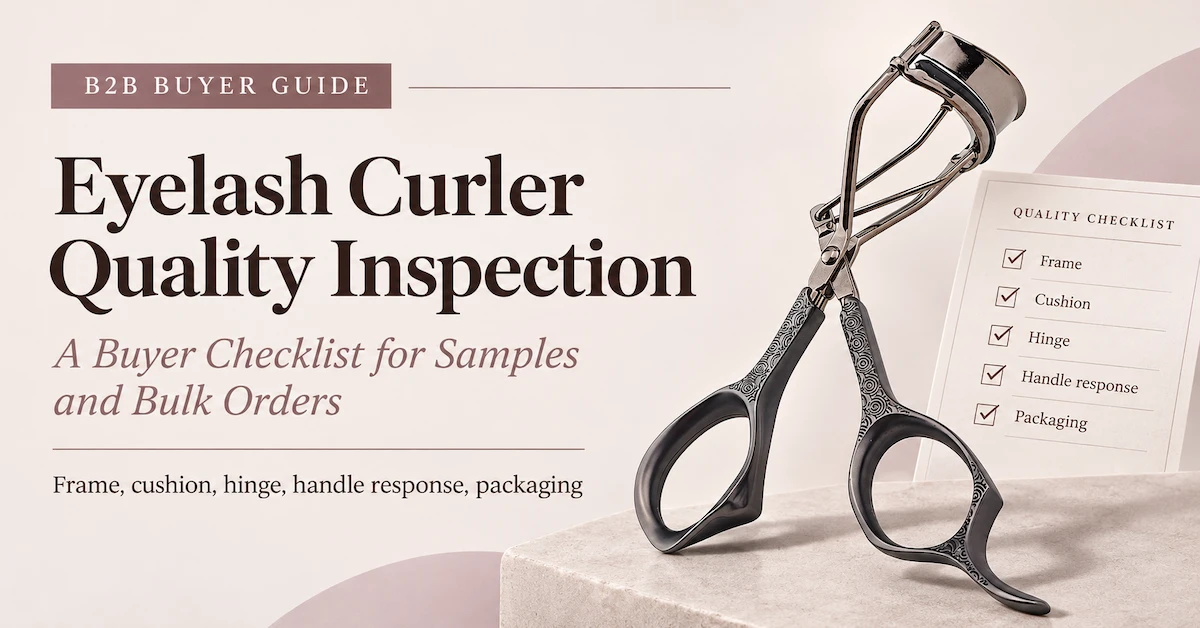
What should eyelash curler quality inspection prove?
Direct answer: inspection should prove that the identified eyelash curler version matches the approved product and packaging reference, performs its intended opening and curling action without an observed defect, and carries the correct finish, logo, cushion and printed presentation. It should also show what was checked, under which conditions, by whom and with what disposition.
That proof has four layers:
- Identity: model code, revision, colour or finish, cushion reference, logo artwork and package version are the same as the approved scope.
- Function: the frame, curve, pad, hinge and handles work together for the intended user task and do not show an agreed functional defect.
- Appearance: surface, edges, seams, marking and colour are consistent with the approved reference under the agreed viewing conditions.
- Presentation: the curler is held, protected, labelled and packed in the approved configuration.
Inspection does not automatically prove a universal safety claim, a fixed service life, sterilization suitability, corrosion performance or consistency beyond the inspected sample or lot. Those claims require a defined requirement and applicable evidence. Keeping the boundary clear prevents a quality report from being used as marketing proof for a claim it was never designed to test.
Plan an Eyelash Curler Sample Review
Which inspection stages should an eyelash curler order include?
Use stages that match the risk of the order rather than relying on one final visual check. A practical sequence is incoming component review, sample inspection, functional review, appearance and branding review, process checks, final product inspection and packed-unit verification. The supplier and buyer should agree which stages apply to the project and what record each stage produces.
Stage 1: confirm the incoming components and reference
Before judging the finished curler, identify the parts that can change its performance or appearance. Depending on the model, this may include the metal frame, cushion or pad, hinge and fastener elements, handles, decorative surface and protective or retail components. Record the supplier's material and finish wording for each relevant part rather than copying a broad description across the entire tool.
The receiving record should connect the component or batch to the product code, approved sample, finish reference and any document supplied for the order. If the cushion, coating, colour or package is substituted, the change should be visible to the product owner before the part is used in a production-representative sample. A component can appear similar in a photograph while changing the contact line, hand feel or packed fit.
Stage 2: inspect the production-representative sample
The sample should represent the version the buyer intends to approve. Record its model code, sample number, revision, finish, cushion reference, logo status and package status before opening the inspection. A loose catalogue sample can help select a direction, but it should not silently become the reference for a customised or retail-packed order. For the distributor-facing inspection sequence, see the related eyelash curler sample evaluation guide; the present checklist adds the production-stage and disposition controls that follow that review.
The buyer should keep photographs or notes that show the front, side, working head, hinge, logo and package. Use the same identification on the inspection sheet and the supplier communication. This is the first control against approving one combination of frame, pad and finish while production uses another.
Stage 3: check the product during production
In-process checks are useful when a characteristic can drift before final packing. The inspection plan may call for review of formed geometry, hinge assembly, cushion installation, surface treatment, logo marking or a first packed unit. Do not assume that a final appearance check can reveal every process issue. Agree which characteristics need an earlier confirmation and who records the result.
Stage 4: release the finished and packed order
Final inspection should combine the product and its presentation. Check the finished curler against the approved reference, then inspect the package as a customer or warehouse handler would receive it. A tool that passes loose-product inspection can still fail because the cushion is compressed, the hinge is exposed, the logo is obscured or the insert allows movement in transit.
How should a buyer perform an eyelash curler inspection checklist?
Use the checklist in a fixed order so the reviewer does not rely on whichever defect is most visible first. The order below moves from identity to structure, then to operation, appearance, branding and package. It is a buyer-side method; the acceptance criteria should be written for the selected product and market.
1. Identify the version before touching the mechanism
Confirm product code, sample or lot reference, revision date, finish, cushion or pad reference, logo artwork and package version. Photograph the item if the physical identification is not printed on it. Mark any mismatch as an identity issue, even when the tool appears to work, because an untracked version cannot be used as a dependable production reference.
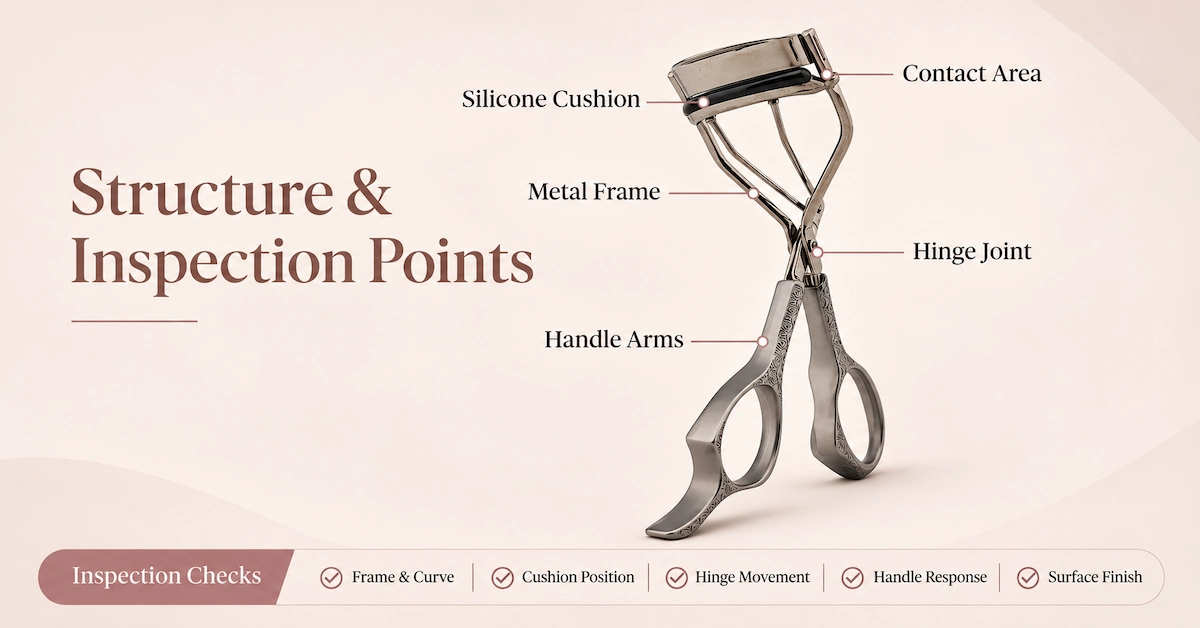
2. Inspect the frame, curve and symmetry
Look at the working head from the front, side and an oblique angle. Check whether the curve is visually even, whether the frame sits squarely, whether the edges are smooth and whether there are visible dents, distortion, burrs, sharp transitions, stains or residues. Compare the sample with the approved reference rather than an imagined universal shape. If a drawing or dimension is part of the specification, record the method used to review it.
The frame should also be checked where it meets the hinge and handles. Uneven forming or a rough transition can affect both appearance and the way force reaches the cushion. A buyer does not need to assign a defect simply because two models have different curves; the question is whether the delivered curve matches the selected design and intended use.
3. Check cushion or pad position and condition
Inspect the cushion for correct position, seating, surface condition and visible damage. Confirm that it is not twisted, loose, compressed, cut, contaminated or displaced from the approved contact area. If the product has a replacement-pad concept, identify the pad reference and the buyer's requirement for replacement information; do not assume that a visually similar pad has the same fit or response.
The pad should be reviewed together with the frame. A cushion can look acceptable on its own but sit too high, too low or off-centre when the curler is closed. Record the result as a product-level observation, not only as a component comment.
4. Operate the hinge and handles
Open and close the curler using the same hand position for each sample. Observe whether the hinge moves smoothly, whether the handles return as expected, whether there is abnormal looseness or scraping, and whether the force feels materially different from the approved sample. Avoid writing a fixed force value unless the project has an agreed method and limit; "smooth," "controlled" and "no abnormal looseness" should be tied to a reference or defined observation.
Repeat the movement enough to reveal an intermittent issue, but record the number of cycles as a buyer-side method if you use one. The count is not an OLIMOR universal standard. It is useful because another reviewer can repeat the same observation and compare results without treating a single opening as proof of durability.
5. Review contact and working action
Close the curler slowly and observe how the cushion meets the working head. Check whether contact is even across the intended area, whether the pad rolls or shifts, and whether one side reaches contact materially earlier than the other. Use a clean, consistent setup and record the observation with photographs where useful. This is not a claim that every user will experience the same result; it is a check that the approved product action is represented.
If the tool is intended for a professional or retail promise that uses terms such as "gentle," "precision" or "consistent," connect the wording to the approved product requirements and evidence. Inspection can identify an observed product condition; it does not by itself validate every marketing statement.
6. Inspect surface, edges and marking
Under agreed lighting, inspect colour, gloss or texture, scratches, pits, stains, residue, exposed base areas and inconsistent transitions. Review edges and contact surfaces for roughness that could affect handling or the product promise. Compare the finish with the approved sample under similar conditions; a phone photograph can support a record but should not be the only basis for a colour or surface release.
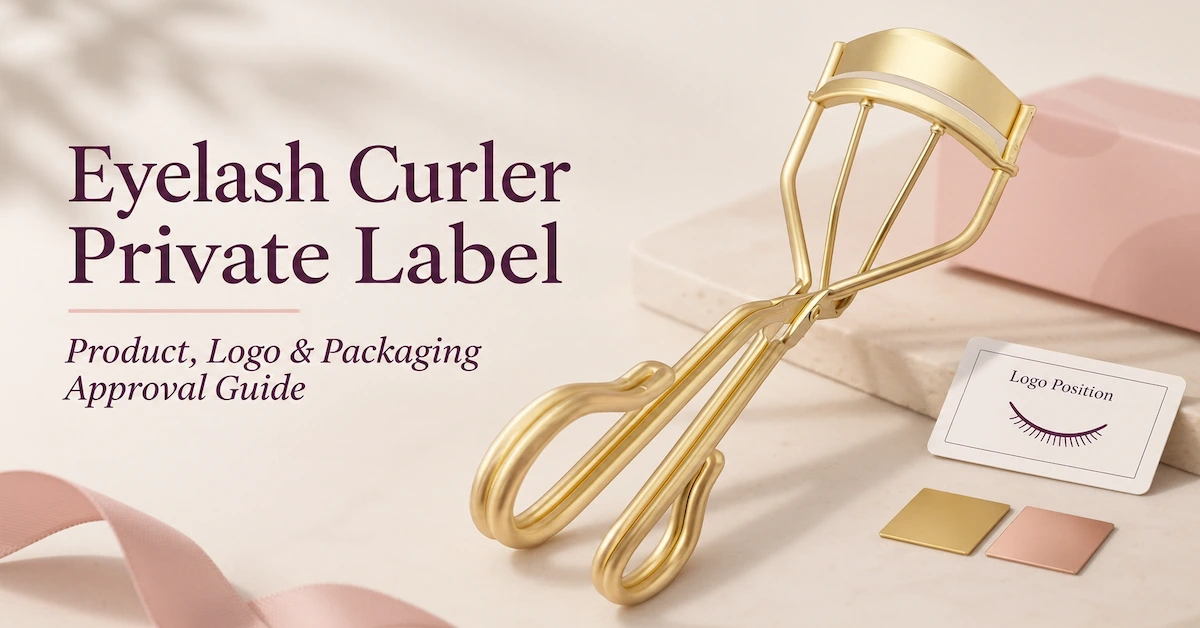
Check logo position, size, contrast, orientation and artwork revision. If the finish or marking method changes, treat the decorated sample as a new reference question. OLIMOR's logo and finishing route provides a relevant project discussion point, while the final marking method and surface result require sample confirmation.
What should an eyelash curler sample inspection record contain?
A useful inspection record lets a second person understand what was received, what was checked and what happens next. Keep the fields short enough to use on the production floor, but specific enough to prevent "passed" from becoming an unsupported opinion.
| Record block | What to record | Why it matters |
|---|---|---|
| Identity | Model, sample or lot code, revision, finish, cushion reference, logo and package version. | Prevents an untracked variant from becoming the approved reference. |
| Conditions | Reviewer, date, lighting, tools used, sample state and inspection environment. | Makes the observation repeatable and limits arguments caused by different conditions. |
| Function | Hinge movement, handle response, cushion contact, closing action and abnormal noise or looseness. | Connects a user-facing promise to an observable product condition. |
| Appearance | Curve, symmetry, edges, surface, colour, residue, scratches and component fit. | Separates a visible defect from a functional observation and supports consistent review. |
| Presentation | Logo, printed information, insert, protection, pack fit, barcode or other agreed retail fields. | Confirms the customer receives the same product-to-pack combination that was approved. |
| Disposition | Pass, pass with recorded deviation, hold, revise and resubmit, rework or reject; owner and due date. | Turns an observation into a controlled next action. |
Do not delete the original record when a sample is revised. Keep the old revision, new revision and change note together. This makes it possible to explain why a sample passed, why a new sample was requested and which version should control production.
How should eyelash curler quality standards be written?
Write standards as observable requirements linked to a reference, method and disposition. "High quality" is not inspectable. "Frame curve matches the approved sample; no visible burr on the agreed contact edge; cushion is seated in the approved position; logo artwork is revision B; packed unit retains the tool without contact damage" gives a reviewer something to verify.
A buyer-side standard should answer five questions:
- What is checked? Name the frame, cushion, hinge, finish, logo or package field.
- Against what reference? Identify the approved sample, drawing, artwork or packaging file.
- How is it checked? State visual conditions, operation method, measurement method or document review.
- What is acceptable? Describe the agreed condition or limit; do not borrow a generic limit from another product.
- What happens if it fails? Define hold, correction, re-sample, concession or rejection and the responsible owner.
If a market claim needs a test report, declaration or other document, list the exact claim and the configuration it must cover. A quality inspection of a sample is not a substitute for evidence of a material or regulatory claim. Likewise, a supplier-level document should not automatically be treated as proof for every finish, cushion or product revision.
OLIMOR's quality inspection route frames quality around specific product and process details. Use that principle when preparing a project brief: ask which checks can be confirmed for the selected curler and which remain open until a sample or document is reviewed.
How should defects be classified and handled?
Classify a defect by its effect on the intended use, customer promise, compliance requirement or ability to identify the approved version. Avoid a universal defect-count rule unless the project specifies the sampling plan and acceptance criteria. A single identity or functional failure can require a hold even when the overall appearance is attractive.
Hold for clarification
Use hold when the sample or lot cannot be compared fairly: the finish is not identified, the cushion version is unclear, the package is missing, or the inspection document does not state what was checked. Hold is not the same as rejection. It protects the decision until the missing scope is supplied.
Request correction or re-sample
Request correction or a new sample when a must-match feature is different and the current piece cannot represent the final product. Examples include a changed curve, displaced cushion, new finish, revised logo, different insert or altered accessory. Record the affected check so the reviewer does not repeat unrelated work while missing the change.
Reject the claim or release
Reject a claim when the required evidence cannot be connected to the selected model, finish or market requirement. Release the product only when the agreed inspection scope is complete and open deviations have an owner and written disposition. "Passed visual inspection" should never silently mean "all commercial and compliance requirements are approved."
Organize Your Inspection Requirements
What packaging checks belong in eyelash curler quality control?
Packaging quality control should confirm both protection and information. Check whether the cushion and working head are protected from pressure, whether the hinge and handles are retained, whether the tool can move inside the pack, and whether the package fits the approved retail or professional presentation.
Review product name, logo, barcode, language, care wording, warnings and other printed fields against the approved artwork. Confirm that the package version matches the product version; a correct card with a different finish or cushion can still create a retail mismatch. For shipping, inspect inner fixing, carton count, orientation, carton marks and visible damage after the agreed handling or shipment check.
OLIMOR's custom packaging route treats protection, layout and presentation as connected decisions. Approve a packed sample when the package is part of the product promise; a loose curler cannot prove that the final retail unit will protect the working head.
How should inspection evidence control repeat orders?
Carry the approved inspection reference into the purchase order, production brief and repeat-order record. Keep the model code, revision, cushion reference, finish, logo artwork, package file, inspection points, open deviations and disposition together. A product name or old photograph alone is too weak to control a replenishment order.
When a supplier proposes a component, finish, packaging or process change, ask whether the change affects function, appearance, marking, fit or documentation. Decide whether the change requires a new sample, updated artwork, new evidence or a revised inspection instruction. The answer should be tied to the affected characteristic rather than a general statement that the supplier "will keep quality consistent."
For a private-label program, the inspection passport can also support internal release: product owner approves function, brand owner approves logo and colour, packaging owner approves packed fit, and quality or procurement records the final disposition. The exact ownership model is project-specific, but the principle is stable: every important characteristic has a reference and an owner.
A project discussion through OLIMOR's OEM/ODM route can connect product requirements, sample review, branding, packaging and quality questions. Share the selected curler reference, target market, quantity, finish direction, cushion requirements, packaging format and requested inspection records so the open items can be confirmed for the project.
Frequently asked questions about eyelash curler quality inspection
What is the most important eyelash curler quality inspection?
The most important inspection is the one that confirms the approved version and its working action together: frame and curve, cushion position, hinge movement, handle response and contact should be checked against an identified reference. Appearance and packaging then confirm that the same version reaches the customer.
What should an eyelash curler inspection checklist include?
Include identity, sample or lot reference, conditions, frame and curve, cushion, hinge, handles, contact action, surface, logo, packaging, documents, disposition and reviewer ownership. The checklist should name the reference and method, not only say "check quality."
Can one sample prove bulk-order quality?
No. One sample can establish a product direction and reveal important functional or visual issues, but it does not prove the consistency of an entire order. Bulk inspection and agreed production records are still required for the selected order.
Does sample inspection prove a material or safety claim?
No. Sample inspection records observed product condition. A material, corrosion, sterilization, chemical or market claim needs applicable evidence connected to the exact model, component, finish and requirement.
Should packaging be included in eyelash curler quality control?
Yes when the tool is sold or shipped in a defined package. Check protection, retention, printed information, logo, pack fit, accessory position and carton configuration. A loose-tool result cannot approve a finished retail unit.
What happens when a sample fails inspection?
Record the affected characteristic, evidence, owner and disposition. Depending on the issue, hold the sample, request correction, require a new revision, reject a claim or release with a documented deviation. Do not replace the failed revision silently.
How should I request an eyelash curler quality inspection discussion?
Send the product reference, intended use, target market, quantity by SKU, cushion or pad direction, finish, logo artwork, packaging format, sample status and the quality records you need. Mark fixed requirements separately from open questions so the supplier can confirm the inspection scope for the selected model.
Conclusion
A reliable eyelash curler quality inspection system does more than find scratches after production. It links the approved model to its frame, curve, cushion, hinge, handles, finish, logo and package, then records the conditions and decision for each stage. The result is a product reference that purchasing, quality, branding and packaging teams can interpret in the same way.
Use an inspection passport, define project-specific eyelash curler quality standards, separate observed defects from unverified claims, and keep every revision traceable. OLIMOR's public product-development, sampling, packaging and quality routes can support the discussion; exact material wording, test evidence, acceptance limits, MOQ, lead time and commercial terms still need confirmation for the selected order.