For a salon or professional beauty organization, the practical answer to OEM vs ODM beauty tools is not "one model is always better." Choose OEM when your team can define the product and needs the supplier to manufacture to a controlled brief. Choose ODM when the supplier must help shape the product direction, structure or development work. Choose a hybrid route when the range can use an established tool platform but still needs a specific finish, logo, package or selected product changes. The decision should be made from the launch work that must be completed, not from the acronym in a supplier presentation.
That distinction matters in professional beauty because a tool is judged in use and in context. A salon may need a repeatable backbar instrument, an academy may need an easy-to-identify training tool, and a professional beauty supplier may need a retail-ready item that can be replenished across several accounts. The same catalogue family can therefore require different product references, handling expectations, package formats and approval records. This guide gives one decision method: identify who controls each decision, select the route, test the route with a sample, and document what releases the first order and the next one.
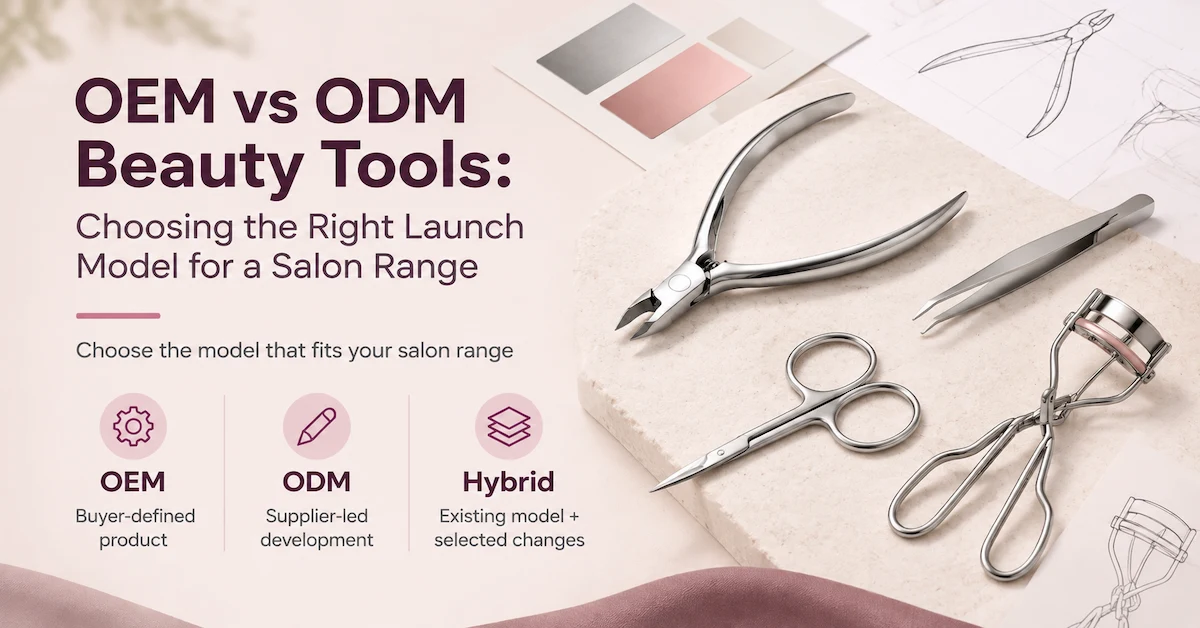
Which launch route should a salon choose?
Use the route that matches the amount of product definition your team can provide and the amount of development work the supplier must perform. The choice is usually clear after four questions: Do you already have a product reference? Which working details must not change? Is the supplier expected to propose structure or appearance? And will the launch be judged mainly by speed, operational consistency or distinctiveness?
- OEM: the buyer supplies the product requirements, reference, drawings or approved sample, and the manufacturer produces to that defined scope. It fits a salon range with a known tool, a controlled working action or an existing internal specification.
- ODM: the supplier contributes more product direction or development from a brief. It fits a team that knows the service problem or customer outcome but does not yet have a production-ready design.
- Hybrid: the buyer starts from an existing model or platform, then requests selected changes such as finish, branding, set composition, packaging or a controlled structural adaptation. It often suits a first professional range that needs a clear brand signature without turning every SKU into a new development project.
These are working definitions for a buying brief, not universal legal definitions. Suppliers may use OEM, ODM and private label differently. Write the scope in observable terms: who supplies the reference, who proposes changes, what must be sampled, which files are delivered, and what the buyer approves before production.
A one-page route decision is more useful than a generic OEM or ODM quotation. If your team cannot complete it, start with a product development discussion.
What actually changes between OEM and ODM?
The meaningful difference is not the label; it is the allocation of decisions, evidence and risk. A salon buyer should compare the two routes across the full launch chain rather than only the product design stage.
| Decision area | OEM route | ODM route | Hybrid route |
|---|---|---|---|
| Starting input | Buyer specification, drawing, reference sample or controlled model. | Service need, customer outcome, product direction and development brief. | Existing model plus a defined list of changes. |
| Supplier contribution | Manufacturing feasibility, process coordination and production execution. | Product proposal, engineering input, sample development or adaptation, subject to the brief. | Advice is concentrated on the selected changes rather than the whole product. |
| Buyer approval burden | High at the specification stage; later approval checks whether production matches it. | Higher during concept, sample and revision reviews because the direction is still being formed. | Focused on the changed components, appearance, pack and final reference. |
| Main launch risk | An incomplete brief is treated as complete, so the wrong version is produced consistently. | Development scope, revision count or approval responsibility remains unclear. | A small requested change affects tooling, finish, pack fit or repeatability more than expected. |
| Best evidence to request | Specification revision, approved sample, inspection points and production reference. | Development brief, feasibility response, sample revisions and a record of accepted changes. | Before/after change list, changed-part sample, packaging proof and repeat-order reference. |
No route is automatically faster or cheaper. Sample count, tooling, finish, packaging, quantity and destination change the result, so compare complete scopes.
When is OEM the better fit for a professional salon range?
OEM is usually the stronger fit when the salon team already knows what the tool must be and wants production control more than design exploration. This can happen when a group has an existing training standard, a reference product used across locations, or a professional service that depends on a particular working action.
Choose OEM when the working result is already defined
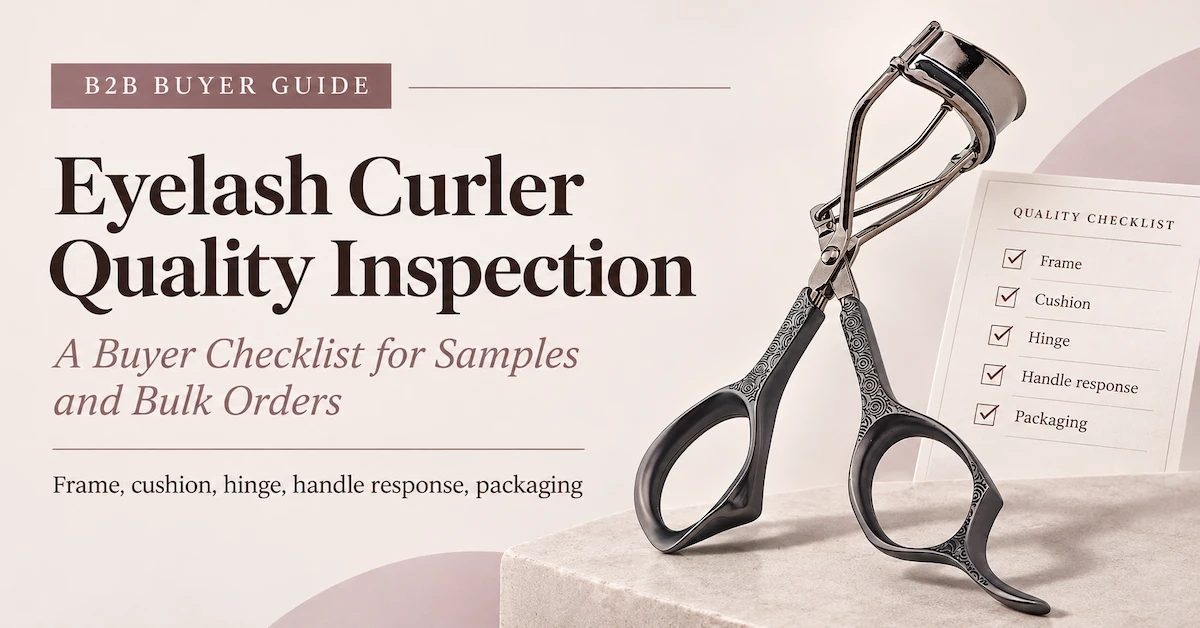
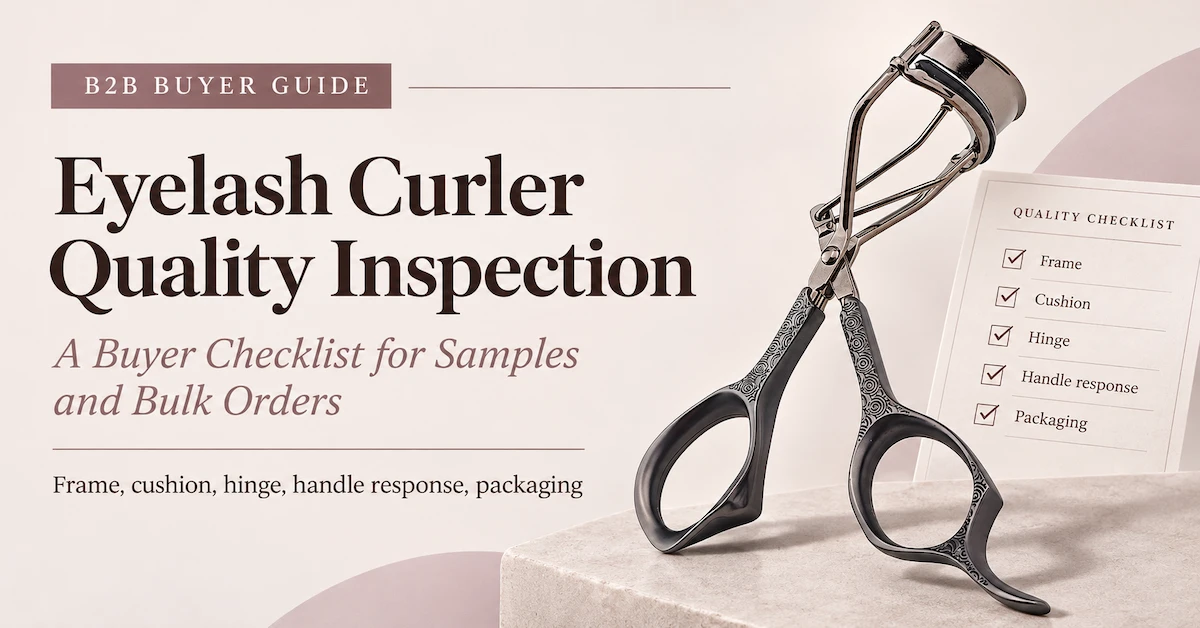
Start with the task the tool must perform, then define the characteristics that can be inspected. For a cutting tool, that may include the contact of the working edges, handle movement and visible surface condition. For tweezers, it may include tip geometry, contact and grip. For an eyelash curler, it may include working shape, pad position and hinge movement. The correct fields depend on the selected product family; do not copy one inspection list across every tool.
An OEM brief should also identify what is not allowed to change. A salon may accept a different carton layout but not a changed handle feel. It may accept a finish recommendation but not a different working head. Mark each item as "must match," "preferred," "open to recommendation" or "not required." This makes the quotation and sample discussion more useful.
Use OEM when repeatability matters more than novelty
A professional chain may need the same tool to be explained and used by several employees. The commercial value is then in a stable reference: model code, approved sample, finish, logo position, package version, inspection method and change record. A supplier should be asked how those references will be carried into production and repeat orders. The fact that a supplier can show a similar catalogue tool does not, by itself, confirm that the exact salon version is controlled.
When the range is built around known models, OLIMOR's beauty tool product range can be used as a starting point for selecting product families. A final OEM brief should then add the intended salon use, model reference, finish, marking, packaging, sample requirements, quality points, quantity and delivery context.
When does ODM make sense for a salon or professional beauty organization?
ODM is useful when the buyer can describe the service problem and customer experience but cannot yet define the complete product. A salon education business may know that a tool must be easy to demonstrate, comfortable for repeated handling and consistent across classes, while still needing help translating that requirement into structure, finish and packaging decisions.
Describe the job before asking for a design
A useful ODM brief is not "send your best professional tool." It describes the user, service, environment, result, handling frequency, brand position, market, pack format and launch constraint. It also identifies the parts the supplier is expected to propose. For example, the supplier may be asked to recommend a suitable product direction and finish while the salon team fixes the target service, price position and package size.
Ask the supplier to return a proposal that separates existing platform features from newly developed or adapted features. That separation affects sample review, tooling discussion, documents, cost assumptions and later change control. It also prevents a catalogue image from being mistaken for an exclusive design.
Treat development support as a sequence of decisions
A professional ODM discussion should move through a visible sequence: share the need, map the scope, review the output and plan the next stage. This is the practical logic described on OLIMOR's OEM/ODM solution page. Each stage needs an owner and a deliverable. "Design support included" is not enough without a defined output.
Do not assume that ODM automatically includes a new mold, exclusive rights, regulatory review, performance certification or a fixed launch date. Those matters must be stated in the project proposal and commercial documents for the selected tool.
Why is a hybrid route often practical for a first salon launch?
A hybrid route can reduce unnecessary development while still giving the range a recognizable point of view. The buyer begins with a product that already fits the intended service, then customizes the decisions customers will see or staff will handle: finish, logo, color where available, set composition, protective feature or retail package.
This route is not a shortcut around sample approval. The changed details still need to be checked together. A finish can change how a logo reads. A package insert can put pressure on a working end. A new set combination can alter pocket fit, labeling and carton assumptions. OLIMOR's private-label route is relevant when the project centers on coordinating selected tools with brand and retail presentation; the exact scope should be confirmed for each model.
Use the hybrid option when the buyer can state which parts are fixed and which parts are open to supplier recommendation. If the requested structural change affects tooling, working geometry or assembly, move that item into the product-development discussion rather than leaving it as a casual artwork note.
How should a salon compare supplier replies?
Compare replies by completeness and evidence, not by whether the supplier writes "OEM" or "ODM" in the subject line. Send the same brief to each supplier and look for answers to the same fields: starting reference, proposed changes, sample stage, material and finish statements, logo method, packaging scope, approval owner, quantity basis, timing assumptions and repeat-order control.
Illustrative buyer-side example: three responses to one salon brief
The following is an illustrative buyer-side example, not a real OLIMOR quotation or a competitor comparison. Its purpose is to show how a salon buyer can decide what to do with incomplete answers.
| Supplier reply | What is clear | What is missing | Buyer decision |
|---|---|---|---|
| A: "OEM available. Send logo and quantity." | Supplier is willing to discuss branded production. | No product reference, working criteria, finish, pack, sample plan or approval gate. | Hold. Send a structured brief and request a scope response before comparing price. |
| B: "We recommend our existing model. Logo and retail box are possible. Sample will show the final version." | A platform, branding and sample direction are proposed. | Which features are fixed, what material/finish is used, how the packed unit is checked, and what terms depend on quantity. | Request evidence. Ask for the model reference, sample scope and quotation assumptions. |
| C: "Based on your service brief, we propose model X, finish Y and a protected retail pack. The sample will cover the working details, marking and pack fit; quantity and timing will be confirmed after approval." | Proposal, sample scope, package scope and approval dependency are visible. | Project-specific commercial figures and any open technical fields still need confirmation. | Proceed to sample review. Keep open commercial items in the decision record. |
The strongest response is the one that makes the next step and unresolved fields visible.
What must be approved before a salon tool launches?
Approve the complete sellable or service-ready unit, not only a loose tool. The approval record should connect product function, appearance, branding, packaging and commercial assumptions to one model revision.
- Product identity: record model, variant, sample code, revision and intended use. If the range includes multiple families, approve each SKU separately.
- Working details: define the product-specific action to review, such as edge contact, tip alignment, hinge movement, spring response, pad position or grip. Record the method used and the observation.
- Material and finish: keep supplier statements separate from marketing language. If a claim such as stainless steel, plated, matte or professional is used on packaging or a listing, attach the model-specific evidence or mark the claim for confirmation.
- Branding: approve logo artwork, marking method, position, scale, contrast and finish compatibility. The logo-finishing route can help frame this conversation, but the actual result must be reviewed on the selected surface.
- Package fit: check that the tool is protected, identified and presented as intended. Confirm the card, box, pouch, case, insert, barcode, language and carton assumptions that apply to the channel.
- Release status: mark each item as Approved, Hold, Request evidence, Re-sample or Reject. A sample approval should not silently approve price, MOQ, packaging cost, payment terms or delivery schedule.
OLIMOR's sampling route describes reviewing appearance, working details, alignment, finish, branding and package presentation before production. Use that sequence as a buyer checklist, then add the exact acceptance criteria for your selected tool.
How do OEM and ODM choices affect packaging and professional use?
Packaging is part of the route decision because a salon tool may be used at a backbar, sold at a professional counter, included in a kit or supplied to an academy. OEM buyers often start with a known pack requirement; ODM and hybrid buyers may need the supplier to help translate the product direction into a workable package.
For backbar supply, prioritize identification, protection, compact storage and efficient case handling. For resale, add shelf information, barcode fields, product naming, language and presentation. For training kits, confirm the set contents, replacement references and how the tool stays protected between classes. One package may serve more than one channel, but that should be a deliberate choice rather than an assumption.
Coordinate package work with the tool. OLIMOR's custom packaging route frames protection, layout, branding and retail presentation together. Ask for a representative packed sample before release when the working end, finish, printed claim or insert position could affect the product experience.
If the package uses a performance or care claim, confirm the wording against the selected product and destination market. A polished box does not create evidence for a claim that has not been verified.
How should a salon control quality after choosing a route?
Route selection is complete only when it produces a quality reference that can be used by purchasing, receiving and salon operations. The reference should state what is inspected, how it is observed, which sample or revision governs, and what happens when a result is uncertain.
Use an accept, hold and re-sample logic
- Accept: the product, finish, marking and package match the approved reference and the documented checks are complete.
- Hold: an open commercial or technical field could change the product or release decision. Do not treat silence as approval.
- Request evidence: a supplier statement is relevant but lacks the model, component, revision, date, test method or other field needed for the claim.
- Re-sample: the proposed change affects the working part, finish, logo, package fit or user handling and cannot be judged from the existing sample.
- Reject: the response or sample cannot meet a must-match requirement, or the supplier cannot define what is being offered.
For product-specific inspection, OLIMOR's quality inspection route is the relevant reference point. The public page does not create one universal acceptance standard for every tool; the buyer and supplier still need to agree the selected model's functional, dimensional, appearance and packaging checks.
Keep route decisions separate from legal and commercial assumptions
OEM or ODM does not automatically settle intellectual-property ownership, exclusivity, tooling ownership, confidentiality, certification, regulatory responsibility, price, MOQ or lead time. Put those questions in the commercial document and ask the supplier to identify which are included, excluded or subject to project confirmation. This is especially important for a professional organization that may later expand the range, change suppliers or sell through several markets.
What should the launch decision record contain?
A decision record turns a route label into a controlled project. It can be one page at the start and grow as samples and quotations are reviewed.
- Business context: salon service, academy, professional retail, kit or mixed use; target market; launch window; buyer and approval owner.
- Route selection: OEM, ODM or hybrid; why it fits; which decisions are buyer-fixed and which are supplier-led.
- Product scope: family, model or reference, intended task, critical working details, material and finish fields, accessory and care wording.
- Brand and package scope: logo file, marking method, surface, package type, printed information, barcode, language, protection and carton assumptions.
- Evidence plan: sample code, revision, photographs, drawings, supplier documents, inspection method, claim wording and unresolved questions.
- Commercial confirmation: quantity by SKU, mixed-SKU assumptions, MOQ basis, sample scope, price scope, payment, delivery stage and change-control contact. Mark each item "to confirm" until agreed.
- Release decision: Approved, Hold, Request evidence, Re-sample or Reject, with owner and next action.
This record is more useful than a generic comparison because it tells the team what to send, inspect and keep open. For several families, keep one program record and one product sheet per SKU.
Frequently asked questions about OEM vs ODM beauty tools
Is OEM or ODM better for a new salon product line?
Neither route is universally better. OEM fits a buyer with a controlled product definition. ODM fits a buyer that needs supplier-side product development. A hybrid route can fit a first line that starts from an existing tool but needs a distinctive finish, logo, set or package.
Does ODM mean the supplier owns the product?
The acronym alone does not answer ownership or exclusivity. Ask who supplies the design, what is pre-existing, what is developed for the project, which files are delivered and what the written commercial terms say.
Can a salon use an existing model and still call the project OEM?
It can use an existing model in a buyer-controlled manufacturing project, but labels vary by supplier. Define the actual scope: model, changes, branding, packaging, sample and approval requirements.
What should be sampled in an OEM or ODM beauty-tool project?
Sample the configuration that represents the intended order: product identity, working details, material or finish statement, logo, package and printed content. A loose tool sample does not automatically approve the packed retail or backbar unit.
Can one project include several salon tool categories?
It can be discussed as one program, but each family still needs its own product reference, working criteria, sample and quality record. OLIMOR's public range includes multiple beauty-tool families; do not assume that one material, inspection method, MOQ or timing applies to every SKU.
How should a salon compare OEM and ODM quotations?
Normalize the scope first. Compare the same product reference, development work, sample stage, finish, logo, packaging, quantity basis, inspection responsibility and delivery assumptions. A lower product-only figure may exclude the work needed to make the item salon-ready.
How are MOQ and lead time confirmed?
They depend on the selected model, finish, branding, packaging, quantity and order requirements. Ask the supplier when timing starts and separate development, sample approval, production and freight stages. The final MOQ and lead time must be confirmed for the project rather than inferred from the OEM or ODM label.
Conclusion
For salons and professional beauty organizations, the right answer to OEM vs ODM beauty tools depends on who can define the product, who must develop it, and what evidence will release the launch. OEM is appropriate when the working product is already controlled. ODM is appropriate when the supplier must help turn a service need into a product direction. A hybrid route is practical when an established model can carry most of the risk while selected changes create the brand's commercial fit.
The strongest launch decision is written, not implied. Record the route, product scope, fixed and open decisions, sample requirements, package, quality checks, commercial assumptions and approval owner. Then bring that record into a focused conversation with the supplier. OLIMOR's public OEM/ODM project route can be used to discuss product, brand, packaging and sample decisions together. Share the professional use case, product families, target market, estimated quantity and packaging direction so the next proposal can address the real launch question.