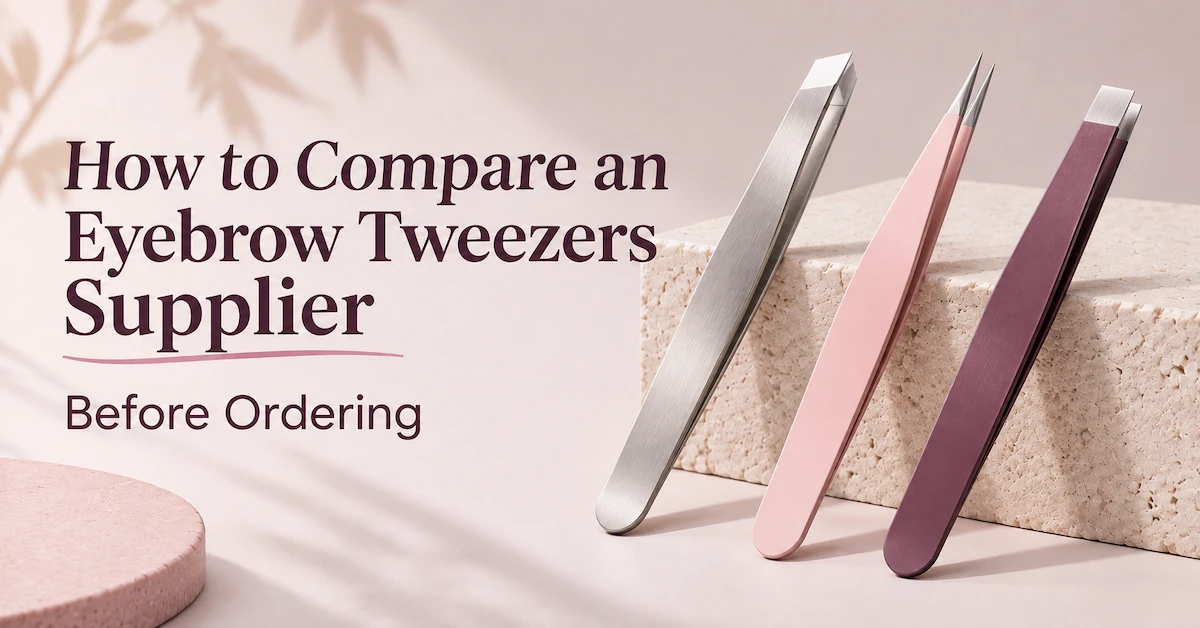
The right eyebrow tweezers supplier is the supplier whose product, sample, branding, packaging and repeat-order assumptions can be compared clearly with the alternatives. A low unit price is not a useful decision point when one quotation covers a plain catalogue tweezer, another covers a decorated retail unit and a third includes a different tip, finish or package. Before choosing a supplier, normalize every response against the same product reference and ask what evidence supports the version you would actually sell.
For a retailer or private-label buyer approving a branded eyebrow-tweezer SKU, the practical work starts before sample approval: define the customer task, compare tip and hand feel, separate material language from appearance language, check branding and packaging scope, and decide whether each supplier response is ready to proceed. The dedicated eyebrow tweezer tip-alignment review covers the working end, while the broader manufacturer evaluation guide covers supplier capability; the comparison method here connects those checks to one purchasing decision.
The goal is a supplier response that tells your purchasing, product and packaging teams what happens next. OLIMOR's public tweezer family can be used as a product starting point, while the final model, material, finish, quantity, packaging and delivery terms remain project-specific. Use the retailer route when the tool must be considered together with channel, presentation and replenishment requirements.
How should a buyer compare an eyebrow tweezers supplier?
Direct answer: send each candidate the same product and channel brief, then compare the completeness of its response across seven fields: product identity, working tip, material and finish, logo, packaging, sample and quality control, and commercial or repeat-order assumptions. Choose the supplier that makes the selected version and the remaining open decisions visible, not simply the supplier that replies fastest or quotes the lowest product-only price.
A useful comparison separates three layers that are often mixed together:
- Product fit: whether the tweezer suits the intended brow task, user and channel.
- Evidence fit: whether the supplier can support the model, material wording, finish, sample and quality statements for the actual SKU.
- Order fit: whether the quote, package, quantity basis, approval path and repeat-order record match the way your business will buy and sell the item.
If one supplier answers only the first layer, you have a product suggestion, not a comparable supply proposal. If a supplier answers the second layer but not the third, you have evidence to review but not yet a release-ready commercial scope.
Review the Tweezer Product Family
What should be fixed before requesting wholesale eyebrow tweezers quotes?
Define the commercial job before asking for a price. "Wholesale eyebrow tweezers" can mean a loose tool for professional counters, an individual retail unit, a private-label product, a salon backbar item or a component in a beauty set. Each use can change the required tip, finish, protective solution, printed information and order assumptions.
Start with the customer task
State whether the customer will use the tool for general brow shaping, detailed work, professional service, take-home maintenance or a gift or kit purchase. This does not force the buyer to choose a tip before seeing samples. It tells the supplier what the tip and hand feel must support. A retailer should also state whether the item is an entry, core or premium SKU, because a decorative finish cannot compensate for a working end that does not match the product promise.
Separate must-match fields from open fields
Mark each requirement as "must match," "preferred," "open to recommendation" or "not required." Must-match fields may include a particular tip profile, overall size, logo location, package format or target market language. Open fields may include a finish recommendation, insert material or secondary color. This simple distinction prevents the supplier from optimizing an open cosmetic preference while missing a working requirement.
Give every supplier the same comparison basis
At minimum, send the product family, intended task, target channel, preferred or reference model, quantity by SKU, logo direction, finish direction, package format, sample requirement, destination market and target delivery window. If a field is unknown, write "to confirm" rather than allowing each supplier to make a different assumption.
What product details should an eyebrow tweezers manufacturer explain?
A credible eyebrow tweezers manufacturer should explain how the selected model is identified and what can be changed, sampled or inspected. The explanation does not need to expose proprietary process details. It does need to connect the product description to a physical reference and a buyer action.
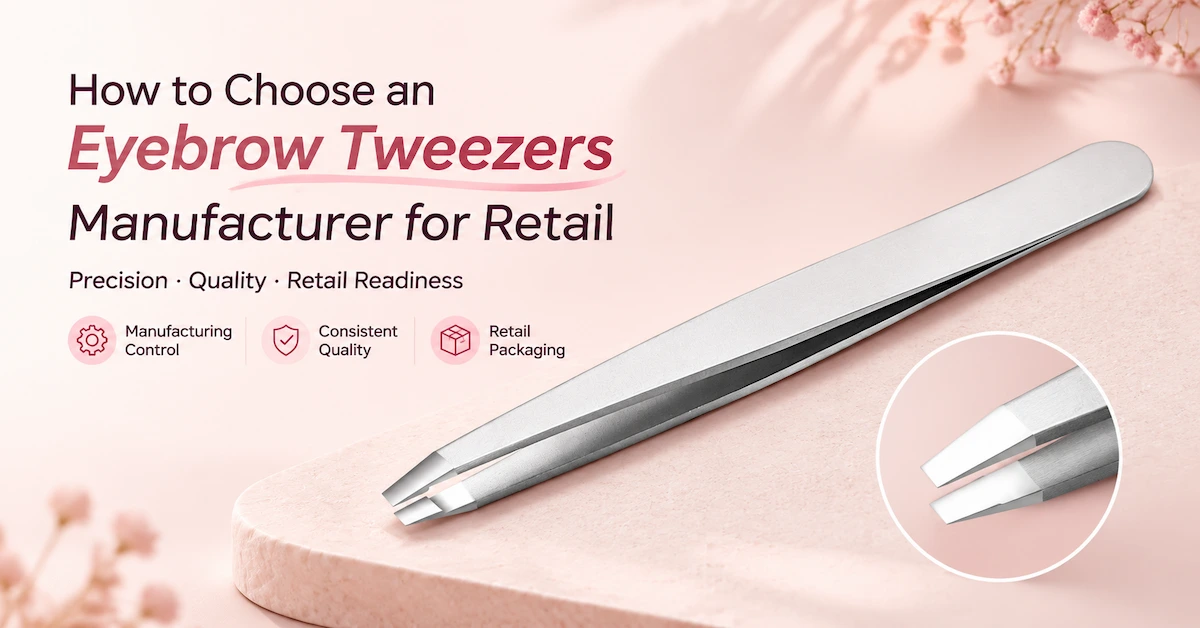
Tip profile and working contact
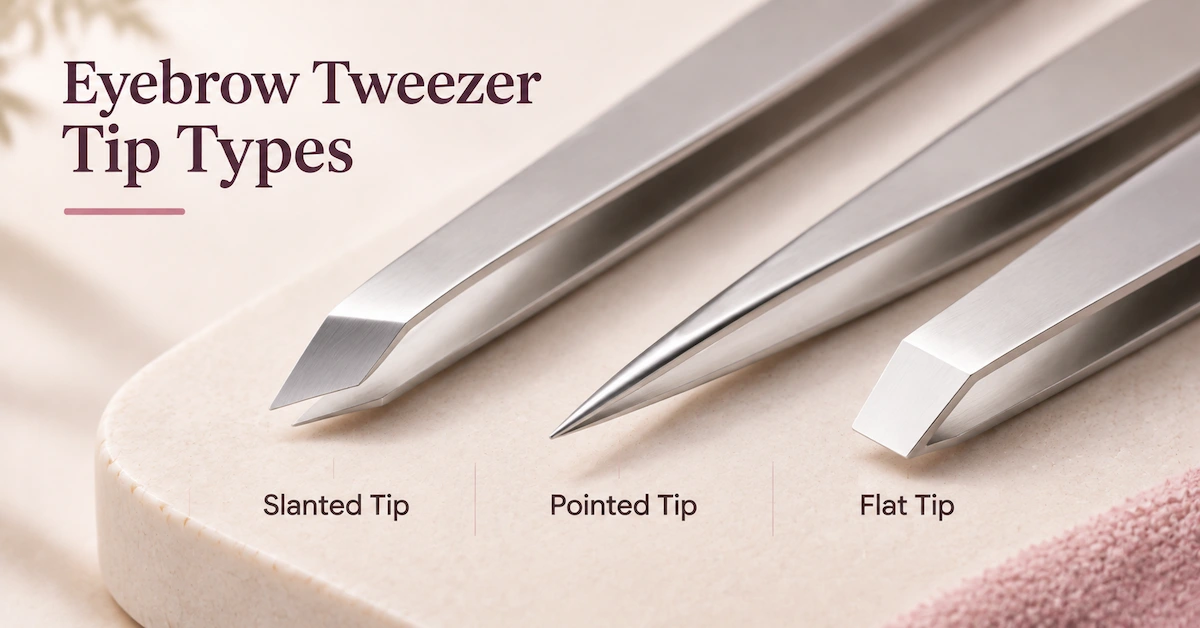
Ask the supplier to identify the tip as slant, pointed, flat or another available configuration, then explain what the profile is intended to support. The supplier should state whether the tip is part of an existing model or a requested adaptation. The buyer should inspect the actual closing contact on a sample under consistent light and record offset, visible gap, burrs, rough transitions and the point at which contact begins.
A photograph can help shortlist a shape, but it cannot prove grip consistency. If your retail copy uses words such as "precision," "fine tip" or "professional," connect the wording to the approved sample and the evidence that supports it.
Body, arm response and hand feel
Record the overall length, body profile, edge comfort, surface feel and closing resistance that your sample reviewer expects. Avoid inventing a universal ideal force or dimension. Instead, ask the supplier which dimensions are fixed for the model and which are adjustable, then use samples to compare the hand feel across candidates. A tweezer that looks identical in a product photo can feel different because of thickness, spring response, surface treatment or edge finishing.
Finish and logo compatibility
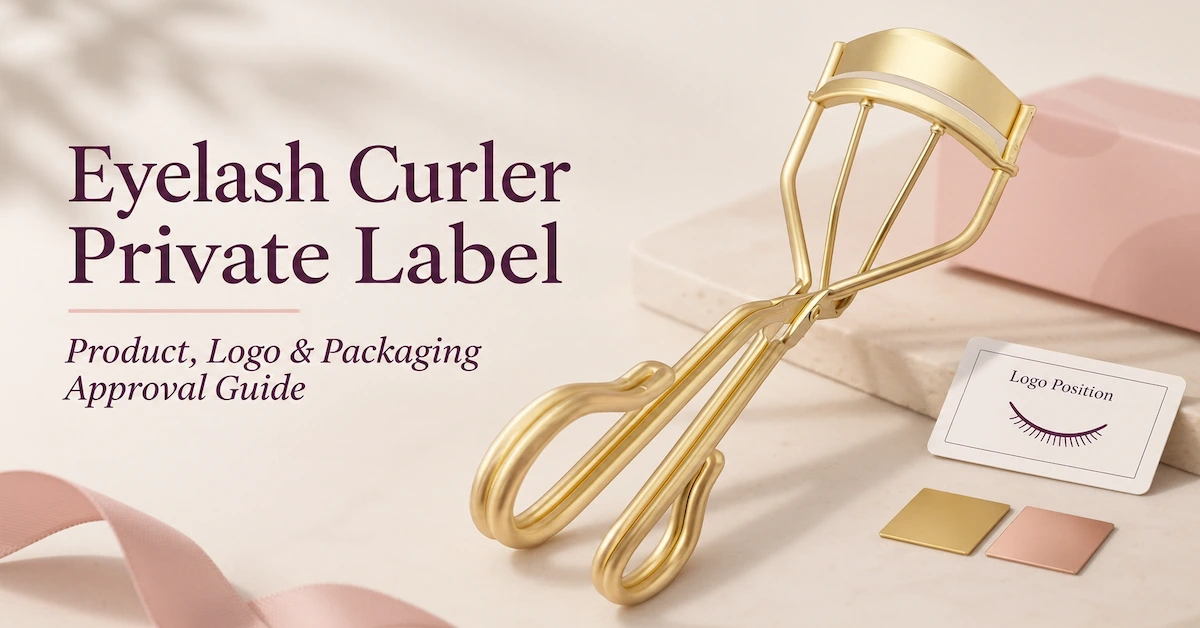
"Black," "rose," "silver" or "premium" is not a complete finish specification. Ask whether the appearance comes from the base surface, polishing, plating, coating or another treatment, which surfaces receive it and how the working end is handled. Then ask how the proposed logo method behaves on that surface. A logo that looks acceptable in artwork may lose contrast, sit across a coating boundary or appear different after the surface is treated.
OLIMOR's public logo and finishing route is a useful starting point for this discussion. The selected marking method, finish, color and surface result still require project-specific sample confirmation.
How should buyers verify material claims from a supplier?
Treat material composition, surface appearance and performance claims as separate fields. "Stainless steel look" or "premium steel" is not a component-level material statement, and a material name does not automatically prove corrosion resistance, sterilization suitability or service life.
OLIMOR public fact: the website presents materials and finishes as part of the beauty-tool discussion. Buyer-side recommendation: ask for the material wording for the selected model and relevant components. Project-specific confirmation: do not publish a grade, resistance statement, medical-use statement or sterilization claim until the exact SKU and applicable evidence are reviewed.
- Main body: identify the material family or grade wording and the model revision it applies to.
- Tips or joined parts: clarify whether they share the body material or require a separate statement.
- Surface treatment: record polishing, plating, coating or color process separately from the base material.
- Document status: distinguish a specification, supplier declaration, test record, sample observation and marketing description.
- Claim owner: assign the person responsible for approving wording on the package, listing and sales sheet.
If a supplier says "certificate available," ask for the model or component covered, document ID, issuing party, date, test or inspection method, sample or finish state and acceptance criterion. Missing fields should trigger Request evidence or Hold, not an automatic rejection of the supplier or approval of the claim.
A buyer can also consult OLIMOR's quality inspection route to frame the evidence conversation. The page does not establish one universal material or test standard for every tweezer model.
How should OEM and private-label scope be compared?
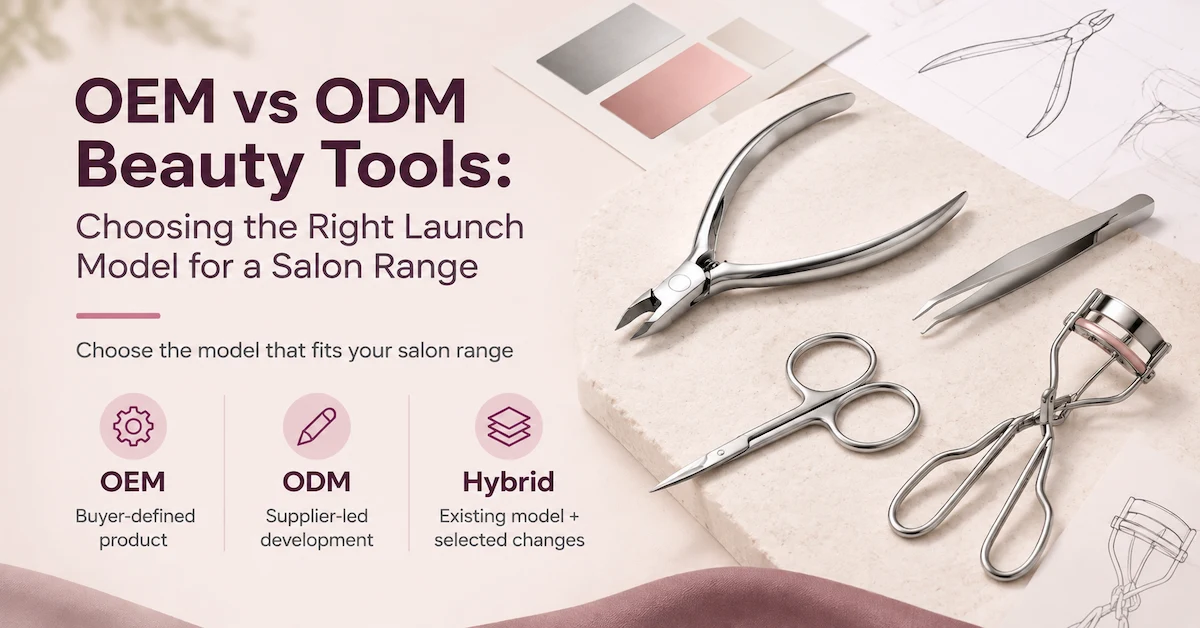
Compare the work included in the quote, not just the label attached to it. An OEM eyebrow tweezers request may begin with a buyer-selected model, reference sample or specification. A private label eyebrow tweezers request may use an existing product with a brand mark, finish and retail package. Either route can involve more development if the buyer asks for a changed tip, body, surface or accessory.
Ask each supplier to separate:
- Existing platform: what remains from the current model.
- Buyer customization: logo, finish, color, package, set composition or other requested changes.
- Development work: feasibility review, changed geometry, tooling, fixtures, sample revisions or engineering decisions.
- Approval output: what sample, artwork, drawing, document or inspection record the buyer receives.
This comparison matters because two suppliers may both write "OEM available" while one is quoting a logo on a standard model and the other is discussing a changed product. OLIMOR's OEM/ODM route describes clarifying the brief, mapping the scope, reviewing the output and planning the next stage. Use that sequence to ask what the supplier will actually deliver.
Discuss an OEM or Private-Label Scope
What should a supplier response normalization sheet contain?
Use one row per supplier and one column per decision field. The sheet below is a buyer-side framework, not an OLIMOR commercial policy. Its purpose is to prevent incomparable quotes from being ranked as if they covered the same product.
| Field to normalize | Buyer question | Record before price ranking |
|---|---|---|
| Model identity | What exact model, revision and tip profile is being quoted? | Supplier code, buyer SKU, photographs or drawing, intended use. |
| Function | What working contact, closing action and hand feel will the sample represent? | Sample status, review method, open performance questions. |
| Material and finish | Which components and surfaces are covered by the stated material or finish? | Component statement, finish reference, evidence status and claim owner. |
| Branding | Which logo method, position, size and artwork revision are included? | Decorated sample, artwork file, surface compatibility and changes included. |
| Packaging | Is the price for a loose tool, protective pack, retail unit, set or carton-ready order? | Pack format, tip protection, printed copy, barcode, insert and carton assumptions. |
| Sample and quality | What will be sampled and how will the approved version be checked? | Sample code, revision, inspection points, approval owner and re-sample rule. |
| Commercial basis | What quantity, MOQ basis, timing stage and delivery scope does the quote assume? | Quantity by SKU, sample or production basis, timing start point and unresolved terms. |
Only after this sheet is complete should the buyer compare unit price. If a field is blank, label it "not answered" or "project confirmation," rather than filling it with an assumption based on another supplier's response.
How should a buyer decide whether a supplier response can proceed?
Use a decision gate that connects the open question to the next action. The decision is not "good supplier" or "bad supplier" in the abstract; it is whether the specific response is ready for the next stage of this SKU.
| Status | Trigger | Next action and owner |
|---|---|---|
| Proceed to sample | Model, intended task, branding scope and package direction are clear; remaining commercial fields are identified. | Buyer releases sample brief; supplier returns coded sample and scope record. |
| Hold | A missing field could change the product, pack, quantity basis or launch decision. | Purchasing owner lists the blocker and due date; do not rank the quote as final. |
| Request evidence | A material, finish, quality or claim statement lacks model, component, revision or document detail. | Quality or product owner requests the missing record and checks its scope. |
| Re-sample | Tip, finish, logo, insert or other changed detail cannot be judged from the current sample. | Supplier issues a new revision; buyer records the change and repeats the affected check. |
| Reject claim or scope | The response cannot meet a must-match requirement or refuses to define what is included. | Buyer records the reason and either revises the brief or removes the response from comparison. |
This gate protects the buyer from two opposite errors: rejecting a supplier because a project detail is simply unfinished, or approving a supplier because a broad marketing answer sounds confident. The status should be attached to a model and revision, not to the supplier forever.
OLIMOR's sampling route can be used when the next decision is a physical product and presentation review. Ask for the sample scope, revision and approval inputs before treating a sample as a production reference.
What should a retailer verify about packaging?
The package must protect the tip, keep the product identifiable and match the selling channel. A supplier quote should state whether it covers a loose tool, protective sleeve, card, box, pouch, case, set insert or shipping carton. Do not treat "custom packaging available" as a complete answer.
For retail, check the tool and printed unit together: logo, product name, material wording, care language, barcode, language, origin text where applicable, warnings and any claim that needs evidence. For a salon or professional counter, prioritize protection, quick identification and efficient storage. If one SKU will serve both channels, ask whether the same pack is suitable or whether two pack references are needed.
Coordinate the package with the working end. An insert that allows movement can expose the tip to impact; a tight pocket can scratch a decorative finish; an incorrect orientation can make the product look inconsistent in photography. OLIMOR's custom packaging route treats protection, layout, branding and retail presentation as connected decisions. The buyer should still approve a representative packed sample.
How should wholesale pricing and repeat orders be compared?
Normalize scope before comparing price, then compare the total work required to make the SKU sellable. A product-only quotation may exclude logo work, finish, retail packaging, sample revisions, inspection, carton labeling or a mixed-SKU assumption. Another supplier may include some of those items but use a different quantity basis.
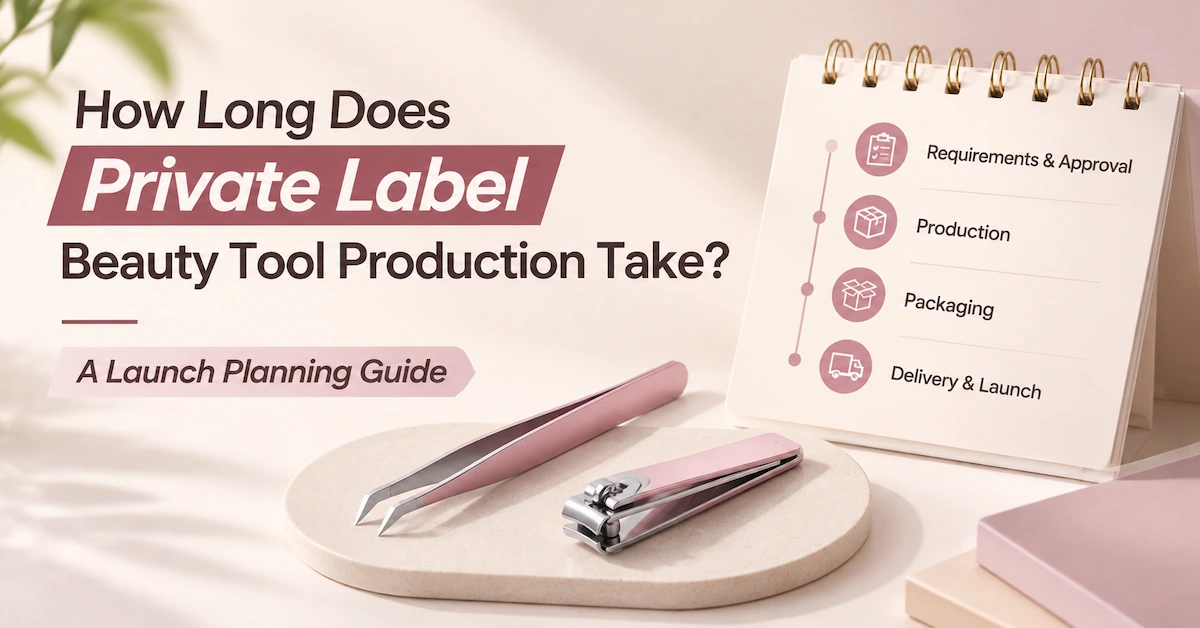
Ask each eyebrow tweezers supplier to state when its lead time starts, what approval is required before production, whether the quoted quantity is per model or per finished SKU, and how changes affect the next order. Do not transfer a MOQ or lead time from one product family or supplier to another. The final MOQ, lead time, material specification and packaging details should be confirmed according to the product model and order requirements.
For repeat orders, retain the approved sample code, model revision, logo artwork, finish reference, package version, inspection points, carton assumptions and change history. A private-label program is not controlled if the second order is based on a product name and an old screenshot.
A strong supplier response should explain how the approved reference is carried into production and how a proposed substitution or process change is communicated. The buyer does not need to demand a universal factory policy; the buyer does need a clear record for the SKU being reordered.
Illustrative supplier replies: what should the buyer do next?
The examples below are an illustrative buyer-side comparison, not real OLIMOR quotations or competitor claims. They show how to handle incomplete answers without confusing confidence with evidence.
- Reply A: "We have many eyebrow tweezers. Send logo and quantity." The supplier has not identified a model, tip, finish, sample or package. Decision: Hold. Send the normalized brief and request a model-specific scope.
- Reply B: "Our stainless steel slant tweezer is suitable for retail. Logo and box are available." The response gives a direction but does not identify components, revision, evidence, package protection or quotation assumptions. Decision: Request evidence.
- Reply C: "We propose model X for general brow shaping, with a slant tip, selected finish and individual retail pack. The sample will show tip contact, logo and pack fit; quantity and timing will be confirmed for the approved version." The response defines a next step without pretending that open commercial items are already fixed. Decision: Proceed to sample.
The most useful response is not necessarily the longest. It is the one that identifies the exact next decision and the evidence needed to make it.
Frequently asked questions about eyebrow tweezers suppliers
What is the most important question to ask an eyebrow tweezers supplier?
Ask the supplier to identify the exact model, tip profile, finish, branding, package and sample scope it is quoting. This turns a broad product category into a comparable SKU discussion.
Should I choose an eyebrow tweezers manufacturer by the lowest price?
No. Normalize the product, finish, logo, packaging, sample, inspection and quantity assumptions first. A lower product-only price may not include the same retail-ready scope.
What should I check in a wholesale eyebrow tweezers sample?
Check the model identity, tip profile, contact, closing action, hand feel, edges, finish, logo and package fit. Record the sample code and revision, then use a product-specific method rather than an invented universal tolerance.
Can OEM eyebrow tweezers start from an existing model?
Yes, a project can start from an existing model or buyer reference, but suppliers use OEM terminology differently. State which features remain unchanged and which require development, sampling or approval.
Does private label mean the product is exclusive?
No. Private label describes branding and market presentation. Exclusivity, design ownership and reuse terms must be agreed in writing for the selected model and project.
How do I compare material claims between suppliers?
Compare component-level wording, model revision, document status, finish state and claim scope. Do not treat "stainless steel" or "premium finish" as proof of a specific grade, corrosion result or professional-use claim without applicable evidence.
When should I request a new sample?
Request a new sample when the tip, body, finish, logo, insert, package or other must-match detail changes and the existing sample cannot show the effect. Keep the old revision identified rather than replacing it silently.
Conclusion
Choosing an eyebrow tweezers supplier is a comparison problem before it becomes a price problem. A retailer or private-label buyer should first make the customer task, tip, finish, logo, package, sample and evidence fields comparable. Then use the supplier response normalization sheet to identify what is included, what is project-specific and what still needs proof.
The strongest supplier is the one that helps you move from an identified model to an approved and repeatable SKU: the working end is reviewed, material and finish language is controlled, branding and packaging are sampled together, quality decisions have owners and repeat orders use a revision-controlled reference. OLIMOR's public product and service routes can support a conversation about product selection, private label, OEM/ODM, sampling, packaging and quality; the final specifications and commercial terms should be confirmed for your project.