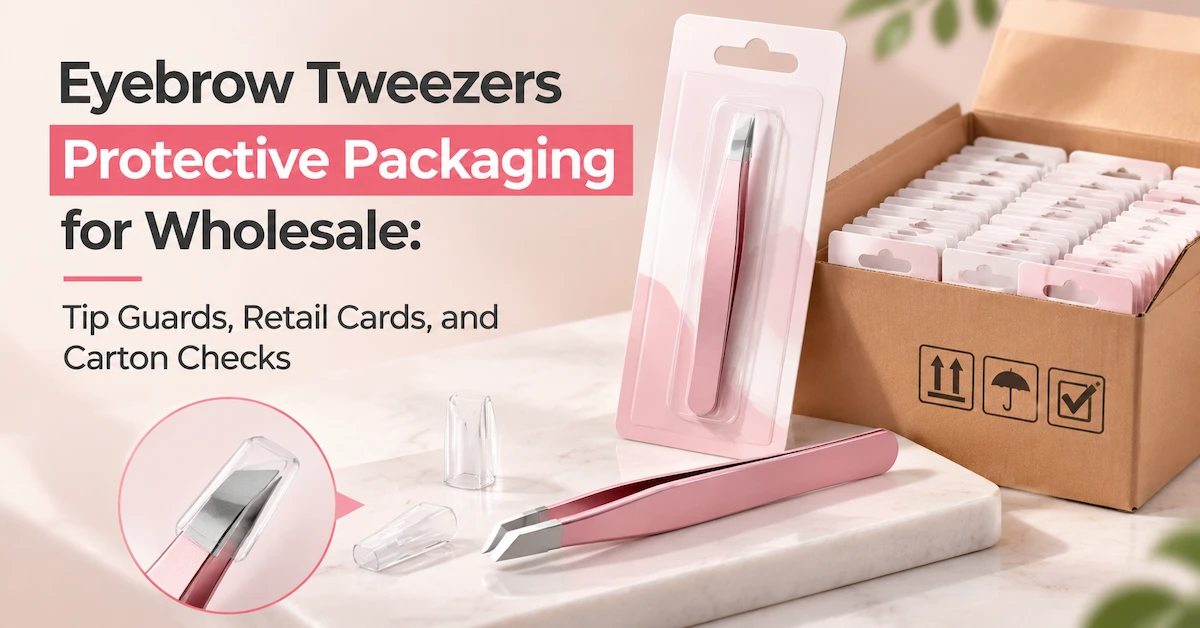
Eyebrow tweezers carton packaging is a product requirement, not an afterthought. A tweezer can leave the factory in good condition and still arrive with a bent tip, a scratched finish, a loose retail card, or an incorrect carton count if the packaging system is not designed around the tool. For wholesale buyers, the packaging decision includes the protective tip guard, the individual pack, the internal fixing method, the retail information, the master carton and the checks used before shipment.
This guide is written for beauty brands, private-label teams, retailers, ecommerce sellers, distributors and importers who are preparing a single-SKU or multi-SKU eyebrow tweezer order. It does not repeat the separate question of which tweezer tip shape to choose. Instead, it explains how to turn an approved tweezer into a pack that can survive handling, display and transport while remaining practical to inspect and replenish.
The central recommendation is simple: approve the tool and its package as one system. A tip guard that fits the loose tool may not fit after a retail card is folded. A card that looks correct on screen may not leave enough clearance around the working end. A carton that holds the correct quantity may still allow individual packs to move and rub during distribution. These interactions should be reviewed through a packed sample, not inferred from a dieline or product photograph.
Build a Better Packaging Brief
Why should eyebrow tweezers carton packaging be specified before production?
The package controls more than presentation. It controls contact, movement, access, identification and the way the finished tool is handled by the next person in the supply chain. For pointed or sharply finished working ends, even a small amount of movement can create a visible defect or change the condition of the tip. For a retail product, the same movement can also make the item look untidy, weaken the card, or create a negative unboxing experience.
Packaging should therefore be included in the same approval record as the model reference, material statement, finish, logo artwork and quality checkpoints. If a buyer approves the tweezer first and discusses the pack later, the package may force late changes to the tip guard, the hanging hole, the card dimensions, the barcode area or the carton quantity. Those changes can affect cost and timing, and they can create a mismatch between the approved sample and the production pack-out.
Buyer answer
Specify protective packaging before production because tip clearance, product movement, retail-card dimensions, barcode placement and master-carton quantity all depend on the exact tweezer model and sales channel. The final packaging configuration should be confirmed through a packed sample for the selected product and order.
A useful packaging brief separates five layers:
- Working-end protection: the cap, sleeve, guard or insert that prevents unwanted tip contact.
- Individual presentation: the card, pouch, sleeve or box that presents one tweezer to the customer.
- Internal fixing: the structure that holds the product in the intended position.
- Shipping configuration: the arrangement of individual packs inside a master carton.
- Verification: the checks used for artwork, quantity, movement, damage and shipment release.
What should an individual eyebrow tweezers retail packaging unit contain?
An individual pack should protect the tool, explain the product accurately and allow the buyer to handle the item without damaging the working end. The format can be a retail card, folded card, sleeve, pouch, small box or a combination of these. The best choice depends on the sales channel, the expected handling environment, the required product visibility and the level of protection needed during shipment.
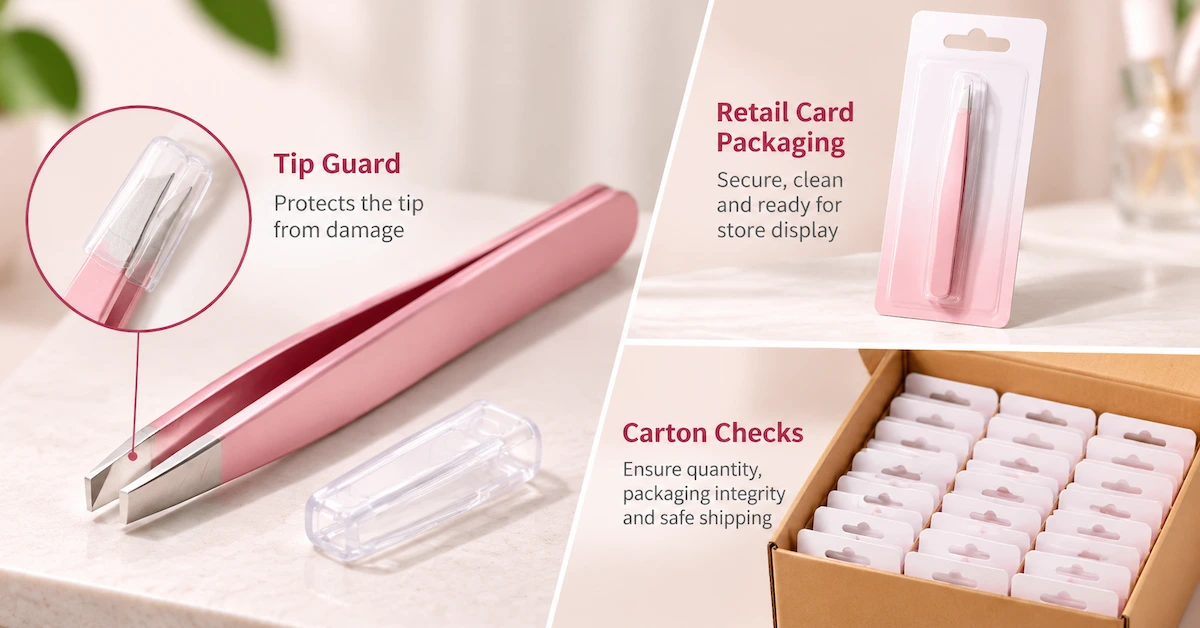
A retail card is often efficient for a hanging display because it uses a visible front panel and a defined hanging hole. It also gives the brand space for the product name, intended use, barcode, care information and any required market-specific copy. However, the card is not automatically a protective structure. If the tweezer is held only by a loose paper loop, the tips may move, contact the card or press into adjacent packs.
A sleeve or small box can offer better control when the product has a fine point, a delicate finish or a premium presentation requirement. The trade-off is that the pack may use more material, occupy more volume and require a more detailed internal fit. A pouch may support a reusable or gift-oriented presentation, but it should not be treated as a substitute for a rigid tip guard when the working end needs positive separation.
| Retail format | Useful when | Buyer should verify |
|---|---|---|
| Retail card | Hanging retail displays, compact assortments and products that benefit from front-facing visibility. | Tip clearance, retention points, hanging-hole strength, barcode area and card rigidity. |
| Folded card or blister-style pack | Products requiring stronger visual separation or more information on the back panel. | Sealing position, opening method, product movement and whether the pack traps the tip. |
| Paperboard box | Premium presentation, gift sets, ecommerce protection or products that need a fitted insert. | Insert fit, empty space, closure security, surface rubbing and carton efficiency. |
| Pouch or sleeve | Travel kits, reusable presentation or coordinated beauty-tool collections. | Whether a separate tip guard is required, closure quality and protection from adjacent items. |
The front panel should sell the product without hiding the protection problem
The front panel should identify the product clearly, show the correct model or tip description and present the brand consistently. If the product is visible, the customer should be able to see the intended orientation without forcing the package open. If the product is covered, the package should still show an accurate image or clear description that matches the supplied item.
Avoid using a large printed image to compensate for an unstable physical pack. Retail packaging is strongest when the physical product remains correctly positioned and the artwork confirms what the customer is seeing. The image, product name, included quantity and any tip description should be checked against the approved product reference before artwork release.
The back panel should support customer use and inventory control
The back panel may contain product use, care instructions, warning copy, country-of-origin information, barcode, item code, batch reference or other market-specific information. These fields should be treated as controlled artwork, not as text that can be changed casually after sampling. A wrong model name or incorrect included quantity can create a retail problem even when the physical tool is acceptable.
Barcode quality is also a packaging-control issue. GS1 guidance notes that barcode position depends on the symbol type and the packaging, distribution and storage process, and recommends verification so the printed code can be scanned in its intended environment. Buyers should therefore test the actual printed pack rather than approving only a digital artwork file. More information is available through the [GS1 barcode quality guidance](https://support.gs1.org/support/solutions/articles/43000734141-what-should-i-check-to-ensure-good-quality-barcodes).
How should eyebrow tweezer tips be protected inside the pack?
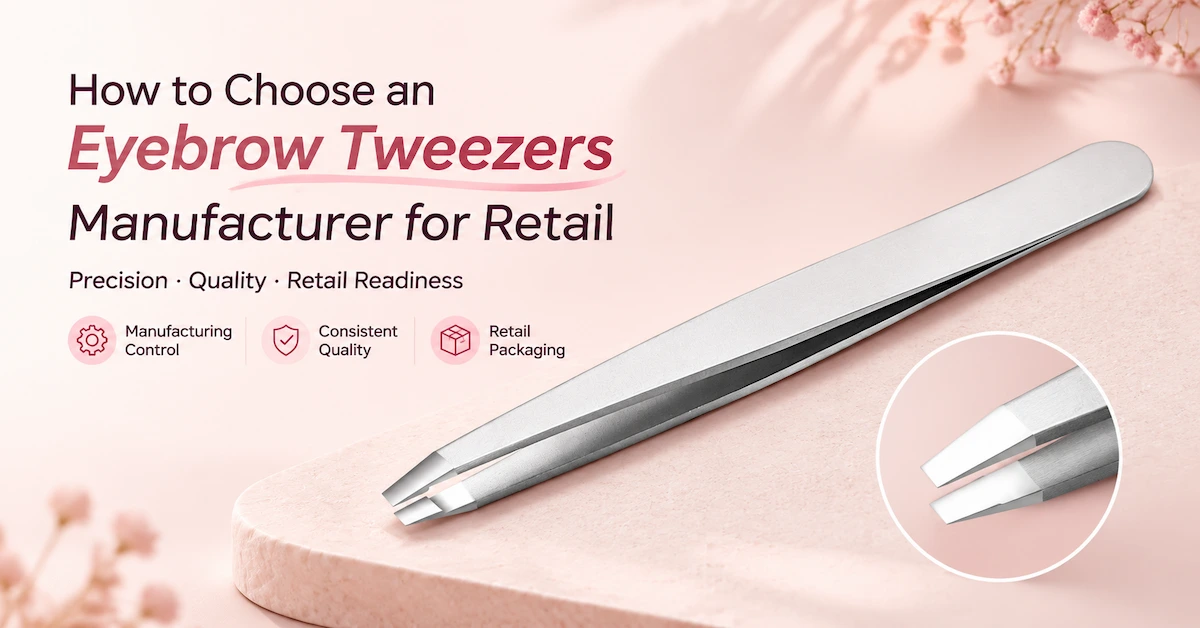
Tip protection should prevent three things: direct contact between the working tips, contact between the tip and the packaging, and movement that allows the product to rub against another product. The guard should fit the exact model and should not force the arms into an unnatural position. It should also be removable without scraping, twisting or misaligning the tips.
A protective cap or sleeve is appropriate when it covers the working end securely and leaves enough clearance around the finished tip. A paper or plastic insert can work when it restrains the product and keeps the tip away from the card surface. A folded card may provide separation only if the folds, slots or retention points are dimensioned for the real product rather than a simplified drawing.
Check the guard on the closed tool and during removal
Inspect the guard while the tweezer is closed, while it is being placed into the pack and while it is being removed. A guard that looks secure after assembly may pull against one arm when removed. That can create an unpleasant customer experience or introduce a risk of tip displacement over repeated handling.
The review should include the front, side and working-edge views. Look for a tip that extends beyond the guard, a guard that touches only one side, a sleeve that slides during handling, or a sharp corner in the protective component. These are practical observations that can be documented with photographs and linked to the package version.
Do not use soft packaging as the only protection for a precision tip
Soft tissue, a loose pouch or a thin paper wrap may reduce surface rubbing, but they do not necessarily control the tip position. If the package will pass through parcel handling, retail replenishment or a master carton, the buyer should confirm whether a more defined guard or fitted insert is required.
The appropriate protection depends on the product geometry, finish, sales channel and shipping route. The exact material, thickness and configuration should be confirmed for the selected model. OLIMOR's custom packaging service can be used to discuss the protection and presentation requirements together.
How should internal fixing keep one tweezer stable?
Internal fixing is the part of the package that stops the product from shifting after the pack is closed. It may use slots, folded tabs, a shaped insert, a tray, a pouch with a retention point or a combination of these. The goal is not to immobilize every millimetre of the product. The goal is to keep the working end, logo surface and visible presentation in the intended position during normal handling.
A good insert restrains the body rather than pressing directly on the finished tip. It should hold the tool at repeatable points, allow the customer to remove it without excessive force and avoid leaving marks on a polished, coated or coloured surface. If the pack includes a logo on the handle, the fixing method should not cover the logo or create an abrasion line across it.
| Fixing point | What it controls | Typical review question |
|---|---|---|
| Working-end guard | Prevents direct contact and reduces the chance of tip impact. | Does the guard remain in place when the pack is moved or turned? |
| Body slot or tab | Controls lateral movement and keeps the tool centred. | Does the slot hold the actual body width without squeezing the finish? |
| Handle retention | Stops the handle from lifting, rotating or rubbing against the pack. | Can the customer remove the product without bending the card or pulling the guard? |
| Set separation | Keeps multiple tools from touching each other in a set. | Are all tools separated after the pack is closed and shaken gently? |
For a single tweezer, internal fixing can often remain compact. For a brow kit containing tweezers, scissors or an eyebrow razor, the insert must manage the relationship between several products with different working ends. A multi-tool pack should be tested as a complete unit because one tool can become a contact point for another during shipment.
What should an eyebrow tweezers shipping plan include?
An eyebrow tweezers shipping plan should connect individual packaging, master-carton configuration, route, handling risk and release checks. It should not be limited to a freight date. The plan needs to explain what is packed, how many units are in each carton, how cartons are identified, how the package is protected from compression and movement, and what evidence is required before dispatch.
Start with the sales unit. Record the finished dimensions of the individual pack, not only the loose tweezer. Then calculate how the units will be arranged in the master carton. Check whether the layout creates empty space, pressure on retail cards, contact between tip guards, or a carton size that is unnecessarily large for the intended route.
Master-carton checks for wholesale orders
The master carton should be treated as a shipping unit with its own identification and inspection requirements. Verify the carton dimensions, quantity per carton, gross and net weight fields where applicable, SKU or item code, carton numbering, destination marks and any handling instructions required by the buyer or carrier.
A carton that is too large may allow individual packs to shift. A carton that is too tight may compress cards, deform boxes or make loading and unloading difficult. The correct configuration is the one that protects the saleable units while remaining consistent with the confirmed shipping plan. Exact carton dimensions, pack counts and logistics assumptions should be confirmed for the selected model and order quantity.
Separate approval time from production and transit time
Packaging artwork approval, packed-sample review, product approval, production, inspection, freight booking and customs or destination handling are different milestones. A general lead-time estimate should not be treated as the full delivery promise. Sample revisions or changes to the insert can affect the schedule even when the tweezer itself remains unchanged.
For a new retail package, the buyer should ask which event starts the production clock. Possible inputs include final product approval, final artwork approval, packaging-material approval, deposit receipt or a combination of these. The answer should be written into the project record so the buyer can distinguish an approval delay from a production delay or a transport delay.
Use a risk-based transport review
A simple packed-sample handling review can identify obvious movement and protection problems before a large order is released. For higher-risk routes, buyers may also discuss a recognized distribution test with a qualified laboratory or packaging specialist. ISTA 3A is designed for individual packaged products shipped through parcel delivery systems up to 150 lb or 70 kg, while ASTM D4169 provides a framework for evaluating shipping units against anticipated distribution hazards. These references do not replace an order-specific packaging decision or prove that a particular OLIMOR package has passed a test.
The correct test depends on the route, the package type and the buyer's risk tolerance. A small retail card shipped inside a protective over-box may require a different evaluation from an individual ecommerce parcel. The package and the product should be assessed together because tip protection, internal movement and outer-carton performance influence one another. See the official [ISTA 3A overview](https://ista.org/docs/3Aoverview.pdf) and [ASTM D4169 information](https://store.astm.org/d4169-16.html) when defining a formal test plan.
Which packaging checks should happen before shipment?
A pre-shipment packaging inspection should confirm the product, the individual pack and the master carton against the same approved reference. The check should be specific enough to identify a problem and repeatable enough for different reviewers to reach a similar conclusion. “Good packaging” is not a useful acceptance criterion. “Tip guard covers the working end, the product stays in the specified orientation, the barcode scans and the carton count matches the packing list” is more actionable.
| Inspection stage | What to check | Evidence to keep |
|---|---|---|
| Incoming packaging materials | Correct card, insert, guard, box, label and artwork version; visible damage or contamination. | Material identification, artwork reference and photographs. |
| First packed unit | Tip protection, product orientation, retention, logo visibility and customer access. | Packed-sample approval with version number and comments. |
| In-process pack-out | Correct placement, guard installation, card folding, seal or closure and absence of surface rubbing. | Operator or line-check record, sample photographs and issue log. |
| Finished retail unit | Product identity, artwork, barcode, quantity, tip condition, cosmetic finish and movement. | Inspection sample record and barcode scan result where required. |
| Master carton | Carton marks, carton number, pack count, inner arrangement, closure and visible compression or damage. | Carton photographs, packing list and final release notes. |
Use sampling deliberately, not as a substitute for a clear specification
Sampling can help buyers balance inspection effort and production risk. ISO 2859-1 describes lot-by-lot acceptance sampling plans indexed by an acceptance quality limit, but the plan must be selected and agreed for the actual inspection purpose. It should not be presented as proof that every unit is identical, and it should not replace critical checks for the working tip, product identity or packaging configuration.
For a wholesale eyebrow tweezer order, define which defects are critical, major or minor for the project. A missing tip guard, a wrong SKU card or a carton count error may have a different commercial impact from a small cosmetic print variation. The buyer and supplier should agree the classification, sample basis and escalation process before the inspection takes place. Refer to the official [ISO 2859-1 standard page](https://www.iso.org/standard/85464.html) when a formal acceptance-sampling framework is needed.
How can buyers compare packaging quotations fairly?
Packaging quotations are comparable only when the scope is comparable. One supplier may quote a loose bulk pack, while another includes an individual retail card, tip guard, printed artwork, barcode placement, inner cartons and a defined inspection. The lower unit price may simply exclude the components that protect the product or make it retail-ready.
| Quotation field | Question to ask | Why it matters |
|---|---|---|
| Individual pack scope | Does the price include the card, guard, insert, pouch, box, label and assembly? | Prevents comparison between different levels of protection and presentation. |
| Artwork scope | Which files, revisions, proofing steps and print checks are included? | Late artwork changes can affect cost and production timing. |
| Carton basis | What is the quantity per master carton, and are carton marks included? | Carton quantity affects storage, freight planning and receiving checks. |
| Sample basis | Will the sample include the final guard, printed card and pack-out arrangement? | A loose tool sample cannot prove the final package works. |
| Inspection scope | Which product, packaging and carton checks are included, and when are they performed? | The buyer needs to know what evidence supports shipment release. |
The final MOQ, lead time, material specification, packaging details and inspection arrangement should be confirmed according to the product model and order requirements. Buyers comparing several SKUs should also ask whether the minimum quantity applies by model, finish, packaging format or printed artwork version.
What should be included in an eyebrow tweezers packaging RFQ?
A complete RFQ makes the supplier's recommendation more useful and reduces the number of assumptions hidden in the quotation. The buyer does not need a finished packaging engineering file on day one, but should provide enough context to define the product, customer, channel and handling environment.
- Product reference or sample, including the exact tweezer model under discussion.
- Target customer and sales channel, such as retail, ecommerce, professional beauty or distribution.
- Required individual format: card, sleeve, box, pouch, fitted tray or an open recommendation.
- Tip-protection expectation, including whether a cap, sleeve or dedicated insert is required.
- Logo artwork, product name, item code, barcode and market-specific information.
- Estimated quantity by SKU, expected replenishment pattern and mixed-SKU question.
- Destination, shipping route and whether individual parcel delivery or master-carton distribution is expected.
- Required sample sequence: loose product sample, printed artwork proof, packed sample and carton pack-out.
- Critical checks, such as tip protection, product movement, barcode readability, pack count and carton marks.
- Open questions that still require supplier recommendation or project confirmation.
The OLIMOR procurement toolkit is designed to help buyers collect product, market, branding, packaging and sampling information before starting a project conversation. Sending that context with the RFQ gives the supplier a stronger basis for discussing the right packaging route.
How can OLIMOR support an eyebrow tweezer packaging project?
OLIMOR's public manufacturing route connects product preparation, quality discussion, packaging coordination and delivery planning. For an eyebrow tweezer project, the practical work may include reviewing the selected model, confirming the working-end protection, coordinating the retail presentation, checking the packed sample and aligning the carton arrangement with the shipment requirements.
The relevant scope depends on the product and order. A buyer may need only an individual protective pack, or may need a complete private-label program with logo marking, retail cards, a fitted insert, multiple brow tools and a repeat-order control record. The selected model, finish, packaging material, artwork, MOQ, lead time and inspection requirements should be confirmed in the project discussion rather than assumed from a general category page.
For quality discussions, OLIMOR identifies working alignment, appearance, marking and packaging as practical review areas for the selected tool. For packaging and logistics, the product, protection, layout and delivery requirements should be coordinated together. This is the correct commercial context for buyers who need packaging to support both the retail experience and the shipping plan.
Send Your Packaging Requirements
FAQ: Eyebrow Tweezers Carton Packaging for Wholesale Buyers
What is the most important packaging feature for eyebrow tweezers?
The most important feature is controlled protection of the working tips. The package should prevent direct tip contact, stop excessive movement and keep the product in a repeatable orientation. The retail card, sleeve or box should then support presentation, identification and customer access without reducing the protection.
Do eyebrow tweezers always need a separate tip guard?
Not always. The correct solution depends on the tip geometry, finish, retail format, internal fixing and distribution route. A fitted insert or folded card may provide adequate separation for one model, while another model may need a cap or sleeve. The final decision should be confirmed with a packed sample.
What is the difference between eyebrow tweezers retail packaging and bulk packaging?
Retail packaging presents one saleable unit to the customer and normally includes product identification, branding and relevant market information. Bulk packaging prioritizes efficient handling and quantity control. A wholesale order may require both: an individual retail pack inside a master carton designed for transport and receiving.
How should a retail card hold one tweezer?
The card should hold the body or handle at defined retention points and keep the working tip separated from the card surface. The product should not swing, rotate or press against the printed face during normal handling. The customer should be able to remove the product without damaging the tip or tearing the card unnecessarily.
What should be checked in a packed sample?
Check the tip guard, product orientation, internal fixing, surface rubbing, logo visibility, artwork version, product description, barcode, hanging hole, closure, customer access and movement after the pack is handled. The packed sample should represent the actual product, finish and packaging configuration intended for production.
What should an eyebrow tweezers shipping plan include?
It should include the individual pack dimensions, master-carton quantity, carton dimensions, SKU and carton marks, packing-list basis, destination, route, shipment milestones, inspection responsibility and release evidence. It should also distinguish production timing from freight, customs and destination handling.
Should buyers test the package against ISTA or ASTM procedures?
A formal transport test may be useful for higher-risk ecommerce, parcel or distribution routes, but the correct procedure depends on the package and shipment environment. ISTA 3A and ASTM D4169 are reference frameworks, not automatic requirements for every order. Discuss the test objective with a qualified packaging or testing partner.
Can the same packaging be used for several tweezer models?
Only when the models share compatible dimensions, working-end protection and retention requirements. A universal card may reduce artwork complexity but can create excess movement or poor tip clearance. Each model should be checked in the actual pack, especially when the body width, tip length or finish differs.
How can buyers reduce carton damage without over-packaging?
Start by controlling movement inside the individual pack and then optimize the master-carton arrangement. Measure empty space, review the orientation of the retail units and check whether cards or boxes are under compression. The goal is a coordinated package, not simply more material. A packed-sample review can reveal where protection is needed and where material can be reduced.
What information should be sent when requesting a packaging quotation?
Send the product reference, target customer, sales channel, estimated quantity, retail format, tip-protection expectation, logo artwork, product copy, barcode requirements, destination, shipping route and required inspection points. State which decisions are fixed and which are open for recommendation. This allows the supplier to separate confirmed requirements from items that need sampling.
Conclusion
A successful eyebrow tweezers carton packaging plan protects the working tips, holds one product securely, presents the brand accurately and gives the logistics team a carton that can be counted, identified and inspected. The critical decisions are the tip guard, the individual retail format, the internal fixing points, the artwork and barcode controls, the master-carton arrangement and the pre-shipment inspection method.
For wholesale buyers, the strongest process is to approve the product and packed sample together, document the exact packaging version, separate approval time from production and transport time, and confirm the final MOQ, lead time, material, packaging and inspection details for the selected model and order. When the package is treated as part of the product specification, fewer defects are discovered after shipment and replenishment orders become easier to control.
OLIMOR can discuss eyebrow tweezers, protective packaging, retail cards, internal fixing, quality checkpoints and shipping coordination as one project brief. Share the product reference, target market, quantity, branding direction and packaging requirements through the OLIMOR contact page to begin a project-specific conversation.