Cuticle Nipper Quotation: What Buyers Need Before Requesting a Price
A cuticle nipper quotation is useful only when the supplier and buyer are pricing the same product, the same approval scope, and the same delivery basis. For a nail-care brand, salon-supply distributor, importer, or private-label buyer, a request that says only "please quote cuticle nippers" leaves too many commercial and technical decisions open. The supplier may select a standard model while the buyer expects a different jaw configuration, finish, logo, protector, or retail package. The resulting price may look attractive but cannot be compared fairly with another quotation.
A strong RFQ (request for quotation) connects five things: the intended user and market, the exact model or reference, the specification fields that matter, the sample approval plan, and the quantity and delivery assumptions. This guide shows how to prepare those inputs, review a cuticle nipper quotation, confirm cuticle nipper MOQ, and carry an approved sample into a controlled cuticle nipper bulk order. It focuses on procurement decisions and order documentation rather than repeating a general explanation of jaw geometry or cutting-edge inspection.
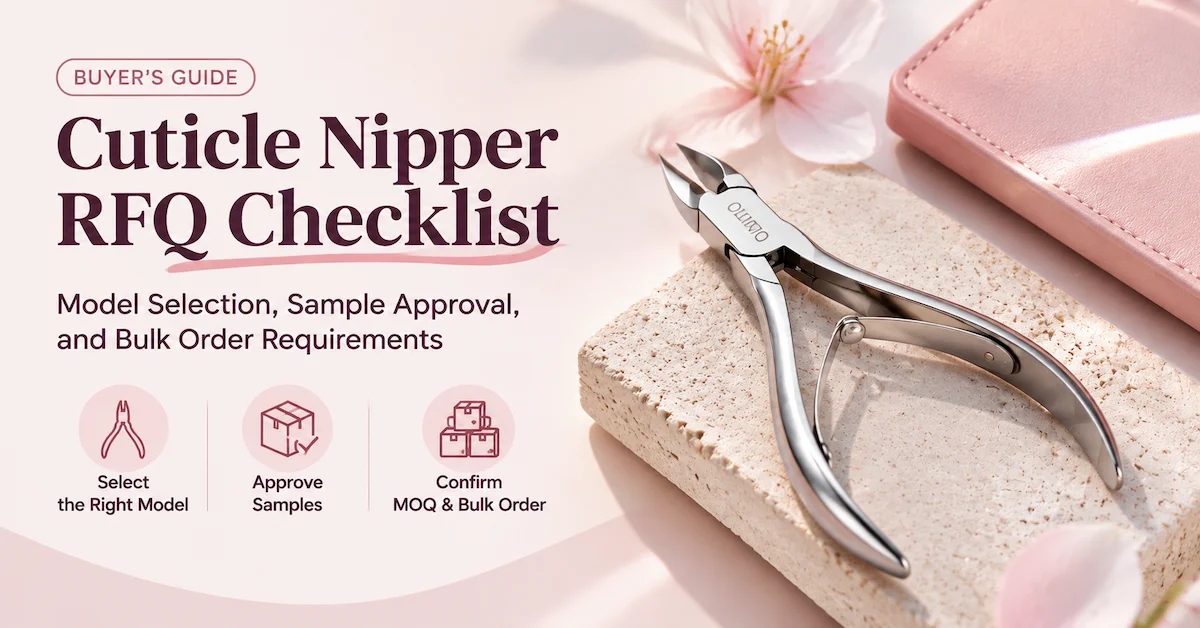
A complete cuticle nipper RFQ should identify the intended use, target market, model or reference sample, required specifications, finish, branding, packaging, quantity by SKU, sample approval requirements, inspection scope, and delivery destination. Buyers should compare quotations using the same product configuration, approve a clearly identified sample, and attach that approved reference to the purchase order before bulk production.
1. What a Cuticle Nipper Quotation Should Actually Confirm
A quotation is a commercial offer for a defined product and scope. It should identify the model, inclusions, open options, quantity basis, and schedule trigger.
For cuticle nippers, the quoted item may vary by model, jaw configuration, overall size, handle design, spring arrangement, material description, surface finish, logo method, protector, and packaging. Not every project changes every field. The purpose of the RFQ is to separate fixed requirements from preferences and undecided items before the supplier calculates the price.
A complete quotation should answer these questions:
- Which model or reference is included?
- Which product specifications are confirmed, and which are still subject to review?
- Does the price include branding, protective components, retail packaging, and carton packing?
- Is sampling included or quoted separately?
- What is the MOQ basis: per model, finish, logo, package, or combined order?
- What inspection scope and documents are included?
- Which currency, payment terms, Incoterms rule, named place, and quotation-validity period apply?
- Which approvals must be completed before bulk production begins?
If any of these points are missing, the buyer should request clarification before comparing the offer with another supplier.
2. Who Should Use This Cuticle Nipper RFQ Checklist?
This checklist is designed for B2B buyers who need to source cuticle nippers as a standalone product or as part of a larger nail-care range.
Beauty and nail-care brands need to translate product positioning into a defined SKU. They may have an existing sample, a target retail price, a preferred finish, and a branding direction, but still need a supplier to confirm which model can meet the brief.
Salon-supply distributors usually care about repeatability and replenishment. Their RFQ should identify the model already used in the range, expected order bands, packaging format, and any requirements that must remain unchanged between orders.
Importers and wholesalers may compare several suppliers. They need a consistent RFQ format so that each quotation covers the same product, quantity, packaging, and delivery basis.
Private-label buyers may need additional coordination for logo artwork, surface finish, colour, protectors, retail cards, pouches, boxes, or manicure-set placement. These elements should be included in the quotation scope rather than added after the product price has been agreed.
This is a B2B purchasing framework, not a consumer-use or market-compliance guide.
3. Define the Buying Brief Before Asking for a Price
The first RFQ input should explain the business context. A supplier cannot make a useful recommendation from a product name alone because the same category may serve different users, channels, and price positions.
Start with the target market and intended customer. Is the product planned for professional nail technicians, general beauty retail, an online private-label range, a salon-supply catalogue, or a manicure set? The answer affects the level of specification detail, packaging, documentation, and assortment planning.
Then describe the buying plan:
- Target country or region and sales channel.
- Intended user and product positioning.
- Initial order quantity and expected reorder range.
- Whether the project is a standard catalogue purchase, a modified model, or a new development.
- Whether the order includes one SKU or several models, finishes, or branded versions.
- Required delivery destination and preferred trade term.
- Target launch or delivery window, clearly marked as a target rather than a confirmed supplier commitment.
A forecast helps the supplier understand whether the buyer is testing one SKU, building a repeat wholesale line, or planning a wider private-label collection. Keep forecast volumes separate from firm order quantities.
The brief should also distinguish "must-have" requirements from preferences. For example, a buyer may require a particular reference model and overall length but be open to the supplier's recommendation on packaging. This distinction prevents the quotation from treating every preference as a mandatory custom-development cost.
4. Select the Right Model Before Comparing Prices
Model selection is one of the most important quotation decisions. A product photograph may show the general appearance, but it does not always identify the exact model, dimensions, jaw configuration, spring arrangement, or finish.
If the buyer already has a reference product, provide its model code if known, clear photographs from several angles, and a physical sample or drawing where practical. Mark the areas that must match and explain which differences are acceptable. A reference sample should be identified as a reference, not automatically treated as the final approved specification.
If the buyer does not have a fixed model, ask the supplier to recommend available options and return a model-by-model comparison. The comparison should use confirmed product information rather than assumptions based on photographs.
| Selection Route | When It May Fit | What the Buyer Must Clarify | Commercial Implication to Confirm |
|---|---|---|---|
| Existing catalogue model | The standard product already matches the intended use and positioning | Exact model code, current specification, finish and included components | Standard MOQ, sample availability and any optional branding |
| Modified existing model | Most of the product is suitable but selected features need adjustment | Which features change, which remain standard, and whether tooling or process changes are involved | Development or setup charges, sample revisions and revised MOQ |
| New custom development | The buyer needs a product not represented by an available model | Drawings, dimensions, functional requirements, ownership and approval stages | Engineering, tooling, sampling, MOQ and schedule must be quoted separately |
Do not assume that a custom model is automatically better. A standard model may be more practical if it meets the buyer's requirements. A modification may be sufficient when only branding or finish needs to change. A new design should be considered when a defined product requirement cannot be met by an existing option.
Before the quotation is finalized, ask the supplier to state the exact model reference on every relevant document: quotation, sample label, specification sheet, approval record, purchase order, and packing list.
5. Build a Specification Sheet That Can Be Quoted
The specification sheet turns the buyer's idea into fields that can be quoted, checked, and approved.
For a cuticle nipper project, the buyer may need to define the following fields. The supplier should confirm the actual available specification for the selected model.
| Specification Field | What to Provide or Request | Why It Matters |
|---|---|---|
| Model reference | Model code, drawing number, or reference sample | Prevents different products being quoted under the same generic name |
| Intended application | Professional salon, retail, personal-care set, or other defined use | Helps assess whether the proposed model fits the target customer |
| Overall dimensions | Required length and any critical dimensions, or request supplier data | Supports model comparison, packaging and SKU identification |
| Jaw configuration | Required style or reference; mark as fixed or open to recommendation | Distinguishes models that may look similar in a catalogue |
| Handle design | Reference image or required handling preference | Helps define the product version |
| Spring arrangement | Confirm the arrangement on the selected model | Prevents a sample and quotation describing different configurations |
| Material statement | Ask the supplier to state the material for the selected model and provide applicable evidence | Avoids unsupported alloy or grade assumptions |
| Surface finish and colour | Specify the finish reference, colour target, or acceptable sample | Supports visual consistency and branding |
| Logo and marking | Artwork file, method preference, location, size and revision | Makes decoration part of the quote and sample scope |
| Protector and packaging | State whether a cap, sleeve, pouch, card, box or set insert is required | Defines what is included in the finished sellable unit |
| Included accessories | List replacement parts or additional items, if any | Prevents missing components and quantity disputes |
| Inspection requirements | Identify critical characteristics and required records | Connects sample approval to bulk inspection |
Do not fill unknown fields with guessed values. If the buyer does not know the material grade, for example, ask the supplier to state the confirmed material description and available documentation. If the jaw size is not yet decided, ask for the available model options and samples rather than selecting a number from an unrelated supplier's catalogue.
The specification sheet should also identify the source of each requirement: buyer-defined, supplier-confirmed, sample-observed, or still open. This simple status distinction is especially useful when the project involves several departments.
Discuss Your Cuticle Nipper Requirements
Share your reference model, target market, preferred configuration and estimated quantities. OLIMOR BEAUTY can discuss the project scope and the information needed for a model-specific quotation.
Discuss Your Nipper Project →6. Compare Cuticle Nipper Quotations on the Same Basis
A low unit price does not necessarily represent the lowest total purchasing cost. One supplier may quote a standard tool in basic packaging, while another includes a custom logo, protector, retail box, and additional inspection. Those offers are not directly comparable.
Ask each supplier to separate one-time charges from recurring costs.
One-time or project-specific charges may include:
- Tooling, mould, fixture, or engineering charges, where applicable.
- Logo setup, artwork preparation, or printing setup.
- Sample development and revision charges.
- Special packaging design or setup.
- Third-party testing or inspection fees, if requested.
Recurring order costs may include:
- Unit price for the selected model.
- Branding or finish cost per unit.
- Protector and retail packaging cost.
- Assembly or packing cost.
- Carton and export-packing cost.
- Inspection or documentation charges included in the order.
Request price breaks at the quantities you are realistically considering. The supplier should identify whether each price tier applies per model, per finish, per logo version, or to the combined order. If several SKUs are included, ask for the price and MOQ basis for each one.
| Quotation Item | What a Clear Quotation Should State | Common Comparison Risk |
|---|---|---|
| Product | Exact model and specification revision | Generic product name with no model reference |
| Unit price | Currency, quantity tier and included configuration | Price excludes requested finish or accessories |
| Branding | Method, location and setup charge | Logo cost is omitted or assumed |
| Packaging | Type, components and packing scope | One quote includes retail packaging while another does not |
| Sampling | Sample type, quantity, fee and shipping basis | Sample cost or revision charges are unclear |
| Inspection | Checks, records and responsible party | "QC included" without defined scope |
| Delivery | Production schedule, destination assumptions and trade term | Freight or delivery basis is missing |
| Validity | Quote expiry or conditions for price review | Old quotation reused after specification changes |
Normalize all offers to one specification and commercial basis. Record unquoted fields as open, not as zero-cost items.
7. Understand Cuticle Nipper MOQ Before Placing an Order
Cuticle nipper MOQ is not necessarily one fixed number for every project. The minimum may depend on the model, finish, colour, logo method, packaging version, custom development, and the way the supplier organizes production.
The buyer should ask what the MOQ applies to. Is it per model, per SKU, per finish, per logo version, per packaging design, or for the total purchase order? This distinction matters when a distributor wants several models or a brand wants the same model in different finishes.
| MOQ Question | Why Buyers Should Ask |
|---|---|
| Is MOQ calculated per model or across the order? | Clarifies whether different models can be combined |
| Does a new finish create a separate MOQ? | Identifies whether colour or surface variations affect the minimum |
| Does custom logo work change the MOQ? | Separates standard products from branded configurations |
| Is packaging MOQ separate from product MOQ? | Prevents a low product minimum from hiding a higher packaging minimum |
| Can the first order be a pilot quantity? | Helps buyers test demand before committing to a larger range |
| Are repeat orders subject to the same MOQ? | Clarifies whether future replenishment follows the same basis |
If the requested MOQ is higher than the buyer's initial demand, discuss alternatives rather than immediately removing the product from consideration. Options may include choosing a standard model, reducing the number of finishes, using a simpler packaging format, combining compatible SKUs, or agreeing on a staged purchasing plan. These are negotiation possibilities, not guaranteed supplier policies; each must be confirmed in writing.
Compare excess-inventory cost with any higher unit price at a lower quantity, considering sales velocity, storage, cash flow, and design changes.
8. Plan Cuticle Nipper Sample Approval in Clear Stages
Cuticle nipper sample approval should answer defined questions. A sample should not be approved simply because it looks similar to a catalogue photograph.
Each sample stage should state what it evaluates and what remains open.
| Sample Stage | Main Purpose | Buyer Decision |
|---|---|---|
| Reference or catalogue sample | Confirm the proposed model and general product direction | Is this the correct model to develop or quote? |
| Functional sample | Review the agreed working characteristics and handling expectations | Does the product meet the buyer's stated functional brief? |
| Customized sample | Review finish, colour, logo, and other agreed modifications | Does the customized version match the approved direction? |
| Pre-production sample | Confirm the production-representative product and configuration | Is the version suitable to release for the agreed bulk order? |
| Packed sample | Confirm protector, retail packaging, accessories and presentation | Does the complete sellable unit match the order requirement? |
Not every project needs five separate physical sample rounds. A standard model may combine some reviews. A new development may need more. The buyer and supplier should decide which stages are necessary for the specific scope.
Reference Sample
The first sample should establish the product identity. Record the model code, source, date received, and any visible differences from the reference image or drawing. If the sample is only for model selection, state that it is not yet approval for finish, logo, packaging, or bulk production.
Functional Sample
The functional sample should be reviewed against the agreed intended use and acceptance criteria. The buyer should record observations in a consistent format. If several reviewers are involved, use the same review method and consolidate their feedback before sending revisions to the supplier.
Customized Sample
A sample with a new finish, colour, or logo should be reviewed as that specific version. Approval of a plain sample does not automatically approve a decorated sample. The logo artwork, marking method, position, size, and appearance should be recorded.
Pre-production and Packed Samples
The pre-production sample should represent the version intended for the order. Where retail packaging or accessories are included, the packed sample should confirm the product, protector, package, printed information, and component count together.
The quotation should state included sample stages, sample quantity, revision charges, freight responsibility, and schedule trigger.
Review Your Cuticle Nipper Sample Requirements
Before committing to a bulk order, clarify which sample stages are needed and what must be approved for the selected model, finish, branding and packaging.
Discuss Sample Approval →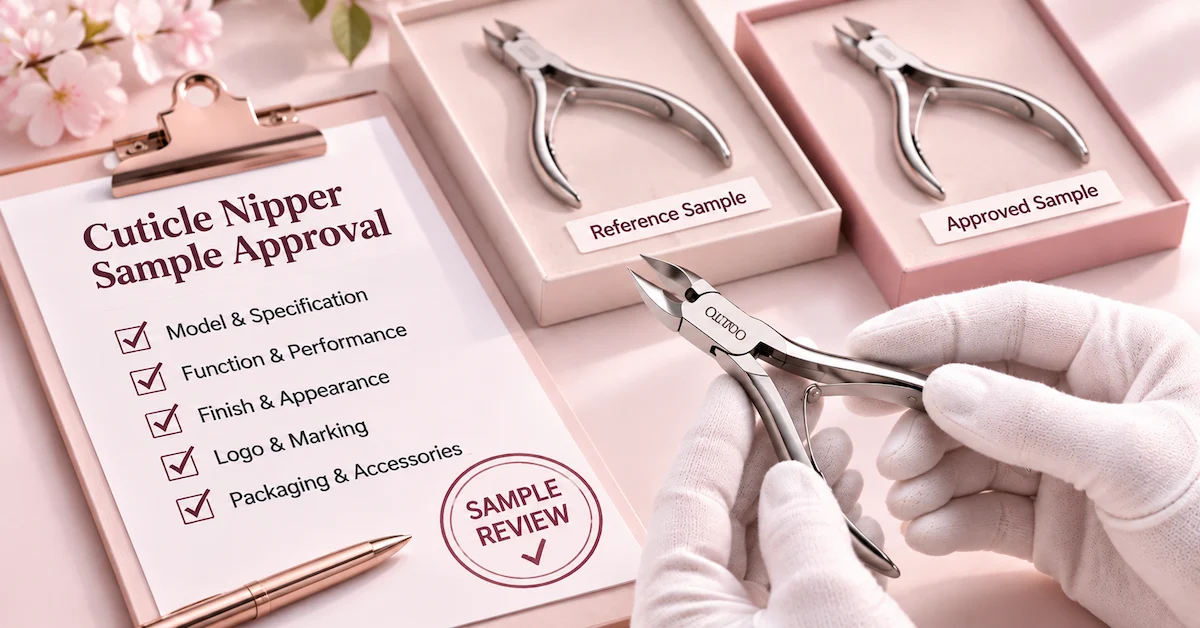
9. Create a Written Sample Approval Record
A sample approval record prevents the buyer and supplier from relying on different memories of what was accepted.
At minimum, record:
- Product name and model code.
- Sample identification number and revision.
- Date received and reviewer.
- Sample purpose: reference, functional, customized, pre-production, or packed.
- Confirmed dimensions and specification reference.
- Material and finish statements confirmed by the supplier.
- Logo artwork version and marking position.
- Packaging and accessory configuration.
- Review criteria and results.
- Deviations, corrections, and unresolved items.
- Approval status, approval date, and responsible person.
Use clear approval statuses. "Approved" should mean the sample meets the stated requirements. "Approved with deviations" should list every accepted difference and identify whether it applies to the sample, the first order, or future orders. "Revise and resubmit" means the supplier must provide another version before release. "Rejected" means the sample cannot be used as the production reference.
A golden sample or controlled reference sample should be identified with a code and date. Keep it with the related specification sheet, photographs, artwork, packaging files, and inspection criteria. If the physical sample cannot be retained, the buyer should agree which approved documents and photographs govern each characteristic.
Sample approval does not approve MOQ, price, packaging cost, inspection responsibility, payment terms, or delivery schedule; confirm these separately.
10. Convert the Approved Sample Into a Purchase Order
The purchase order should describe the same product that was approved and quoted. It should not rely on a product name alone or refer to an email thread that contains several conflicting versions.
Attach or reference:
- Final model code and specification revision.
- Approved sample code, date, and status.
- Confirmed quantity by SKU, finish, and logo version.
- Material and finish statements agreed for the selected model.
- Logo artwork revision and marking instructions.
- Packaging configuration and included accessories.
- Inspection criteria and required records.
- Unit price, one-time charges, currency, payment terms and quote reference.
- Production and delivery milestones.
- Destination, shipping method, Incoterms rule and named place.
- Rules for changes, substitutions, and approval of deviations.
For a mixed-SKU order, create a separate line for each model or configuration. Do not combine several models under one generic line if their prices, finishes, packaging, or MOQ bases differ.
The purchase order should also identify the approved documents by revision. If the buyer updates artwork after issuing the PO, the change should be recorded and accepted by both parties before the affected work proceeds.
11. Define Bulk Order Quality and Release Requirements
A cuticle nipper bulk order needs an inspection plan that follows the approved specification. The plan should distinguish product checks from branding, packaging, quantity, and shipping checks.
The buyer and supplier should agree which checks are performed, when they occur, who records the results, and what happens when a requirement is not met.
A practical order may use several checkpoints:
- Pre-production review: confirm the current specification, sample reference, artwork, and packaging.
- First-piece or initial-production review: compare the first production units with the approved reference.
- In-process review: check agreed characteristics during production where appropriate.
- Final product inspection: review the finished goods against the agreed acceptance criteria.
- Packed-unit inspection: confirm model, logo, protector, accessories, labels, and packaging.
- Pre-shipment review: verify quantities, carton marks, packing list, and shipment readiness.
For lot-based inspection, buyers may choose to use an acceptance-sampling plan. ISO 2859-1:2026 defines sampling schemes indexed by AQL for lot-by-lot inspection. The standard does not choose the buyer's AQL or defect classification automatically. The buyer and supplier should agree the inspection level, AQL, sample size, acceptance and rejection numbers, and defect categories before the order is inspected. See the official ISO description of ISO 2859-1:2026.
Do not use "100% inspection" or "AQL passed" as vague promises. Ask what was inspected, by whom, against which criteria, and what record will be supplied. If a third-party inspection is required, define the timing, scope, sampling plan, report format, and responsibility for cost.
Shipment release should confirm that product, packaging, quantity, and documents match the approved order reference.
For more context on project-specific quality discussions, buyers can review OLIMOR's quality review approach.
12. Confirm Delivery, Packing, and Trade Terms
The quotation and purchase order should state the delivery basis clearly. A lead-time estimate should be separated into sample preparation, approval, production, inspection, packing, and freight where these stages are relevant. Ask what event starts each stage. For example, the production clock may start only after sample approval, artwork approval, deposit receipt, or completion of another agreed condition.
The delivery section should identify the destination, shipping method, carton information, and required export documents. Buyers may need a commercial invoice, packing list, carton marks, product descriptions, and other documents according to the transaction and destination.
If Incoterms are used, state the chosen rule, named place or port, and version. The International Chamber of Commerce explains that Incoterms® rules allocate obligations, costs, and risks between buyer and seller; they do not replace the sales contract or product specification. Refer to the ICC Incoterms® rules and specify the agreed term precisely, for example, "FCA [named place] Incoterms® 2020" where that is the agreed arrangement.
Avoid comparing two quotations when one includes freight to a named destination and the other is based on collection at the supplier's premises. The product price may be similar while the delivery obligations and total landed cost are very different.
13. OEM, ODM, and Private Label: What Changes in the RFQ?
The commercial route affects how much information the buyer needs to provide.
For an existing catalogue model, the RFQ can begin with the model reference, quantity, finish, logo, packaging, and required sample review. The buyer should still confirm that the quoted model is the one represented by the sample.
For a modified model, identify each requested change and ask whether it affects tooling, materials, process, finish, packaging, or inspection. The supplier should separate standard features from development items.
For a new OEM or ODM project, the buyer may need to provide drawings, reference samples, dimensions, functional requirements, intended market, and design constraints. Development charges, sample stages, intellectual-property ownership, and change approval should be discussed before work begins.
Private label projects add branding and retail presentation. Provide vector logo artwork, preferred position, marking method if known, finish direction, packaging format, barcode information, and any market-specific label content. The physical customized sample should be reviewed before bulk release.
OLIMOR's OEM/ODM project page, Private Label solutions, and Sampling service are relevant starting points for discussing the scope. The actual available options, MOQ, costs, and schedule must be confirmed for the selected model and order.
14. Copyable Cuticle Nipper RFQ Template
Use the following template to prepare an inquiry. Replace the bracketed fields with confirmed information. If a detail is unknown, write "please advise available options" rather than guessing.
Buyer and market
- Company:
- Contact person:
- Target country or region:
- Sales channel:
- Intended user:
- Product positioning:
Product requirement
- Product: Cuticle Nipper
- Reference model or sample:
- Intended application:
- Required dimensions:
- Jaw or model preference:
- Handle or spring preference, if applicable:
- Material requirement or documentation requested:
- Surface finish and colour:
- Required accessories or protector:
Branding and packaging
- Logo artwork attached: Yes / No
- Preferred marking method:
- Logo position:
- Packaging type:
- Label or barcode requirement:
- Included components per retail unit:
Quantity and commercial basis
- Initial quantity by model:
- Expected reorder quantity:
- Mixed-SKU requirement:
- Target delivery destination:
- Preferred shipping method:
- Requested Incoterms rule and named place:
- Target delivery window:
Sample and approval
- Sample type required:
- Sample quantity:
- Required review criteria:
- Number of revision rounds to quote:
- Sample fee and freight:
- Approval record required:
Quotation requested
- Unit price by quantity tier:
- MOQ and its calculation basis:
- One-time tooling or setup charges:
- Logo and finish charges:
- Packaging and assembly charges:
- Inspection scope and report:
- Production and delivery milestones:
- Payment terms:
- Quotation validity:
Attachments
- Reference photos or drawing:
- Existing sample photos:
- Logo artwork:
- Packaging reference:
- Buyer specification sheet:
A structured RFQ helps the supplier identify missing information before quoting. It also makes it easier for the buyer to compare suppliers without assuming that each quotation includes the same model, customization, packaging, and delivery scope.
15. Frequently Asked Questions About Cuticle Nipper Quotations
1. What information is required for a cuticle nipper quotation?
Provide the model or reference sample, intended use, target market, required dimensions or model preferences, material and finish requirements, logo and packaging details, quantity by SKU, destination, sample expectations, and inspection requirements. Mark unknown fields as open for supplier confirmation.
2. How do I compare quotations from different cuticle nipper suppliers?
Compare the exact model, specification revision, material statement, finish, logo, packaging, sample scope, inspection, quantity tier, currency, payment terms, delivery basis, and quotation validity. A lower unit price is not comparable if it excludes customization or packaging included in another offer.
3. What affects cuticle nipper MOQ?
MOQ may depend on the model, finish, colour, logo method, packaging version, custom development, and production arrangement. Ask whether the minimum applies per model, per SKU, per finish, or to the combined order. Confirm the basis in writing.
4. Can I order several cuticle nipper models in one bulk order?
Mixed-model orders may be possible, but the MOQ and price calculation can differ by model, finish, logo, and packaging. List each SKU and quantity separately, then ask the supplier whether compatible items can be combined for production or packing.
5. Should I approve a sample before placing a bulk order?
For a customized or specification-sensitive order, a production-representative sample should normally be reviewed before bulk release. The buyer should confirm the exact model, functional requirements, finish, logo, packaging, and agreed deviations in a dated approval record.
6. Does sample approval mean the bulk order is automatically approved?
No. Sample approval confirms the identified sample version against agreed criteria. The purchase order, quantity, quotation, artwork, packaging, inspection plan, and delivery terms still need to be confirmed separately.
7. What is a golden sample for cuticle nippers?
A golden sample is a controlled physical reference retained after approval. It should be identified by model, revision, and approval date and linked to the specification sheet, finish reference, logo artwork, packaging files, and inspection criteria. It helps the buyer and supplier compare future production and repeat orders against the same approved version.
8. What should be included in a cuticle nipper purchase order?
Include the model code, specification revision, approved sample reference, quantity by SKU, material and finish statements, logo artwork, packaging, inspection criteria, unit price, one-time charges, payment terms, delivery schedule, destination, and agreed Incoterms rule. Attach the documents that define the approved product.
9. How can I reduce differences between the approved sample and bulk production?
Use one controlled specification, keep the approved sample and artwork version identifiable, define which characteristics must remain unchanged, and require written approval for changes. Agree first-piece, in-process, final, and packed-unit checks as appropriate to the project.
10. What should I do if the supplier cannot confirm a specification before quotation?
Ask the supplier to identify the field as open, state what information or sample is needed, and separate any provisional price assumption from confirmed quotation items. Do not treat an unverified material, dimension, finish, MOQ, or delivery estimate as a final commitment.
Conclusion
A reliable cuticle nipper quotation starts with a clear product brief and ends with an order that can be checked against the same approved reference. Buyers should identify the model, separate fixed requirements from open choices, define the specification, compare quotations on an equivalent basis, confirm the MOQ calculation, and plan sample approval before committing to bulk production.
The most important control is continuity. The model on the quotation should match the sample, the approved sample should match the purchase order, and the bulk goods should be inspected against the approved specification and agreed acceptance criteria. This creates a clearer basis for first orders, supplier comparisons, and future replenishment.
OLIMOR BEAUTY supports beauty-tool product discussions, OEM/ODM and private-label projects, sampling, and quality-related reviews. Share your cuticle nipper reference, target market, quantity by model, branding requirements, and sample expectations to request a project-specific quotation. Exact product specifications, MOQ, pricing, sample costs, lead time, and available customization must be confirmed for the selected model and order.
Ready to Request a Cuticle Nipper Quotation?
Send your model reference, order quantity, target market, branding requirements, and sample expectations to OLIMOR BEAUTY. Start with a clearly defined project brief before moving to sample approval and bulk production.
Request a Cuticle Nipper Quotation →