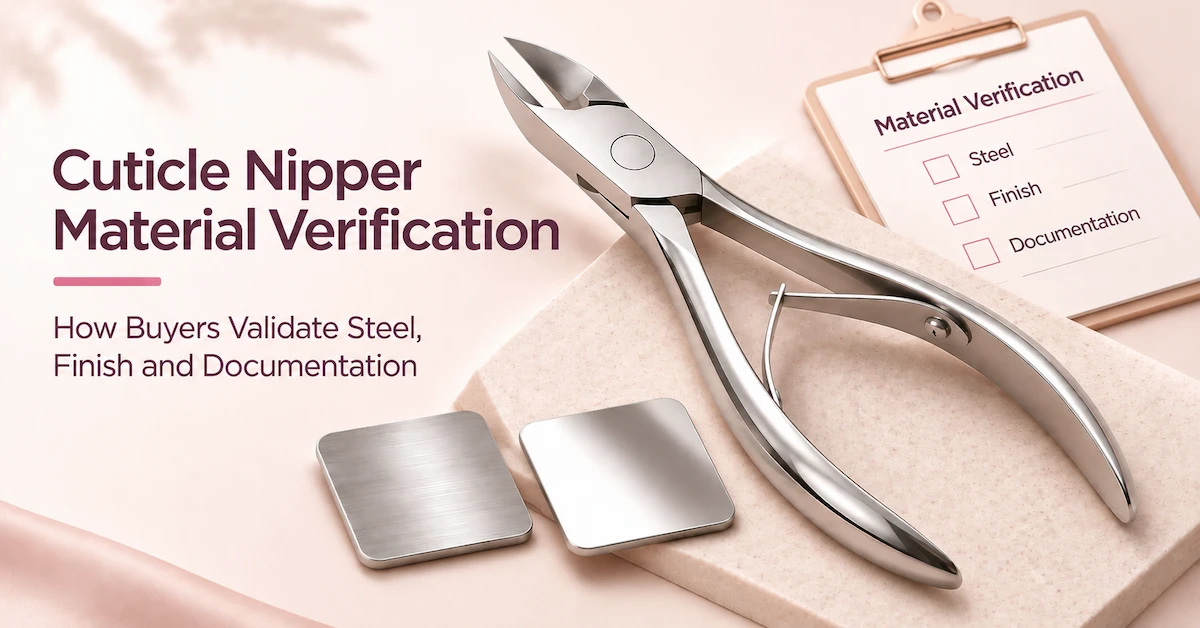
When a branded nail-care range is built around a cuticle nipper, the phrase “stainless steel” is only a starting point. A buyer still needs to know which component the statement covers, whether the supplier can identify the material designation, what finish was applied, and which documents support any claim about corrosion, cleaning, durability or market compliance. A polished photograph cannot answer those questions.
The practical question is not whether a cuticle nipper is described as stainless steel. It is whether the material wording covers the right components, whether the finish on the approved sample matches the retail version, and whether the documents support the claims that will appear on the package or product page. The process below keeps those decisions connected from first quotation to final release.
Review Your Model, Finish and Claim Brief
What should a cuticle nipper material specification prove?
Short answer: a material specification should identify the relevant component, state the material designation or the current status of that information, identify the finish separately, and connect the statement to an applicable record. It should not use a visual description such as “premium silver” as a substitute for a steel grade, and it should not convert a material name into an untested corrosion or sterilization claim.
For a buyer, “proof” has four levels:
- Identity: the document or supplier response names the exact model, revision and component.
- Designation: the material is described in a technical way, not only by colour or sales wording.
- Traceability: the statement can be connected to a batch, incoming record, declaration or other applicable evidence.
- Claim fit: the evidence supports the exact wording the brand wants to publish for its market.
OLIMOR's public cuticle nipper product family is useful for identifying a starting model. The product family name does not, by itself, establish one universal alloy, hardness, finish, cleaning compatibility or compliance position for every SKU. Those points should be confirmed for the selected product and order.
The evidence priority changes by buyer type
The same material answer is not equally useful to every purchasing team. Rank evidence by the problem that would be most expensive to correct after artwork, production or launch. The matrix below helps set that order; it does not change OLIMOR's commercial terms.
| Buyer type | Highest-priority evidence | Typical stop point |
|---|---|---|
| E-commerce or private-label brand | SKU-specific material wording, approved finish, product photography reference and packaging claim review. | Do not release listing or artwork while the claim covers more components than the evidence. |
| Salon distributor | Working-end sample, joint and spring condition, care guidance, finish durability and repeat-order reference. | Hold the order if the functional sample and the proposed care or performance wording describe different use conditions. |
| Importer or retail compliance team | Document identity, issuing party, model/revision scope, destination-market claim review and package copy. | Request evidence when a company certificate is offered instead of product or component documentation. |
| Manicure-set or gift-set brand | Component compatibility, finish boundaries, protector contact, insert fit and consistency across every tool in the set. | Re-sample when the tool, insert or adjacent metal component changes after the set sample is approved. |
How is a material designation different from marketing language?
A technical designation answers “what material is this component declared to be?” Marketing language answers “how should the product be perceived?” The two can support each other, but they cannot replace each other. “Mirror silver,” “surgical quality,” “professional steel,” “rust-proof,” and “medical grade” each create a different level of expectation, and none should be printed without checking the evidence and the destination-market rules.
| Statement seen in a quote or draft | What it may describe | Buyer follow-up |
|---|---|---|
| Stainless steel | A broad material family, sometimes used as a short catalogue description. | Ask which component, designation and record are covered. |
| Polished silver finish | A visual surface description, not proof of base metal or alloy. | Request the base material and approve a physical finish master. |
| Professional grade | Positioning language that may refer to intended channel or design. | Translate it into measurable or observable product requirements. |
| Rust-proof or corrosion-resistant | A performance or durability claim under an exposure scenario. | Ask for the method, exposure, duration, sample and pass criteria. |
| Medical grade | A regulated or market-sensitive claim with a scope beyond appearance. | Require qualified market review and product-specific documentation before use. |
The safe commercial habit is to keep three fields separate in the specification: material designation, surface finish, and approved product claim. For example, a buyer may record a supplier's material response in one field, the approved visual finish in a second, and the exact wording permitted on the package in a third. This prevents a colour name from being mistaken for an alloy and prevents a general material statement from becoming a performance guarantee.
Which cuticle nipper components need separate material statements?
A cuticle nipper is an assembly, not one undifferentiated piece of metal. The jaws, body, spring, pivot, handle surface and any protector or accessory can have different materials or processing routes. A specification that says only “stainless steel cuticle nipper” may be too broad for a branded range, especially when the product page, packaging or compliance file makes a claim about the complete unit.
| Component or area | Why the buyer should identify it | Evidence or confirmation to request |
|---|---|---|
| Jaws and working edges | The working area may need a different balance of hardness, edge preparation and corrosion environment than the handle. | Material designation by component, applicable heat-treatment or hardness record, and sample reference. |
| Body and handles | The body controls hand feel, visual continuity, marking area and the surface that customers see most often. | Material statement, finish reference, logo compatibility and visual approval sample. |
| Spring | The spring influences reopening behaviour and may not share the same material statement as the body. | Component description, assembly reference and any applicable movement or corrosion evidence. |
| Pivot, screw or joint | Dissimilar materials, lubricant, exposed interfaces and joint finish can affect cleaning and visible staining. | Joint material or treatment description, care guidance and finished-sample review. |
| Protector, pouch or insert | The package can contact the finish, retain moisture or create pressure on the working end. | Packaging material, contact points, packed sample and storage assumptions. |
This component-level approach is also useful when a supplier proposes a substitute. A change from one spring, joint coating or protector material to another may not alter the product name, but it can alter movement, appearance, cleaning instructions or packaging risk. Ask for a revised specification and decide whether a new sample is required.
What do material options change in a cuticle nipper?
Short answer: a material option can change the balance between working-edge hardness, toughness, forming, finish response and corrosion exposure. It is therefore unsafe to choose a grade from a colour, a catalogue phrase or a generic “professional steel” label. The final choice must be tied to the selected component, processing route, intended environment and evidence available for that SKU.
Stainless-steel families do not have identical property profiles. Martensitic stainless steels are commonly associated with heat-treatable hardness and cutting-tool applications, while austenitic, ferritic and other families have different balances of corrosion resistance, formability and mechanical properties. These comparisons explain why a grade and processing condition matter; they do not identify the grade used in a particular OLIMOR product. The selected nipper's actual material, heat treatment and performance must be confirmed in the project documents.
| Material question | Why it matters to the buyer | Evidence required before a claim |
|---|---|---|
| Material family or grade | Sets the starting expectation for strength, corrosion behaviour and suitability for forming or working edges. | Current designation, component scope and a traceable supplier or incoming-material record. |
| Heat treatment or condition | Can affect hardness, toughness, edge behaviour and movement stability; a grade name alone does not describe the delivered condition. | Applicable process record or agreed property check for the selected component, when relevant to the project. |
| Surface condition and finish | Grinding, polishing, coating and residues can change appearance, contact behaviour and corrosion risk at exposed areas. | Physical finish master, marked boundaries and any applicable test or care evidence. |
| Use and exposure | Water, salts, cleaning agents, drying and storage can create a different risk from a dry retail display environment. | Defined use condition, care instructions and a product-specific evaluation where a performance claim is proposed. |
This distinction is important when a supplier cites an industry standard. ASTM F899-23 covers chemical requirements for wrought stainless steels used in surgical instruments and states that typical hardness and heat-treatment data are reference information, not an automatic requirement for every product. A buyer should therefore treat a standard reference as a scope question: which component, which material record and which claim does it actually support?
What material information should buyers request before approving a cuticle nipper?
Request enough information to connect the commercial claim to the product that will actually be shipped. The buyer does not need every internal manufacturing detail in the first email, but should ask questions that expose missing scope.
Start with the exact product identity
Record the model or reference, product URL, quotation revision, sample date and intended sales channel. If the product is an existing platform, say whether the material statement applies to the standard model or to a changed version. A material record from another SKU or an old sample should not be treated as evidence for the current configuration.
Ask for the designation and scope
Ask the supplier to state the material designation for the jaws/body and to identify any components made from a different material. If the supplier can provide a mill certificate, incoming material record, declaration or another document, ask which lot, component and model it covers. The document type may vary by project; the important point is that its scope is clear.
Ask what processing affects the material claim
Forming, heat treatment, grinding, polishing, deburring, assembly and coating can all affect the delivered tool. A supplier may list these as company capabilities, but the buyer should ask which operations apply to the selected nipper and which characteristic is checked at each relevant stage. OLIMOR's public quality route is a useful starting point for discussing inspection scope; it is not a model-specific test report.
Ask what the buyer is allowed to claim
If the product page or package will say “stainless steel,” “easy to clean,” “professional,” “corrosion resistant” or “suitable for salon use,” list the exact wording for review. A supplier's material statement may support one part of the wording but not the whole claim. The brand should have its market or regulatory reviewer decide whether the final wording is appropriate.
Submit Your Model, Finish and Evidence Brief
How should buyers compare cuticle nipper surface finish options?
Finish is not just a colour choice. It affects how the surface looks under retail light, how a logo reads, how scratches appear, how the handle feels, and how the nipper contacts a protector or pouch. Compare finish options on the actual nipper rather than approving a digital rendering or borrowing a finish sample from another tool.
| Finish direction | Buyer comparison points | Evidence to retain |
|---|---|---|
| Bright or mirror polish | Glare, fingerprints, fine scratches, cloudy areas, edge coverage and logo contrast. | Physical master, neutral-light photographs and approved customer-facing areas. |
| Satin or brushed appearance | Direction, uniformity, visible transition lines, handle feel and consistency across units. | Directional reference, lighting condition and sample approval note. |
| Coloured or coated surface | Colour reference, coverage around joints, logo adhesion, edge wear and contact marks. | Approved colour reference, decorated sample and any applicable finish evidence. |
| Uncoated functional area | Whether the working edge, pivot or contact area is intentionally different from the handle. | Marked drawing or photograph showing finish boundaries. |
Finish approval should include the areas a customer may not notice in a catalogue image: the inside of the handles, the transition around the joint, the underside of the jaws, the area around the logo and the surface that touches the protector. If the finish is applied after edge preparation, ask whether the working end is checked again. A good-looking handle cannot compensate for a damaged or contaminated working area.
For private label, connect the finish master to the artwork and product photography. OLIMOR's logo-finishing service route can support a discussion about marking method and surface compatibility. For a project combining material, finish, branding and packaging decisions, the OEM/ODM route is the more relevant commercial starting point. The exact logo process, contrast, durability and minimums still need confirmation for the selected model and finish.
What documents support cuticle nipper material compliance?
“Compliance” is not one universal document. It depends on the destination, product classification, intended use and claims. A buyer should first define the claim or market requirement, then request the record that can actually support it. Do not collect a generic certificate and assume it covers the nipper, its components and its final package.
| Buyer question | Potential evidence category | Scope check before acceptance |
|---|---|---|
| What is the declared metal? | Material designation, supplier declaration, mill or incoming material record. | Correct component, model, lot or revision. |
| Does the surface meet the visual standard? | Approved finish master, inspection record, marked photographs or sample record. | Same finish, lighting basis and customer-facing areas. |
| Can a corrosion claim be published? | A model-specific test report or agreed exposure evaluation where relevant. | Method, duration, sample condition, pass criteria and claim wording. |
| What cleaning or reprocessing information applies? | Supplier care instructions, compatibility statement or validation information where applicable. | Exact product, finish, chemicals, temperature and market use. |
| Does a company certificate cover this product? | Company-level quality, social or management-system documentation. | Certificate scope is separate from model-level material or performance evidence. |
A material record and a corrosion test answer different questions. A material record describes what material was supplied or declared. A corrosion test evaluates a sample under a defined method and exposure. Neither one automatically proves the other. The same distinction applies to a company quality certificate: it may describe a management system, but it does not automatically prove the alloy, finish or performance of one current nipper.
If a buyer is considering a salt-spray or chemical-resistance claim, the test plan should be agreed before the result is interpreted. Define the method, duration, sample preparation, finish, exposure, acceptance criterion and report identity. If the claim is market-sensitive, have a qualified person review the wording. Do not place a standard name on packaging as if it were a test result.
How should buyers judge an incomplete supplier response?
Use the response to decide whether the project can proceed, not simply to decide whether the supplier has replied. The three replies below are hypothetical examples, not OLIMOR quotations or competitor offers.
| Response | What is actually evidenced | Buyer decision | Next action |
|---|---|---|---|
| Supplier A: “Stainless steel, polished finish.” | No component scope, designation, revision, sample reference or claim boundary. | Hold | Request a component-level statement and current supporting record before artwork or approval. |
| Supplier B: grade named for jaws/body, but no batch or revision scope. | The main component is identified, but traceability to the offered sample or order is open. | Request evidence | Ask for document ID, issuing party, date, SKU/revision and applicable lot or incoming record. |
| Supplier C: current material record and finish sample; corrosion wording has no test scope. | Material and appearance can be reviewed; the performance claim remains unsupported. | Proceed with limits | Approve the material/finish fields, hold “corrosion-resistant” or “rust-proof” copy, and agree whether testing is needed. |
This approach prevents a common sourcing error: treating a fast reply as a complete reply. A supplier may be technically capable but still leave the buyer without enough evidence to publish a claim or release packaging. The decision should follow the missing field, not the supplier's confidence.
Use a disposition rule for every open item
| Open issue | Minimum evidence to review | Disposition | Owner or next gate |
|---|---|---|---|
| Material wording covers the whole tool, but only jaws/body are identified. | Component statement and package claim draft. | Hold claim | Buyer product/compliance reviewer narrows wording or requests additional component evidence. |
| Finish sample differs from the photographed or packed sample. | Sample number, finish master, photo and package state. | Re-sample | Supplier and buyer approve one physical finish/pack reference before release. |
| Corrosion claim has no method, exposure or acceptance criterion. | Model-specific report or agreed test plan. | Reject claim | Remove or soften the wording; request qualified review before any new claim. |
| Document matches the SKU, revision and component, and sample finish is approved. | Evidence sheet complete with file reference and owner. | Proceed | Freeze the revision and define which substitutions trigger reapproval. |
How should material, finish and claim evidence be recorded?
Use one controlled evidence sheet for each model and revision. The sheet should be short enough for a purchasing team to maintain, but specific enough to prevent a later buyer from relying on an old photo or an unrelated certificate.
Cuticle nipper material evidence sheet
- Product identity: model, SKU, revision, quotation date, target market and intended channel.
- Component statement: jaws/body, handles, spring, pivot, protector and any accessory.
- Material status: confirmed designation, supplier declaration, document requested, or still open.
- Finish status: polished, satin, coated or other direction; include a physical master and lighting note.
- Claim status: approved wording, wording under review, or prohibited until evidence is received.
- Evidence reference: file name, document ID, document date, lot or batch, issuing party, component scope and owner.
- Claim test fields: test method, sample/finish state, exposure or use condition, acceptance criterion and exact claim wording.
- Sample record: sample number, approval decision, photographs and any deviations.
- Change control: what changes require a new sample, new document or new packaging approval.
Use status labels that distinguish what is already demonstrated from what is merely proposed: demonstrated for this SKU, company-level information, proposed for this project, and not yet confirmed. This is more useful than a yes/no box because it tells the next person what action is required.
A sample reference should include the physical unit, date, finish, logo version and package state. Store a photograph of the jaw and joint, but do not treat the photograph as a replacement for the material document. If the finish changes after the original photography, update product content and the evidence sheet together.
How do surface finish and packaging affect material claims?
The finished retail unit is the product that reaches a customer, so the finish and package must be reviewed together. A nipper that passes a loose-tool appearance check can arrive with rubbing marks, moisture spots or pressure damage if the protector, pouch, insert or carton allows movement.
- Check whether the protector contacts the jaw or only the handle.
- Check whether the package traps moisture near the pivot or uncoated area.
- Check whether coated surfaces rub against card, plastic or another metal tool.
- Check whether the logo remains legible after the unit is handled and packed.
- Check whether the package wording describes the approved material and finish rather than a stock image.
OLIMOR's custom packaging route and packaging and logistics route are relevant for discussing product-to-pack coordination. The exact package, carton and storage assumptions should be confirmed for the selected nipper, finish and destination.
Do not use “rust-proof” simply because a surface looks bright or because the package is closed. Corrosion behaviour can be affected by alloy, surface condition, residues, moisture, chemicals, dissimilar materials, cleaning, drying and storage. Translate the intended use into a documented claim or keep the wording conservative.
What is the correct approval sequence for a branded cuticle nipper?
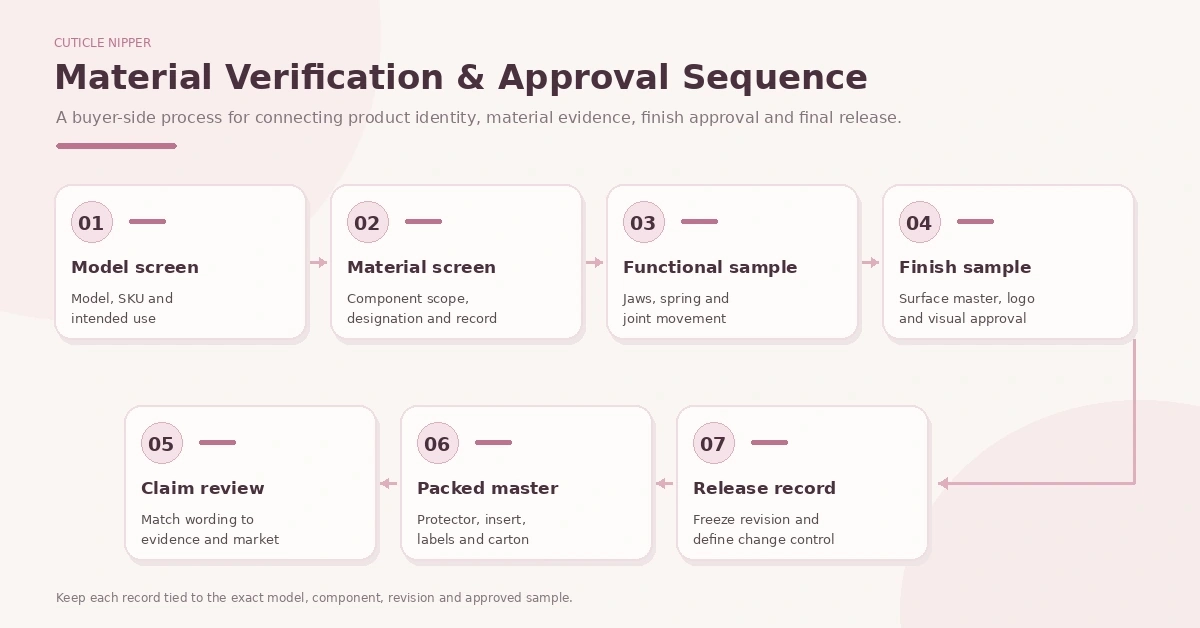
Approve evidence in stages so that a visual decision is not mistaken for a material decision. A practical sequence is:
- Model screen: identify the product reference and intended use.
- Material screen: request component-level designation and the available record.
- Functional sample: review jaw meeting, edge condition, spring response and joint movement separately from finish.
- Finish sample: approve the actual polished, satin or coated version, including logo compatibility.
- Claim review: match package, listing and distributor wording to evidence and market requirements.
- Packed master: review protector, pouch, insert, labels and carton assumptions with the approved tool inside.
- Release record: freeze the revision and state which material, finish or process changes require reapproval.
This sequence prevents a common commercial mistake: approving a bright sample, printing “stainless steel professional nipper” on the box, and only later discovering that the supplier's material statement covered a different component or an older version. It also gives a supplier a precise path for answering open questions rather than forcing every detail into the first quotation.
What should a buyer send in a material-verification inquiry?
A material-focused inquiry should be short but technically specific. Include the selected product link or reference, target market, intended channel, approximate quantity, finish direction, branding and package requirement. Then ask the supplier to complete the evidence fields below.
| Inquiry field | Buyer wording | Supplier response status |
|---|---|---|
| Material by component | Please identify the material designation for the jaws/body and any different material used for spring, pivot or protector. | Confirmed / proposed / not yet confirmed. |
| Supporting record | Please state which current record supports the material description and which SKU, lot or revision it covers. | File available / summary only / to be requested. |
| Surface finish | Please describe the proposed finish and provide a sample in the intended customer-facing version. | Sample reference and visual limits. |
| Corrosion or cleaning claim | Please identify whether the proposed claim has model-specific evidence and under which conditions. | Evidence available / claim needs review / no claim proposed. |
| Change control | Please identify which material, finish or component substitutions require a new sample or document review. | Supplier process and buyer approval point. |
For a broader project, the procurement toolkit can help organize the material brief, sample questions and packaging information before the quotation is requested. The goal is not to demand a document that is irrelevant to the product; it is to make the supplier's answer traceable enough for the brand's decision.
Sources and scope notes for material verification
The material-family statements above come from public technical references, not from a claim about a specific OLIMOR SKU. World Stainless explains that stainless-steel families differ in composition, mechanical properties, fabrication behaviour and corrosion resistance. ASTM F899-23 addresses chemical requirements for wrought stainless steels used in surgical instruments and distinguishes reference data from requirements that must be agreed with the purchaser and supplier. These sources help clarify the questions to ask; they do not replace a current material record, sample review or destination-market assessment for a beauty tool.
Keep three kinds of information separate when approving the product: facts published for the applicable OLIMOR product or service page; checks a buyer chooses to request; and material, finish, test, packaging or claim details that must be confirmed for the selected model and order.
World Stainless: categories, grades and product forms and ASTM F899-23: wrought stainless steels for surgical instruments are reference points for terminology and scope. They should not be presented as evidence that a selected cuticle nipper meets a particular grade, hardness or medical-use requirement.
Cuticle nipper material specification FAQ
Is “stainless steel” a complete cuticle nipper material specification?
No. It is a broad material description. Identify the exact model and component, request the material designation and supporting record, and keep the finish and approved claim in separate fields.
Can a product photo prove the steel grade?
No. A photo can help identify the model and visible finish, but it cannot establish alloy chemistry, heat treatment, hardness, corrosion performance or compliance.
Should jaws, body, spring and pivot have separate material statements?
They should be identified separately when their materials or processing may differ, or when a claim concerns the complete product. At minimum, ask the supplier to state which components the main material description covers.
What are the main cuticle nipper material options?
A buyer may encounter broad stainless-steel descriptions, specific alloy designations, coated or coloured surfaces, and different component materials. The suitable option depends on the working requirement, finish, cleaning environment, market claim and project evidence. Do not select a grade from appearance alone.
Does a polished finish prove corrosion resistance?
No. Polish is a surface appearance and process result. Corrosion behaviour also depends on material, surface condition, residues, exposure, chemicals, cleaning, drying and storage. A corrosion claim requires a relevant method and evidence for the final configuration.
What should cuticle nipper material compliance documents include?
The appropriate document depends on the market and claim. Ask for the material designation, document identity, model or component scope, lot or revision where applicable, and any test method and acceptance criteria relevant to the claim. A company-level certificate alone may not prove the product statement.
Should I request a salt-spray report?
Only when corrosion exposure is relevant to the intended use or claim. Agree on the method, duration, sample condition, finish, pass criteria and exact product before interpreting a result. Do not cite a test name without a result and scope.
How should a buyer approve a cuticle nipper surface finish?
Use a physical sample in the intended finish, under a consistent lighting reference. Check the jaws, joint, handle, logo area, underside and protector contact points. Keep the sample number, photographs and visual limits with the material record.
Can a branded package say “medical grade” or “rust-proof”?
Not without product-specific evidence and qualified review for the destination market. Branding does not upgrade an unverified material statement. Match package copy, product listings and distributor data to the approved evidence.
What information should I send to OLIMOR for a material review?
Send the selected product link or reference, target market, intended channel, quantity, material wording under consideration, finish direction, logo and packaging needs, plus any required document or claim. The exact material, finish, testing, MOQ, packaging and delivery details should then be confirmed for the selected project.
Conclusion
A reliable cuticle nipper material specification is more than the phrase “stainless steel.” It identifies the product and each relevant component, separates material designation from surface finish, connects claims to current evidence, and preserves the approved sample and package as one controlled reference. That process helps buyers avoid unsupported statements about grade, corrosion, cleaning or professional use.
For a branded nail-care range, request the material record, compare the actual finish, define the claim wording and ask which changes require a new sample or document review. OLIMOR's materials and finishes, sampling, quality, packaging and product-development routes can support that discussion. Exact material designations, documents, tests, MOQ, lead time and final packaging remain subject to confirmation for the selected cuticle nipper and order.