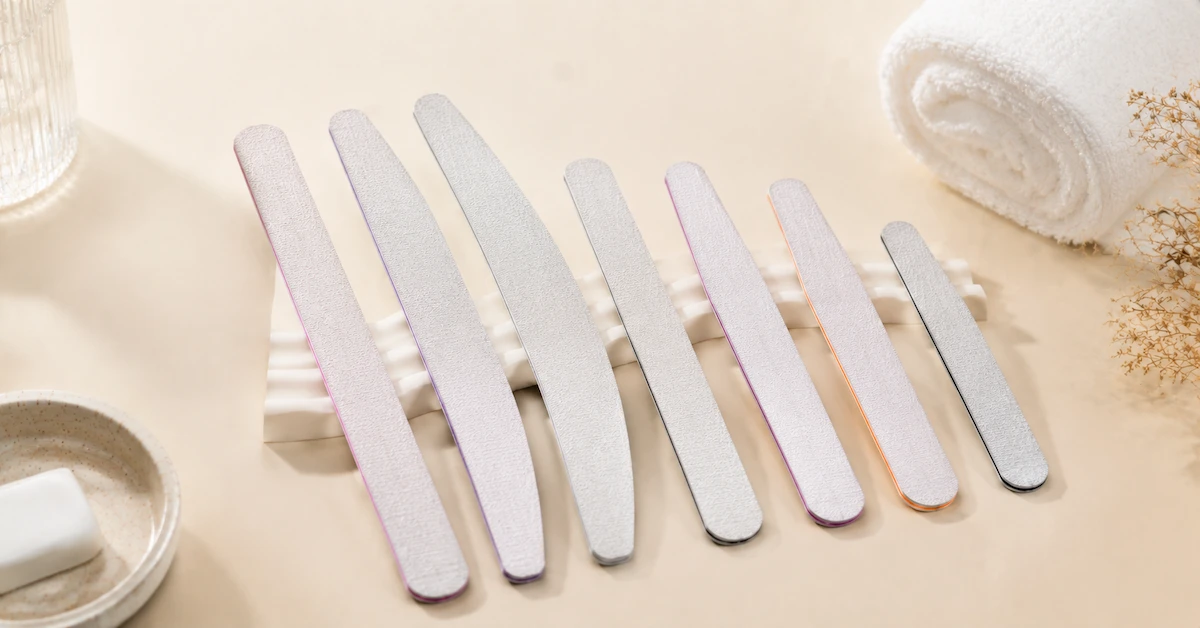
Nail file wholesale buying looks simple until the first shipment reaches a salon, retail shelf or amenity packing line. A file is a small, low-cost grooming tool, but at volume the details matter: abrasive feel, core stiffness, cut accuracy, edge finish, packing method and consistency from piece to piece. The right purchase is not only the lowest quoted unit cost. It is the file that performs acceptably for the intended user, arrives in usable condition and fits your sales or kit assembly process.
This guide is for beauty distributors, salon suppliers, hospitality amenity buyers, private-label sellers and sourcing teams comparing bulk nail files. It explains what you are usually buying, how to compare options, what to inspect in samples and what to ask a supplier before placing a larger order.
What a Wholesale Nail File Order Usually Includes
Most wholesale nail files in this category are slim emery-board-style grooming tools used for shaping, shortening and smoothing nails. The common visual format is a long, narrow rounded rectangle with tapered ends and a flat profile. The abrasive surface is typically applied to a thin core, and the edges may be finished or color-trimmed to improve appearance and handling.
Construction can vary, so buyers should not assume that two similar-looking files are the same. The substrate may feel more flexible or more rigid. The abrasive coating may feel smoother or more aggressive. The edge finish may look clean on one batch and rough on another. These details influence how the product feels in use and how presentable it appears in a retail pack or amenity kit.
Wholesale nail files are commonly purchased for several B2B channels:
- Salon back bars and technician kits: everyday shaping and finishing tools where handling consistency matters.
- Beauty retail and resale: packaged files or multi-piece sets where shelf appearance is important.
- Hospitality amenities: compact grooming items for hotel, travel or guest kits.
- Promotional grooming sets: lightweight add-ons for branded or seasonal kits.
- Home manicure and pedicure bundles: practical accessories paired with other nail care tools.
A file that works well as a simple hotel amenity may not be the best choice for a busy salon. Start with the use case, then compare specifications, packaging and supplier support.
How Wholesale Nail Files Are Typically Made
The general manufacturing route is straightforward: an abrasive layer is bonded, laminated or coated onto a shaped substrate, then cut or die-cut into the final outline. Edge finishing, color trim or surface printing may be added depending on the design and packaging plan.
Even simple production steps can create quality differences. If abrasive application is uneven, the file may feel inconsistent across the surface. If bonding is weak, the abrasive layer can lift during use, packing or transit. If cutting is not controlled, files in the same pack may vary in shape or have rough edges. If packing is too loose, abrasive faces can scuff against each other before the product reaches the buyer.
For sourcing teams, the important point is not to overcomplicate the product. Instead, inspect the basics carefully. A nail file should look uniform, feel stable in the hand and match the intended use. When ordering for private label or retail, it should also present well in packaging and remain neat after normal handling.
Comparison Table: What Buyers Should Evaluate
The table below summarizes the main factors that separate workable bulk nail files from disappointing ones.
| Evaluation point | Why it matters | What to check in samples |
|---|---|---|
| Abrasive surface feel | Controls how the file shapes and smooths nails. | Test whether it removes material steadily without feeling too harsh or too weak for the target user. |
| Core stiffness | Affects control, comfort and perceived quality. | Bend the file lightly and compare whether it feels stable enough for salon, retail or amenity use. |
| Edge finish | Influences appearance and handling. | Look for clean trimming, no obvious fraying and no sharp or messy edges. |
| Shape consistency | Important for multi-piece packs and retail presentation. | Compare several pieces side by side for length, width, taper and overall outline. |
| Surface bonding | Weak bonding can lead to peeling or early wear. | Rub and flex samples during practical use to see whether the abrasive layer remains attached. |
| Color and finish consistency | Matters for color-coded sets, retail display and private-label assortments. | Check whether colors and trims look intentional rather than random across multiple pieces. |
| Packaging format | Impacts retail readiness, warehouse handling and kit assembly. | Confirm whether files are loose, bundled, bagged, carded or prepared for custom packing. |
| Transit protection | Small items can still arrive bent, dusty or scuffed. | Ask how inner packing and outer cartons protect shape and abrasive faces. |
Choosing Files by Sales Channel
For salon and technician use
Salon buyers usually need predictable handling more than decorative presentation. A salon file should feel controlled along the nail edge, be comfortable to hold and show reasonable consistency from piece to piece. If technicians need to adjust their pressure constantly because some files feel weak and others feel too aggressive, service quality suffers.
For salon distribution, ask whether the file is intended for general manicure and pedicure use, single-use service settings or light-duty home grooming. Do not rely on appearance alone. Test samples with real handling motions and compare multiple pieces, not just one file from the sample pack.
For retail and private label
Retail buyers need both function and presentation. Clean edges, uniform shapes, neat colors and consistent packing help the product look intentional on a shelf or marketplace listing. If the file is part of a private-label line, discuss print areas, color assignment, pack format and how files will be arranged in the final retail unit.
However, presentation should not hide poor function. A colorful or well-packaged file can still create complaints if it feels flimsy or inconsistent. Evaluate the abrasive face first, then decide how much packaging and customization are worth adding for the sales channel.
For hospitality and amenity kits
Hospitality buyers often prioritize compact size, clean appearance, light weight and simple packing. Nail files used in hotel or travel amenities do not need to be overbuilt, but they should look tidy when opened by the guest. Files stored for extended periods should not appear dusty, warped or poorly cut.
If files will be inserted into small kits with other grooming items, ask how they are packed for assembly. A format that works for bulk warehouse storage may slow down a kit-packing line if pieces are difficult to separate or arrive mixed with dust from the abrasive surface.
Cost Factors Beyond the Unit Price
The quoted unit price is only one part of a wholesale nail file decision. Small differences in finishing, packing and consistency can affect the real landed value of the order. A lower-cost file may be acceptable for a simple amenity project, while a higher-finish option may make sense for retail or private-label presentation.
Common cost drivers include:
- Construction and substrate: different cores can affect stiffness, hand feel and perceived durability.
- Abrasive surface quality: a more consistent surface may cost more but reduce complaints.
- Edge finishing and color trim: useful for presentation, sorting or set differentiation.
- Packaging choice: loose bulk, bundled packs, retail-ready formats and custom packaging all change handling cost.
- Customization: colors, printing, pack design and assortment planning may add setup or coordination requirements.
- Inspection expectations: clearer quality requirements can reduce risk, but they should be discussed before production.
- Shipping protection: inner packing and carton design affect whether the files arrive clean and usable.
When comparing suppliers, ask for a breakdown of what the quotation includes. If one price includes retail packing and another is for loose bulk only, the comparison is not equal.
Sample Inspection Checklist Before a Larger Order
Because nail files are tactile products, samples are essential. Photos can show shape and color, but they cannot show feel, stiffness or surface consistency. Use this checklist before committing to a larger purchase.
- Confirm the intended use: salon, retail, hospitality, promotional kit or home grooming bundle.
- Check several pieces, not only one, for shape, size and edge consistency.
- Run a fingertip lightly along the edges to identify rough, uneven or frayed finishing.
- Compare abrasive feel across the full surface of each file.
- Flex the file gently to judge whether the core feels too weak for the target channel.
- Use the file in a realistic way to see whether the abrasive layer lifts, sheds visibly or wears unevenly.
- Inspect color trim and surface appearance under normal room lighting.
- Review how the sample is packed and whether that method protects files from scuffing.
- Ask whether production samples, approved samples and mass production will follow the same construction and packing approach.
- Document any approved details in writing before confirming an order.
For consumer goods, buyers may also need to consider applicable product safety and labeling rules in the destination market. Public bodies such as the U.S. Consumer Product Safety Commission and the European Commission provide guidance for consumer product requirements. Always verify current versions of regulations and review supplier documents for the actual product and market. Do not assume compliance based only on a product photo or general category description.
Common Problems and How to Prevent Them
Problem: Files look different within the same pack
This usually points to weak process control, mixed lots or unclear cosmetic requirements. Prevent it by approving a reference sample and specifying which differences are acceptable, such as intentional color variation, and which are not, such as uneven cutting or random size changes.
Problem: The abrasive surface feels too harsh or too weak
This is often a mismatch between product and end use. A file for a basic amenity kit may not satisfy salon technicians, while a more aggressive feel may not suit a general retail audience. Test with the actual user group when possible.
Problem: Files arrive bent, scuffed or dusty
Packing may be unsuitable for the order size or shipping route. Discuss inner packing, carton strength and how abrasive faces are protected. A very low quote can become expensive if usable yield drops after transit.
Problem: Packaging does not fit the sales channel
Loose bulk may be efficient for kit assembly but unsuitable for retail resale without additional packing. Retail-ready formats may be attractive but unnecessary for salon back-bar use. Decide the downstream process before confirming the packing style.
Supplier Evaluation Questions for B2B Buyers
A reliable supplier should be able to discuss practical production and packing details, not only quote a unit price. Before placing a larger nail file wholesale order, ask targeted questions:
- What end use is this nail file best suited for?
- Can you provide samples that represent regular production?
- What parts of the file can be customized, such as color, surface print or packaging?
- How are files packed to protect the abrasive surface and shape during shipment?
- What quality checks are used for appearance, cutting, bonding and packing consistency?
- Can the same product be supplied consistently for repeat orders?
- What documents or product information can be provided for the destination market?
If you are building a broader grooming assortment, it may be more efficient to review related tools at the same time. You can browse Olimor beauty tool options through the product catalog or review broader categories in the current collection. Keeping files, nail tools and other small grooming accessories within one sourcing plan can simplify packaging decisions and supplier communication.
Where Nail Files Fit in a Wider Assortment
Nail files are often small add-ons, but they can influence the value of a kit or retail set. A manicure bundle feels incomplete without a shaping tool. A hotel grooming kit feels more useful when it includes a neat, lightweight file. A private-label nail care line can use color-coded or coordinated files to support a consistent visual identity.
Because files are low-cost and easy to bundle, buyers sometimes underestimate them. Yet they pass through many handling points: production, inspection, packing, export, warehousing, resale, kit assembly and final use. Weakness at any stage can lead to waste or complaints. Treating nail files as a managed component rather than a throwaway accessory helps protect both margin and customer experience.
A Sensible Next Step
The best wholesale nail file choice starts with the end use. Decide whether your priority is salon utility, retail presentation, hospitality simplicity or flexible kit assembly. Then compare samples for abrasive feel, core stiffness, edge finish, consistency and packing protection. Only after those points are clear should price become the deciding factor.
For B2B sourcing support, you can send an inquiry with your target channel, packaging needs and customization questions. If you need help narrowing options for a specific project, contact the Olimor team through contact us for practical product discussion.
FAQ
Can I request samples before ordering wholesale nail files?
Yes. Samples are strongly recommended because nail file performance depends on touch, stiffness and surface feel. Ask whether the sample represents normal production and confirm which details will match the final order.
Is there a minimum order quantity for customized nail files?
Minimum order requirements can depend on the file style, packaging format and customization method. Confirm the current MOQ with the supplier before finalizing artwork, colors or pack design.
What customization options are usually discussed?
Buyers commonly discuss color selection, edge trim, surface printing, assortment planning and packaging format. Availability depends on the chosen product and production arrangement, so request confirmation before quoting to your own customer.
How should I judge quality before approving a bulk order?
Inspect multiple samples for abrasive consistency, edge finish, shape accuracy, bonding and packing protection. Record approved details in writing and ask what inspection steps will be used during production and packing.
How long will production and delivery take?
Lead time depends on order quantity, customization, packaging and shipping arrangement. Ask for the current schedule during quotation and confirm it again after sample approval and order details are fixed.