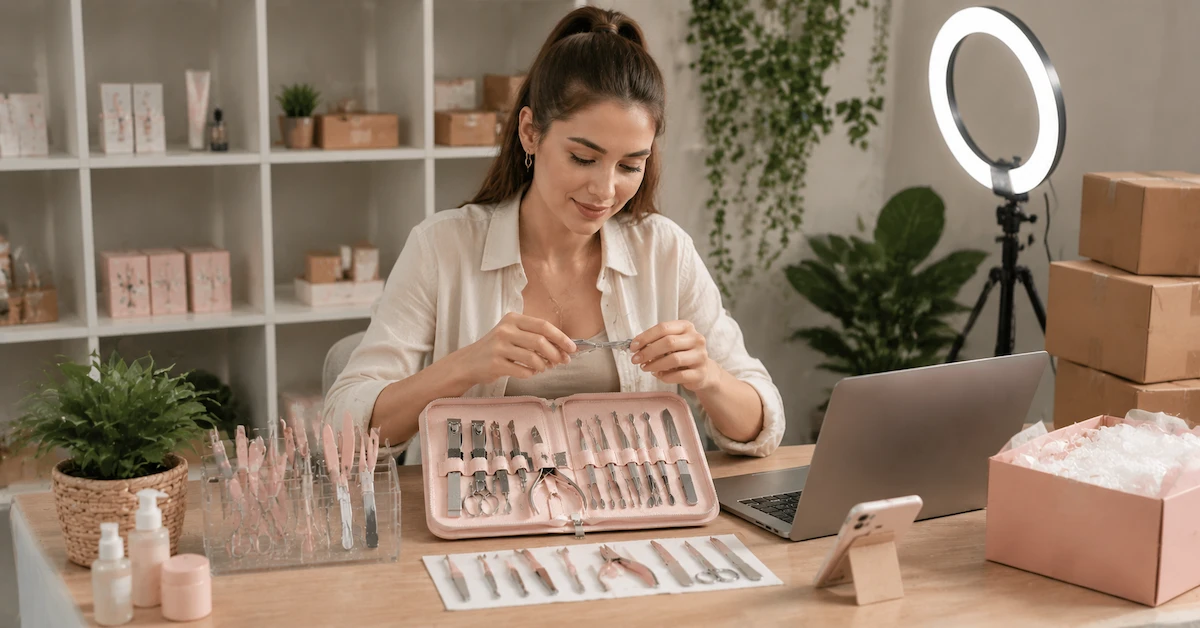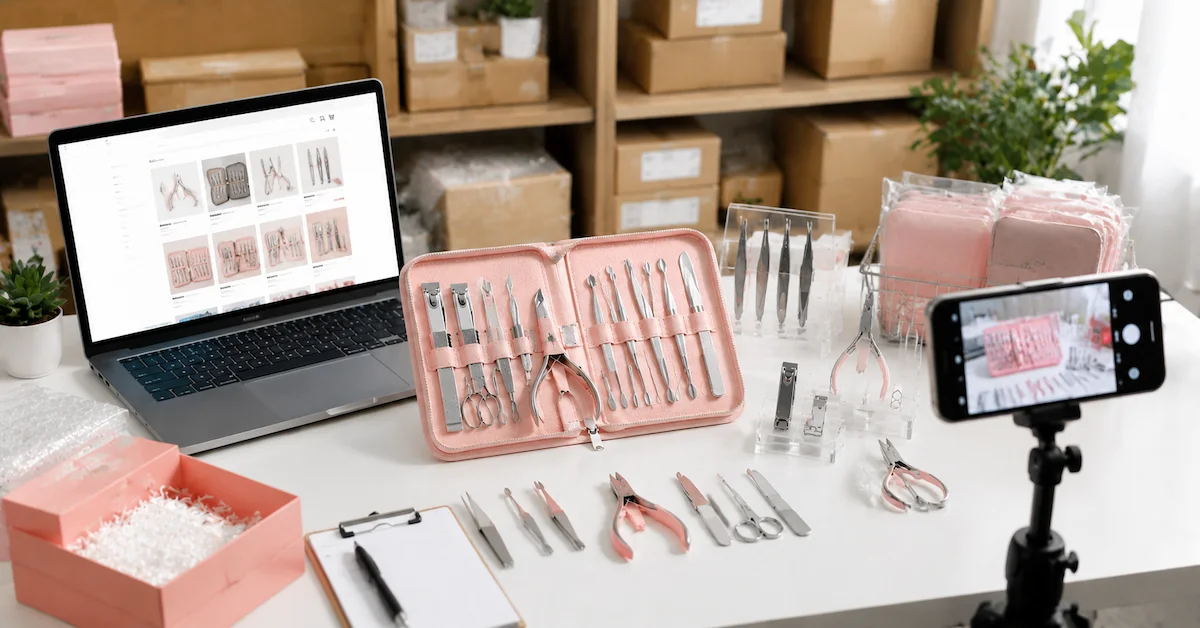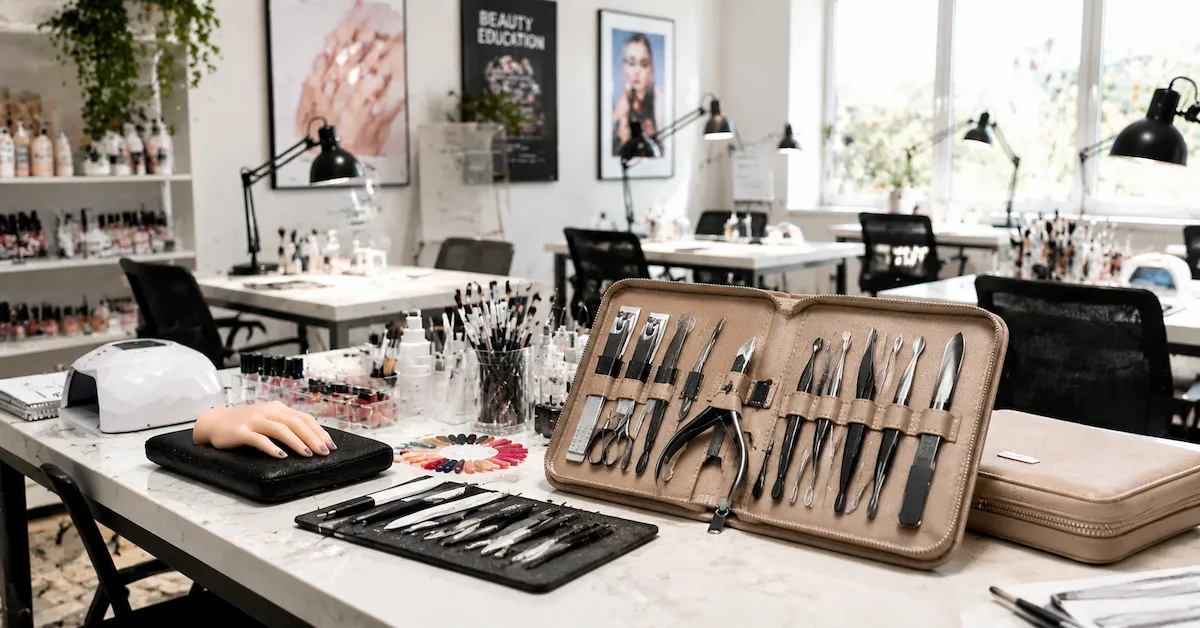











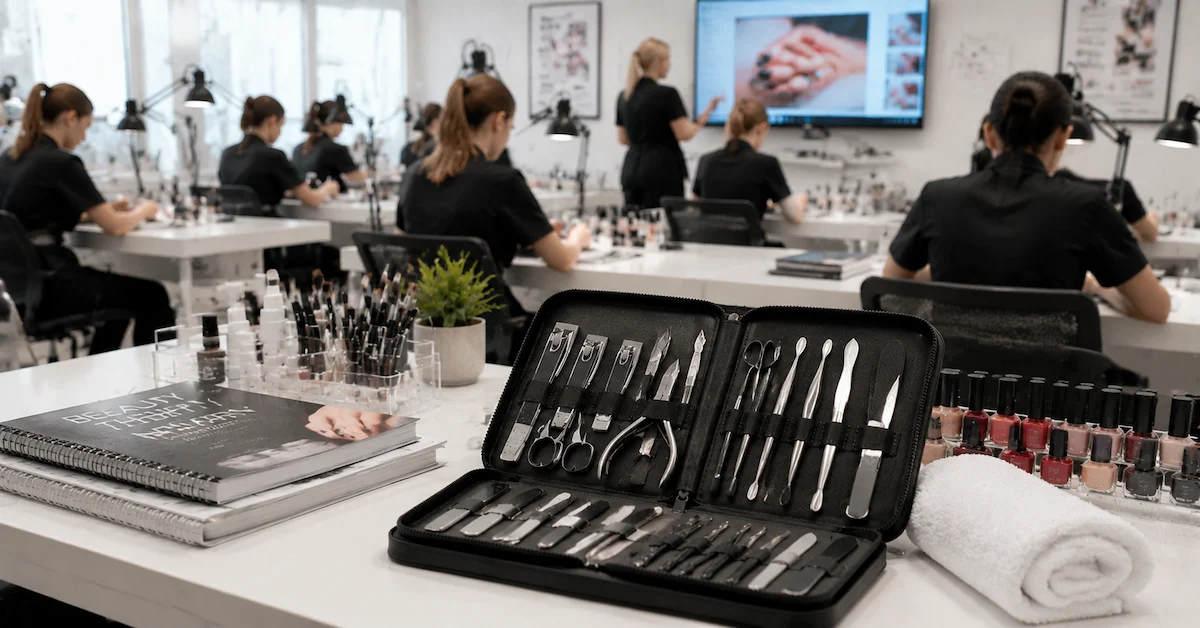
Beauty school buyers often search for hairdressing school tools, makeup school tools or nail technician tools when they are really trying to solve one purchasing problem: how to give students a practical kit that supports hands-on learning without wasting budget on unsuitable equipment. For nail-care training, the most useful answer is a compact manicure and pedicure tool kit with enough implements for basic prep, trimming, shaping, detail work and organized storage.
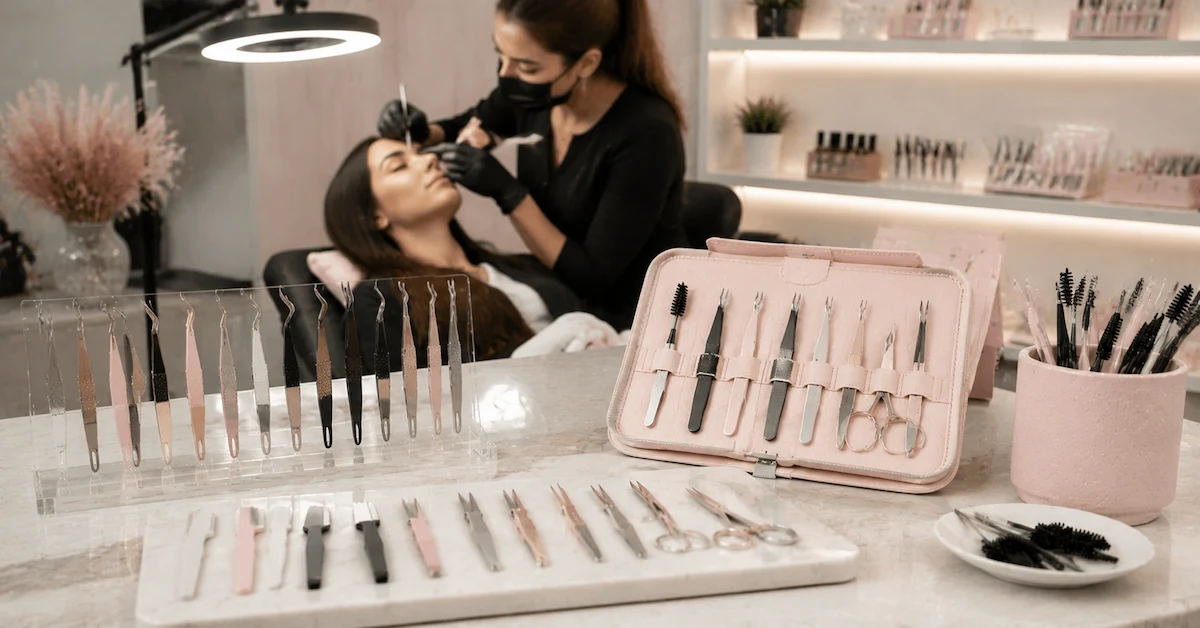
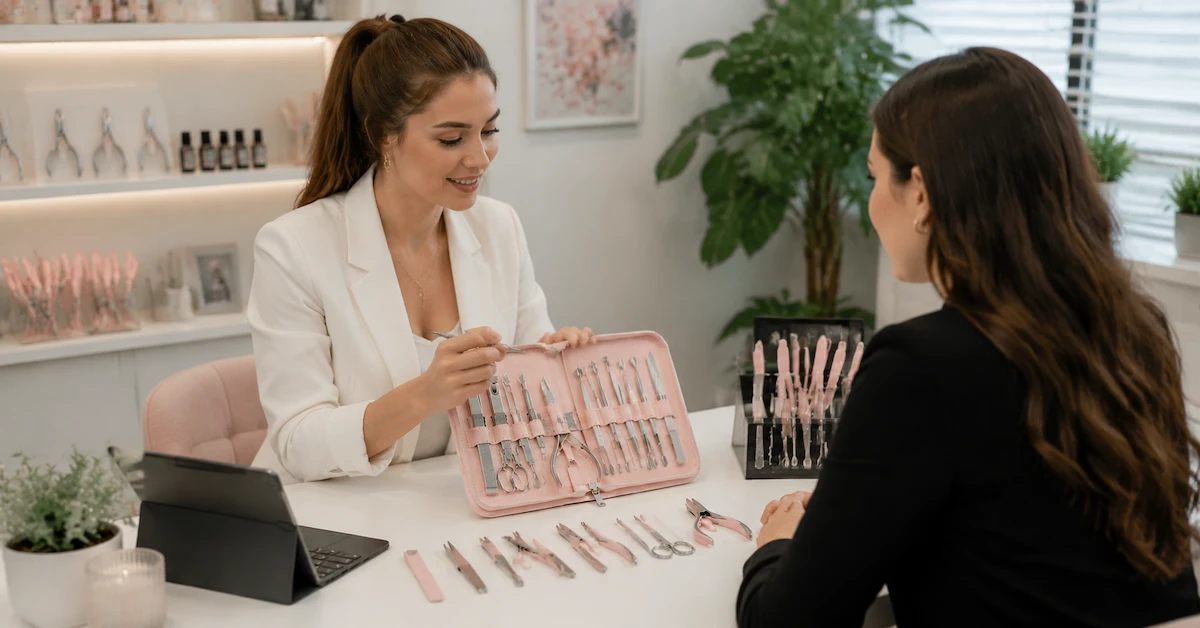
The product format discussed here is a portable manicure and pedicure set in a black case, with multiple polished metal hand tools arranged in fitted slots. The visible tools include nail clippers, cuticle nippers, scissors, tweezers, pusher or spatula-style implements and several small files or detail picks. This is not a complete salon system, and it should not be treated as a replacement for curriculum planning, sanitation supplies or professional workstations. Its value is more specific: it gives students a manageable set of hand tools for repeated practice and gives schools a kit format that is easy to store, inspect and assign.
Who This Type of Training Kit Is For
A manicure and pedicure training kit is most relevant to cosmetology schools, nail technician programs, starter salons, mobile service providers, distributors and private-label beauty tool buyers. It can also be relevant when a school is comparing broader beauty training categories, because many programs teach more than one discipline. Hairdressing students need combs, clips, sectioning tools and cutting practice equipment; makeup students need brushes and application tools; nail students need small precision implements that support careful hand control.
The key is to buy by task, not by department label. A nail kit is useful when students need to practice nail length reduction, edge refinement, cuticle area preparation, small-area cleaning and tool handling discipline. It is less useful if the class mainly needs hair sectioning or makeup application tools. For a mixed cosmetology program, a nail kit may sit beside hairdressing and makeup kits as one part of a broader student supply package.
For B2B buyers, this distinction matters because catalog titles can be broad. A listing may mention beauty school tools, professional grooming tools or student salon kits, but the purchasing decision should be based on what the kit helps the learner do. If the program includes manicure and pedicure fundamentals, a compact multi-tool nail kit can be a practical starting point.
What a Practical Manicure and Pedicure Training Kit Should Cover
A useful student kit does not need to be complicated, but it should cover the main stages of a basic nail-care workflow. The visible set suggests a balanced training format because it combines cutting tools, gripping tools and detail implements in one case. That variety allows a learner to move through a service sequence instead of practicing isolated actions with a single tool.
- Length reduction: Nail clippers help students practice controlled trimming and understand how much length to remove before shaping.
- Cuticle-area work: Cuticle nippers and pusher-style tools support careful practice around the nail edge, where pressure control is important.
- Detail handling: Tweezers, small files or picks help students learn fine motor control and tool positioning.
- Scissor use: Small scissors provide another cutting format for instructors who teach different hand positions or grooming tasks.
- Storage discipline: A fitted case helps students return each item to the correct place and helps instructors spot missing tools quickly.
Tool count alone should not drive the decision. A large kit can look impressive but still fail if the tools are repetitive, awkward to handle or not aligned with the training plan. A smaller, better-organized kit can be more useful if every item has a clear purpose in the curriculum. Before buying, schools should map the tool list against lesson plans and ask instructors which implements students will actually use during early practice.
How to Evaluate Materials and Construction Without Overassuming
The tools in this type of kit appear to be mainly polished metal, with some black accents or handles, stored in a black synthetic case. Metal is common for nail and grooming implements because it can provide rigidity, edge definition and long service life when properly made and maintained. A synthetic zippered or clamshell-style case is also common because it keeps the set portable and separates individual tools.
However, buyers should not assume technical details from appearance alone. A product image does not confirm steel grade, heat treatment, edge retention, spring quality, corrosion resistance, sterilization compatibility or long-term durability. These are supplier-confirmed details, not visual guarantees. If the kit will be used in a school lab, shared training room or starter salon, the purchasing team should request the exact tool list, material description, cleaning guidance and packaging details before placing a bulk order.
The likely manufacturing route for this product category is straightforward: metal hand tools are formed by stamping or forging, shaped and ground at the working edges, polished or finished, checked for basic fit and assembled into a sewn or molded case. For a B2B buyer, the important question is not only how the tools look when new, but how consistently they are produced across a shipment. Inconsistent spring tension, uneven edges or loose case slots can create classroom problems even when the product photographs well.
Schools should also separate tool quality from sanitation compliance. A tool may be well made but still require specific cleaning, disinfection and storage procedures. In the United States, many schools and salons refer to state cosmetology board rules and EPA-registered disinfectant label instructions for applicable disinfection practices. Requirements vary by location and can change, so buyers should verify current local regulations, disinfectant labels and supplier documents before approving tools for classroom or service use.
Training Kit, Salon Kit or Retail Gift Set: Key Differences
One reason buyers make poor choices is that many compact manicure sets look similar online. A student training kit, salon backup kit and retail gift set may share a case format, but they are judged by different standards. A beauty school needs tools that are easy to count, consistent enough for repeated instruction and simple to replace. A salon may prioritize service workflow and sanitation procedures. A retail gift buyer may focus more on presentation and perceived completeness.
| Kit type | Primary purpose | What to check before buying |
|---|---|---|
| Beauty school training kit | Student practice, classroom assignments and tool-handling habits | Curriculum fit, item list, case organization, replacement support and cleaning guidance |
| Starter salon or mobile kit | Portable backup tools, demos or basic service support | Tool comfort, durability, sanitation workflow and compatibility with service procedures |
| Retail or promotional kit | Consumer grooming, gifting or display | Packaging, appearance, safe instructions and expected home-use positioning |
This comparison helps schools avoid paying for features that do not support learning. For example, a decorative case may improve retail appeal but do little for classroom efficiency. Conversely, a plain but well-organized case can be a better school purchase if each implement stays visible, secured and easy to inspect.
Selection Criteria for Schools, Distributors and Sourcing Teams
The most reliable way to evaluate a manicure and pedicure training kit is to start with the daily workflow. Ask what students need to practice, how often tools will be handled, who checks completeness and how replacements are managed. A good purchasing process should combine instructor feedback with supplier documentation.
Use this checklist before approving a kit for school or distributor use:
- Confirm the exact contents. Do not rely only on a photo. Ask for a named tool list and confirm whether the visible items match the shipped set.
- Check curriculum coverage. Match clippers, nippers, pushers, files, scissors and tweezers to the lessons students will practice.
- Inspect edge and hinge consistency. Cutting tools should open and close smoothly, and working edges should be even enough for controlled training use.
- Review the case construction. Slots should hold tools securely, and the zipper or closure should tolerate repeated student handling.
- Ask about cleaning guidance. Confirm what the supplier recommends and compare it with your school, salon or local regulatory requirements.
- Plan for loss and replacement. Small implements can disappear in shared classrooms, so replenishment support is a real cost factor.
- Request samples when possible. A sample lets instructors evaluate grip, balance, case layout and actual tool usefulness before larger purchasing decisions.
For buyers comparing products across a range, Olimor’s broader beauty-tool categories can be reviewed through the product selection or the beauty tools collection. Use those pages as a starting point for category comparison, then verify the details of the specific kit under consideration.
Cost Factors That Matter More Than the Lowest Unit Price
In school procurement, the cheapest kit is not always the lowest-cost kit. The real cost includes replacement frequency, instructor time, missed tools, student frustration and whether the kit fits the course without extra purchases. A low-priced set that lacks key implements may require supplemental buying. A kit with weak storage may create ongoing inventory problems. A set with inconsistent cutting tools may slow instruction because students struggle with tool behavior instead of learning technique.
Several factors can influence cost without requiring any invented price claims. Tool count, metal finishing, case material, packaging style, branding requirements, order quantity, inspection level and customization all affect quotation discussions. If a buyer requests private-label packaging, a different case color or a modified tool assortment, the supplier may need to confirm feasibility, production requirements and commercial terms.
Distributors should also consider market positioning. A school-focused kit should be described in practical terms: organized, portable and suitable for training workflows when used according to applicable guidance. Avoid overstating professional performance unless the supplier provides documents to support those claims. Clear positioning reduces returns and helps sales teams answer B2B questions accurately.
Common Problems and How to Prevent Them
Problem one: the kit looks complete but does not match the lesson plan. Prevent this by having instructors review the tool list before purchasing. A tool that looks useful in a catalog may not be used in a beginner module.
Problem two: tools go missing after class. A fitted case helps because empty slots are visible. Schools can also assign each kit to a student, workstation or storage bin and build tool checks into closing procedures.
Problem three: buyers assume all metal tools are the same. They are not. Edge shape, spring resistance, alignment, grip comfort and finish can change the learning experience. Sampling and inspection are especially important for shared educational settings.
Problem four: sanitation planning is left until after delivery. Tool selection and hygiene procedures should be discussed together. Confirm cleaning and disinfection expectations before use, and verify current rules from relevant local authorities or cosmetology boards.
Problem five: the case is treated as decoration. In a school environment, the case is part of the operating system. It protects edges, keeps items separated, supports inventory checks and teaches students to work in an orderly way.
Supplier Evaluation Questions for Bulk or Custom Orders
When sourcing manicure and pedicure training kits, a professional supplier conversation should be specific. Instead of asking only for the lowest price, ask how the kit is assembled, what can be confirmed in writing and what support is available after the first order. This is especially important for schools, distributors and retailers that need consistency across multiple batches.
- Can the supplier provide a complete tool list for the kit being quoted?
- Are sample kits available for instructor or buyer evaluation?
- What packaging, case or branding customization options can be discussed?
- What quality checks are performed before shipment, especially for cutting edges, hinges, tool placement and case closure?
- Can replacement pieces or repeat orders be supported if the school needs the same kit format later?
- What documents or guidance does the supplier provide regarding product materials, cleaning recommendations and intended use?
For a project-specific discussion, buyers can use the inquiry form to share kit requirements, intended use and customization questions. If the purchase involves a school rollout, distributor program or branded kit concept, contacting Olimor through the contact page can help align the tool assortment with the buying objective.
FAQ: Beauty School Nail Tool Kit Buying
Can schools request samples before choosing a manicure and pedicure kit?
Sample availability depends on the supplier’s current process and the specific product. Schools and distributors should ask for a sample when instructor evaluation is important, especially for checking grip comfort, case layout, edge feel and actual tool assortment.
Is there a fixed MOQ for customized beauty school tool kits?
MOQ depends on the customization request, packaging, tool assortment and production arrangement. Buyers should confirm the current requirement directly with the supplier rather than assuming a standard quantity.
Can the kit be customized for a school or private-label program?
Customization may be possible for elements such as tool assortment, case style, packaging or branding, depending on feasibility. The buyer should provide clear requirements and request confirmation before planning a launch or course rollout.
How should buyers check quality before a bulk order?
Start with a sample and a written tool list. Inspect edge alignment, opening and closing action, surface finish, tool placement in the case, zipper or closure function and packaging consistency. For regulated classroom or salon use, also verify cleaning guidance and current local requirements.
What affects lead time for training kit orders?
Lead time can be affected by product availability, order quantity, customization, packaging requirements and inspection needs. Buyers should confirm timing for the exact order instead of relying on a general estimate.
Final Buying Guidance
A practical beauty school nail tool kit should be selected for learning value, not just appearance. The compact manicure and pedicure format described here is useful because it combines multiple hand tools in an organized portable case. That supports repetition, storage discipline and instructor inspection, all of which matter in training environments.
The smartest purchasing process is simple: define the curriculum task, confirm the exact contents, evaluate a sample, review cleaning and regulatory requirements, then discuss replenishment and customization with the supplier. When buyers follow that sequence, a beauty school tool kit becomes more than a collection of small implements. It becomes a dependable training resource for students learning controlled, hygienic and organized nail-care practice.