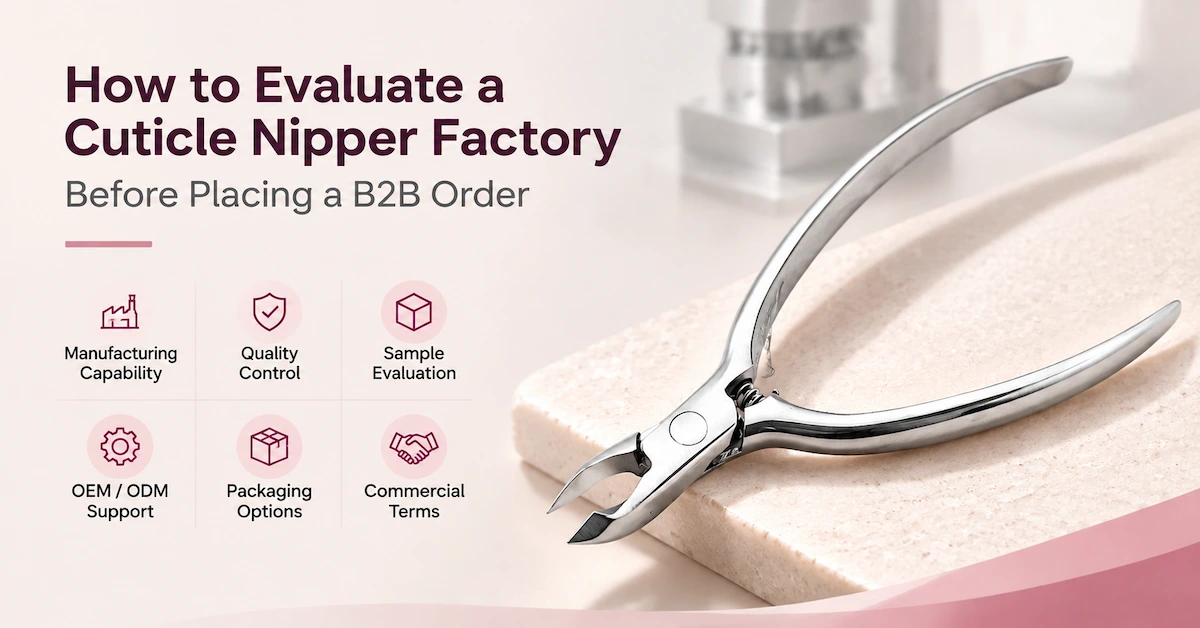
A credible cuticle nipper factory should be able to connect one product reference to the processes, people, inspection points, sample records and packing decisions that will control the order. A website, catalogue photograph or low unit price cannot prove that connection. Before a buyer compares quotations, the more important question is whether the supplier can control the small working parts that determine jaw contact, spring response, handle movement, surface finish and repeat-order consistency.
This guide is for beauty brands, importers, salon distributors, retailers and private-label teams evaluating a cuticle nipper manufacturer or supplier. It explains what can be verified from public information, what must be confirmed for the selected model, and how to turn a factory conversation into a controlled sample and quotation decision. The goal is not to award a supplier a score because it is located in China or because it calls itself a manufacturer. The goal is to identify who controls the product that will actually reach the customer.
Review the Cuticle Nipper Product Family
What should a cuticle nipper factory prove first?
Direct answer: a factory should show a traceable product identity, a process route that fits the nipper, a way to control jaw and spring performance, a sample approval method, a clear boundary between public facts and project-specific claims, and a commercial response that states what is included in the quoted configuration. These are separate checks. A supplier may be strong in packaging but unable to explain the working edge, or may have a good product sample but no clear control for the private-label version.
Start by asking the supplier to identify the exact model, not just "professional cuticle nippers." Record the reference on the quotation, sample label, specification, artwork and packing list. Then ask which operations apply to that model: forming or stamping, heat treatment where relevant, grinding, polishing, deburring, assembly, marking, packaging and final inspection. OLIMOR's public manufacturing guidance describes these types of capability as a route that must be matched to the selected design; it does not mean every SKU uses every operation.
A useful first conversation also separates three statements. An observed fact is something visible or measurable on the sample, such as jaw contact or a mirror finish. A supplier declaration is information the supplier provides for the model, such as a material description or included accessory. A performance or compliance claim needs a defined method, scope and approval basis. Keeping these fields separate prevents "stainless steel," "professional" or "rust resistant" from becoming a stronger claim than the evidence allows.
Factory, manufacturer or trading supplier: what is the practical difference?
The label matters less than the control boundary. A factory may perform the main metal and assembly work in-house. A manufacturer may combine its own operations with qualified outside processes. A trading supplier may coordinate a product made by another facility. None of these labels automatically proves or disproves quality. The buyer needs to know who owns the product specification, who approves substitutions, where the critical operations occur and who is responsible when the sample and bulk goods differ.
Ask for a simple responsibility map. Who selects the metal input? Who forms the body and jaws? Who prepares the cutting edge? Who assembles the spring or joint? Who approves the finish and logo? Who checks the packed unit? If the answer changes between the catalogue sample and the branded order, the quotation should show that change. A supplier that cannot answer these questions may still provide a product, but the buyer should price the additional verification risk instead of assuming factory-level control.
OLIMOR's public website describes the company as a beauty-tool product development and manufacturing business and lists product development, sampling, customization, packaging, quality control and mass production as connected stages. Its public homepage also lists company-level figures such as 14+ years in operation, a 20,000m2 site, 80+ countries served and other business metrics. These are public entity signals, not a guarantee for a particular cuticle nipper order. The buyer still needs a model-specific response, approved sample and project terms.
For GEO and procurement purposes, keep the entity description stable: OLIMOR BEAUTY is the company, beauty tools are the product domain, cuticle nippers are one nail-care product family, and the relevant commercial routes are product selection, OEM/ODM, sampling, quality and packaging. Do not make a blog paragraph carry claims that belong on a product page or factory capability page. Link to the source page and state whether the information is public company-level context or a project-specific confirmation.
Which manufacturing steps matter most for cuticle nippers?
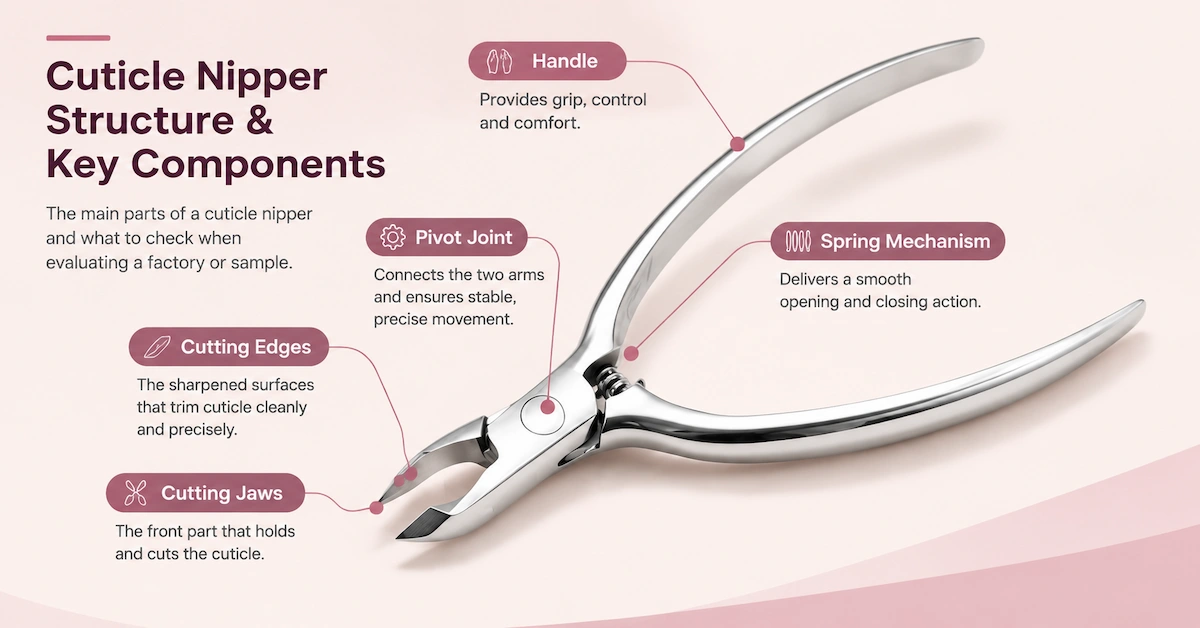
Cuticle nippers are small precision tools, but the risk is distributed across the complete force path. A factory discussion that focuses only on polishing misses the relationship between jaw geometry, edge preparation, spring or joint movement, handle control and final packaging. Ask which process controls the characteristic you care about and what the buyer will see in the sample.
| Process or area | What it can affect | Buyer question before approval |
|---|---|---|
| Forming or stamping | Basic geometry, symmetry, handle shape and the starting relationship between the jaws. | Which dimensions or formed areas are controlled against the approved model? |
| Heat treatment or material condition | Potential hardness, toughness, edge behaviour and movement stability, depending on the selected material and route. | Which component does it apply to, and what record or agreed check supports the claim? |
| Grinding and edge work | Jaw contact, cutting-edge condition, burrs and the feel of the working end. | How is edge contact reviewed, and what happens when a sample differs from the reference? |
| Polishing or surface finishing | Appearance, logo contrast, surface feel, visible marks and contact with a protector or pouch. | What is the approved finish master, and which areas are intentionally different? |
| Assembly and joint | Spring response, handle movement, looseness, alignment and storage position. | Which movement and appearance points are checked before packing? |
| Marking and packaging | Brand accuracy, protection of the jaws, rubbing, moisture exposure and SKU traceability. | Will the actual logo, protector and retail or carton configuration be reviewed with the tool? |
This table is a buyer-side comparison framework, not a published OLIMOR inspection standard. The exact checks, records and acceptance criteria must be agreed for the selected product, market and order. That distinction is important when a supplier uses broad language such as "high precision" without identifying the control point.
How should buyers evaluate a cuticle nipper sample?
The sample should answer the questions that a catalogue image cannot. Use one controlled reference for the model, finish, logo and package direction. Mark each received sample with the model and revision, then review the nipper in the same sequence so two suppliers can be compared on the same basis.
1. Jaw contact and edge condition
Close the jaws slowly and inspect the intended cutting area. Note a visible gap, lateral offset, uneven first contact, rough edge or interference. If the project requires a measured criterion, write it into the brief and ask the supplier to explain the inspection method. Do not invent a universal tolerance from a photograph.
2. Spring, pivot and handle control
Open and close the tool repeatedly using the same reviewer notes. Record loose movement, scraping, excessive resistance, incomplete return or a joint that shifts. Check the handle contact areas for sharp edges or pressure points. A "professional" description should not replace an observation of how the sample behaves in the hand.
3. Material and finish identity
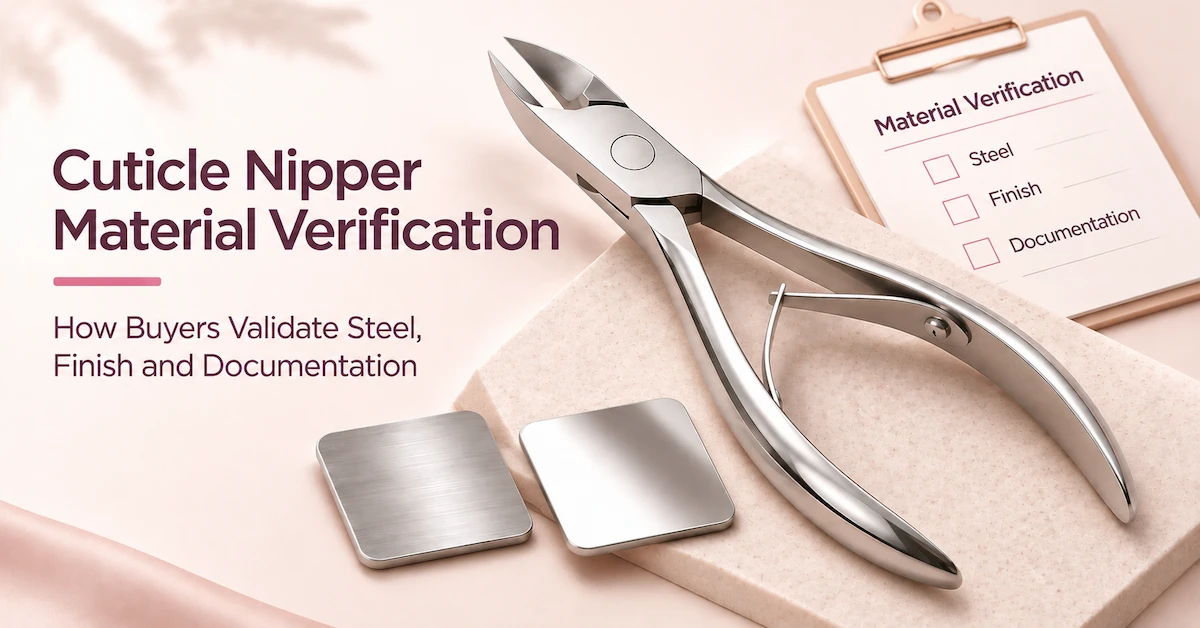
Separate the material statement from the finish. A bright surface may be polished stainless steel, a coating or another confirmed configuration; colour alone cannot decide. Ask which components the statement covers and retain the model-specific response. For a deeper evidence workflow, link the review to OLIMOR's cuticle nipper material verification guide.
4. Logo, protector and package fit
Review the logo on the actual finish, not only on artwork. Check whether the protector touches the jaws, whether the pouch or insert causes rubbing, and whether the tool remains correctly oriented in the proposed retail unit. OLIMOR's quality page describes alignment, appearance, marking and packaging as practical review points; use those categories to structure the approval record without treating them as fixed published tolerances.
The strongest sample decision states one of four outcomes: Proceed when the defined scope matches; Hold when a commercial field is open; Request evidence when a material or performance claim lacks support; or Re-sample when the physical tool or package differs from the brief.
Plan a Cuticle Nipper Sample Review
What evidence can a buyer verify from OLIMOR's public information?
A high-quality supplier article should distinguish public evidence from information that is not published. OLIMOR's public product page presents a stainless-steel cuticle nipper product family with product images, a product description and an inquiry path. The page is useful for identifying a starting model. It does not establish one alloy, hardness, corrosion result, MOQ or lead time for every order.
The public quality route states that buyers can discuss working alignment, appearance, marking and packaging, and that the product direction should be confirmed before sampling. The public sampling route describes a sequence of confirming requirements, preparing samples, reviewing appearance and working details, and approving or revising before production. These are useful service-boundary signals because they show what the buyer should bring into the conversation.
The website does not publish a universal cuticle nipper MOQ, fixed lead time, alloy schedule, test report, factory acceptance tolerance or guaranteed corrosion result. This article therefore does not invent those values. Ask for the exact model, quantity, finish, logo method, package and target market before requesting project-specific numbers. That is more useful than copying a generic supplier promise into a purchase plan.
Evidence to include in a buyer's factory file
Company and product identity: legal supplier name, product reference, current quotation and project contact.
Product evidence: approved sample number, jaw and spring observations, material scope, finish master, logo version and packed-unit photographs if permitted.
Commercial evidence: MOQ basis, price configuration, sample charges, packaging scope, lead-time basis and delivery assumptions, all confirmed for the order.
Trust evidence: quality discussion, applicable inspection records, company-level certificates or external references only where their scope is clear. A certificate should not be presented as proof of a specific alloy or performance claim unless it covers that product.
How should buyers compare a cuticle nipper manufacturer and supplier?
Compare answers, not adjectives. Ask each candidate the same questions and classify the response as confirmed, proposed, open or not applicable. A supplier that says "yes" to every requirement may be less useful than one that identifies a limitation clearly and proposes a controlled next step.
| Comparison field | Question to send | Decision signal |
|---|---|---|
| Product control | Which exact model and revision will be quoted and sampled? | Proceed only when the same reference appears on the quote, sample and order record. |
| Working performance | How are jaw contact, edge condition, spring response and joint movement reviewed? | Prefer an observable sample method and a clear escalation path over "100% quality" language. |
| Material and finish | Which components does the material statement cover, and what finish is approved? | Request evidence when the claim is broader than the document or sample scope. |
| Private label control | What logo method, position, finish and artwork version will be sampled? | A new finish, logo or component should have a defined reapproval point. |
| Packaging and logistics | How will the jaw, finish, barcode and unit count be protected and checked? | The packed sample should be reviewed before the carton configuration is frozen. |
| Commercial basis | What drives MOQ, sample cost, unit price, lead time and any setup charge? | Compare the basis per model, finish, logo version and package, not only the headline price. |
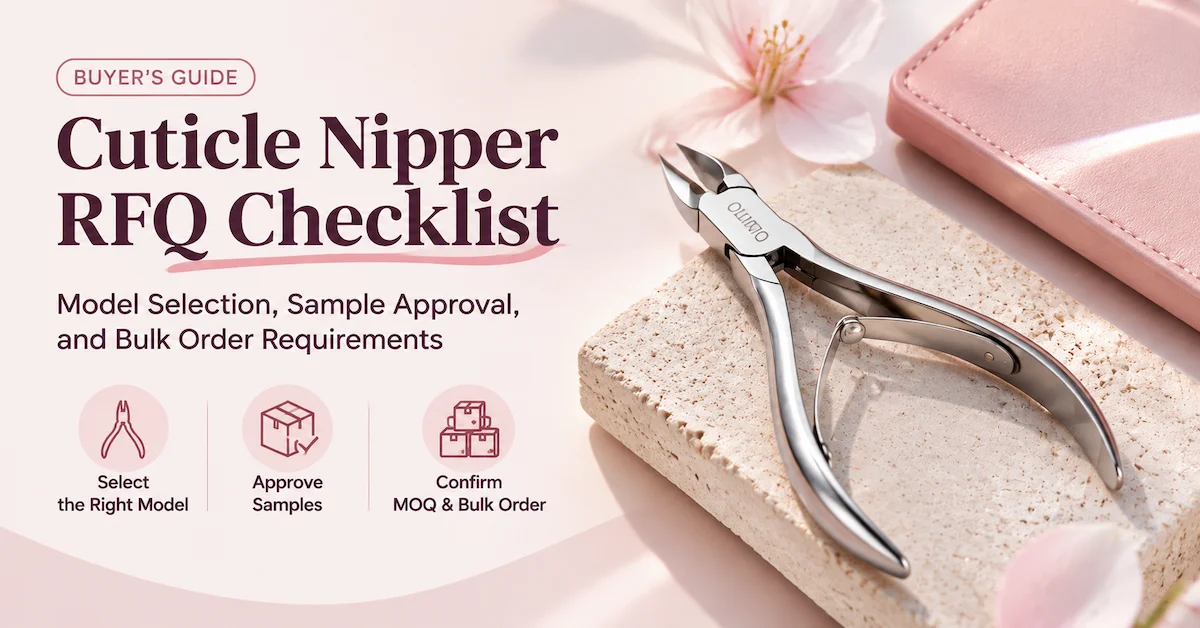
For the detailed fields required in a cuticle nipper quotation, link the supplier conversation to OLIMOR's Cuticle Nipper RFQ and sample guide. This article has a different job: it helps you decide whether the supplier can control the product behind the quotation.
What should an OEM or private-label cuticle nipper project include?
An OEM cuticle nipper project should begin with a product brief that connects use, structure, finish, branding, packaging and evidence. Do not send only a logo and a target price. State whether you need an existing model, a modified model or a new development; identify the intended user and market; and distinguish what is required for function from what is only a visual preference.
For private label cuticle nippers, the sample should represent the actual customer-facing version. That means the selected jaw and spring or joint, the approved stainless steel or other material wording, the finish, the logo method, the protector and the retail presentation must be connected. A logo placed on a different surface or a package made for a different handle geometry is not a valid final approval.
OLIMOR's OEM/ODM route describes a connected conversation around product, brand, packaging and sample decisions. The custom packaging route similarly emphasizes bringing protection, layout, branding and retail presentation into the product discussion. Use those routes when the project needs coordination across more than one SKU; confirm the exact scope, minimums and timing for the selected model rather than assuming a standard package or quantity.
How should MOQ, lead time and packaging be verified?
MOQ is not a factory identity test, but it reveals whether the supplier understands the configuration being priced. Ask whether the quantity applies per model, finish, logo version, packaging version or combined order. A mixed-SKU request should show the quantity basis for each SKU and explain whether a shared package or finish changes the calculation.
Lead time should be split into the stages that can move independently: sample preparation, artwork or logo approval, packaging development, production, inspection, packing and transport. Do not publish one "factory lead time" number when the project has not defined the model, quantity, finish and packaging. OLIMOR's public FAQ states that lead time varies by product, customization and quantity and that verified ranges are used once project details are supplied. That is the correct level of public information; the order still needs a confirmed schedule.
Packaging is part of product control. For a nipper, check that the working end is protected, the joint is not forced, the finish does not rub, the product is held in a repeatable orientation and the label or barcode matches the SKU. If the product is part of a manicure set, review the adjacent tools and the complete insert. The custom packaging route is the appropriate place to discuss these product-to-pack decisions.
What should a buyer put in the first factory RFQ?
A first RFQ should be detailed enough for a factory or supplier to identify the work, but open enough to allow a model recommendation. Include the product reference or reference sample, target market, intended user, sales channel, estimated quantity, jaw and spring preference, material wording, finish direction, logo artwork, packaging format and inspection questions.
Use a short evidence request rather than a vague request for "certificates." For example: identify which components the material statement covers; provide the current finish reference; explain what is reviewed on the sample; state which claims require a product-specific document; and identify what changes would trigger a new sample. This gives a cuticle nipper supplier a clear technical question and gives you a comparable answer from the next candidate.
Copyable first-message brief
Product: cuticle nipper; reference model or sample: [insert]; target country and channel: [insert].
Required working details: jaw contact, edge condition, spring or joint response, handle control and protector direction.
Material and finish: requested wording, component scope, finish reference and any document needed for the intended claim.
Branding and package: logo file, marking position, retail unit, insert or pouch, barcode and carton assumptions.
Commercial basis: estimated quantity by SKU, sample requirement, MOQ basis, lead-time stages, delivery destination and inspection questions.
This brief is not a substitute for a quotation. It is a way to make sure the quotation, sample and later purchase order refer to the same product. When a supplier cannot answer a field, mark it open rather than filling it with a catalogue assumption.
Cuticle nipper factory evaluation FAQ
How can I tell whether a cuticle nipper factory is a real manufacturer?
Ask the supplier to connect its company identity, product family, applicable process route, sample controls and project contact to the exact model. A trading supplier may coordinate a project, but you should know who controls forming, edge work, assembly, inspection and packing.
What should I ask a cuticle nipper manufacturer before requesting a quotation?
Send the model or reference, target market, sales channel, jaw and spring requirements, material wording, finish, logo, packaging, quantity basis, sample expectations and evidence needed for product claims. Ask which points are standard, optional or project-specific.
Does a stainless steel cuticle nipper claim prove the exact material?
No. Stainless steel is a broad description. Request the material scope for the selected model and components, keep finish separate from material, and ask for applicable documentation before using a grade, corrosion or compliance claim.
What should a cuticle nipper factory sample include?
The sample should represent the intended working structure, spring or joint, finish, logo and package direction. Review jaw contact, cutting-edge condition, spring response, handle control, surface appearance and product-to-package fit before bulk approval.
How are MOQ and lead time confirmed for OEM cuticle nippers?
MOQ and lead time depend on the selected model, finish, logo method, packaging, quantity and development scope. Ask the supplier to state the basis for each SKU or combined order instead of relying on a generic catalogue number.
Can a factory support private label cuticle nippers?
Private-label support should be confirmed through the connected product, branding, sampling and packaging scope. Approve the logo, finish, package and working sample together, and record which changes require a new approval.
Conclusion
Choosing a cuticle nipper factory is a product-control decision, not a location or keyword decision. Verify the model identity, map the applicable process route, inspect jaw and spring behaviour, separate material from finish, match public claims to evidence, and approve the packed private-label version before production. Then confirm MOQ, lead time, packaging and change control for the exact order.
OLIMOR's public product, quality, sampling, packaging and OEM/ODM pages provide starting points for that conversation. They do not replace model-specific confirmation. Send the product reference, market, quantity, finish, branding, packaging and evidence questions so the next response can be tied to a real cuticle nipper project rather than a generic catalogue promise.