










An eyelash curler supplier is not just a source for a small beauty accessory. For wholesale buyers, private-label beauty brands, salon distributors and retail sourcing teams, it is a manufacturing and quality decision. The tool must feel steady in the hand, close evenly at the lash line, present well in packaging and remain consistent across repeat orders.
The basic function is simple: an eyelash curler shapes lashes before mascara or as part of a makeup preparation routine. The sourcing decision is more complex. Buyers need to compare metal forming, hinge action, pad fit, surface finish, packaging suitability, customization support and supplier communication. A product that looks acceptable in a catalog image can feel loose, sharp, uneven or low value when a customer opens the box.
This guide explains how to evaluate an eyelash curler manufacturer or supplier for B2B purchasing without relying on sales language alone. It focuses on practical inspection details, sourcing trade-offs and the questions buyers should ask before approving samples or building a private-label program.
What an Eyelash Curler Is and Why Construction Matters
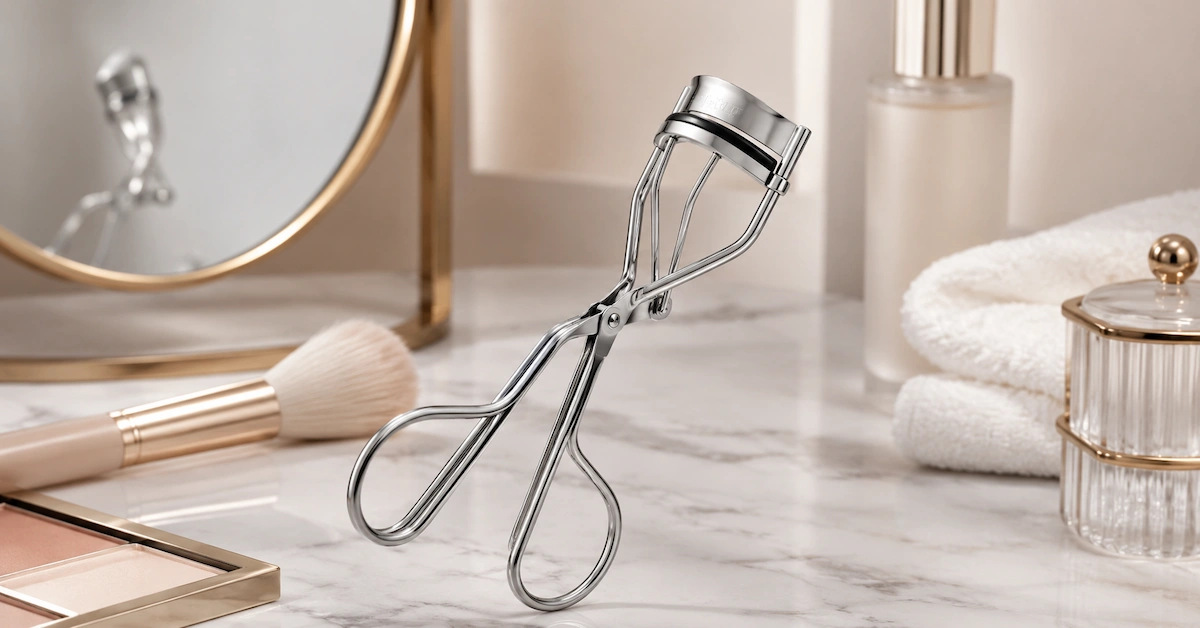
An eyelash curler is a hand-operated beauty tool with a scissor-style frame, two finger loops, a central pivot and a curved clamping head. A dark cushion, usually described as silicone or rubber depending on the product specification, sits at the lash-contact area. The frame is commonly presented in a polished silver-colored finish that may resemble stainless steel or chrome plating, but buyers should confirm the actual material and finish method with the supplier rather than assume from appearance.
The structure leaves little room for poor manufacturing. If the arms are not aligned, the squeeze feels uneven. If the curved head does not sit correctly near the eyelid contour, the user notices immediately. If the cushion is poorly seated, the entire tool can feel cheap even when the frame looks bright and attractive. In this category, small defects are visible and tactile.
For B2B buyers, the product should be treated as a small mechanical hand tool, not only as a cosmetic accessory. The final user judges it by touch, resistance, smoothness, symmetry and visual cleanliness. That is why buyers comparing wholesale eyelash curler offers should request samples and inspect them by hand before committing to packaging, artwork or broader line planning.
How Eyelash Curlers Are Typically Made
Exact factory methods vary by supplier, tooling and product design. Still, most eyelash curlers involve a sequence of metal forming, bending or stamping, pivot assembly, surface finishing and cushion insertion. Each step affects the final feel of the tool.
Metal Frame Forming
The frame must be stable enough to resist unwanted flex during routine use. If forming is inconsistent, the arms may not move evenly and the jaws may not meet cleanly. Buyers should compare several samples side by side, not only one golden sample. Look for consistent finger-loop shape, centered alignment and clean edges around the frame.
Curved Clamping Head
The curved head is central to user experience. It should appear symmetrical and close evenly across the cushion. A small shift in geometry can make the tool feel awkward or less controlled. For retail and e-commerce channels, visible jaw misalignment can also increase return risk because customers can spot the problem immediately after opening the package.
Pivot and Hinge Action
The pivot is the most mechanically sensitive part of the tool. Too much play makes the curler feel loose; too much tightness makes it stiff and uncomfortable. A suitable supplier should be able to maintain a repeatable opening and closing feel across samples and production lots. When reviewing samples, open and close each unit several times and listen for rough movement, uneven resistance or wobble.
Cushion Pad Insertion
The cushion pad is the direct lash-contact surface. It should sit straight, fill the intended channel and remain secure during normal handling. Buyers should ask whether replacement pads are available if the product is positioned as a higher-value beauty tool or kit component. If the pad is fixed, that may be acceptable for a basic assortment, but the decision should be intentional and documented.
Surface Finish and Presentation
A polished metal finish can photograph well for e-commerce listings and retail displays, but a bright surface can also reveal fingerprints, scratches, burrs or uneven plating. Inspect samples under light from multiple angles. The finish should support the intended channel: a promotional kit may need attractive consistency at a controlled cost, while a private-label beauty line may require a cleaner finish and more careful pack-out.
Supplier, Manufacturer or Trading Source: Which Is the Right Fit?
Search terms often overlap, but the supply model matters. An eyelash curler supplier may be a factory, a trading company or a sourcing partner. An eyelash curler manufacturer is usually the better fit when you need more control over structure, finish, packaging or private-label details. A trading-oriented source may be practical when speed, assortment coordination or simpler wholesale purchasing is the main priority.
Neither model is automatically better. The best choice depends on product complexity, quality expectations, documentation needs and how much customization you require. If you are buying a standard wholesale eyelash curler for a basic retail program, a catalog item with stable packaging may be enough. If you are building a branded beauty accessories collection, you will likely need closer coordination on logo placement, finish consistency, packaging artwork and sample approval.
Olimor supports beauty-tool sourcing as part of a broader cosmetics accessories assortment. Buyers can review related options through the Olimor product range or discuss program requirements through the Olimor contact team.
Comparison Table: Match the Eyelash Curler to Your Sales Channel
| Buying scenario | Main sourcing priority | What to inspect first | Supplier questions to ask |
|---|---|---|---|
| Private-label beauty line | Consistent appearance, branding support and coordinated packaging | Finish uniformity, logo area, pad fit and sample-to-sample consistency | Can you support custom packaging, brand details and repeatable approved samples? |
| Wholesale retail program | Stable supply, clean presentation and acceptable cost structure | Frame alignment, retail pack-out, visible marks and hinge movement | How do you control cosmetic appearance and packaging condition before shipment? |
| Salon or professional kit | Handling comfort and repeated-use feel | Finger-loop comfort, pivot resistance, frame stability and pad seating | Can samples be tested for repeated opening and closing before approval? |
| Promotional or gift set | Compact appearance, attractive finish and kit compatibility | Size fit, finish consistency, packaging dimensions and visual match with other tools | Can the curler be packed with other beauty accessories without damaging the finish? |
| E-commerce assortment | Photo appeal and lower risk of complaints from visible defects | Surface marks, jaw symmetry, rough edges and product presentation | How are units inspected for alignment and cosmetic defects before packing? |
Selection Criteria That Matter More Than Marketing Claims
Buyers should evaluate eyelash curlers with the hand as much as the eye. Marketing descriptions may say polished, durable or comfortable, but the sample must prove it. The following criteria help separate a reliable supplier from a low-control source.
- Closure symmetry: The curved heads should meet evenly and the pad should align with the upper frame.
- Smooth action: The tool should open and close without grinding, wobble or sudden stiffness.
- Frame stability: The arms should not flex in a way that makes the product feel weak or uncertain.
- Clean edges: Finger loops, arms and jaw areas should be free from rough points that affect comfort or perceived safety.
- Pad placement: The cushion should be straight, secure and visually neat.
- Finish quality: Polished surfaces should be checked for scratches, dull patches, fingerprints, plating issues or visible marks.
- Packaging fit: The tool should sit securely in retail, salon, kit or promotional packaging without rubbing or shifting excessively.
- Customization readiness: If you need private label, confirm where branding can be applied and how packaging approvals are managed.
A useful sample review should include more than one unit. Ask for representative samples when possible and record the approval criteria clearly. If your team approves only a highly polished presentation sample without confirming hinge action, pad seating and batch consistency expectations, disputes can appear later during production inspection.
Cost Factors in Wholesale Eyelash Curler Sourcing
Buyers often start with unit price, but the total sourcing decision includes more than the quoted cost. The main cost factors usually include frame material, forming complexity, surface finish, cushion type, packaging style, customization requirements, inspection expectations and order coordination. A bright finish, custom package or kit-ready presentation may change the cost profile even when the tool shape looks similar.
It is important not to over-specify features the channel does not need. A basic promotional program may not require the same packaging, finish or accessory support as a mid-tier private-label beauty collection. At the same time, under-specifying a retail or e-commerce product can create hidden costs through returns, complaints or repacking work.
For buyers comparing supplier quotations, ask each supplier to clarify what is included: the tool, cushion, any spare pad if applicable, individual packaging, carton packing, branding work, sample fees if relevant and inspection steps. Do not assume that two quotes include the same scope just because both describe an eyelash curler.
Quality Checks Before Approving Production
A practical eyelash curler inspection plan does not need to be complicated, but it should be specific. The goal is to catch mechanical, cosmetic and packaging issues before the product reaches retail buyers or end users.
- Check frame alignment: Place samples on a flat surface and compare the symmetry of arms, loops and curved heads.
- Test opening and closing: Operate each sample several times to feel resistance, smoothness and hinge stability.
- Inspect the cushion: Confirm the pad sits correctly, does not appear twisted and does not shift during normal handling.
- Look for rough edges: Pay attention to finger loops and any area close to the eye or hand.
- Review finish under light: Rotate the product to identify marks, dullness, scratches or uneven surface appearance.
- Check package fit: Confirm the curler does not move excessively in packaging and that the finish is protected during transit.
- Confirm documentation: Keep approved samples, written specifications and packaging artwork aligned before production begins.
For regulated markets, buyers should also confirm which material and consumer product requirements apply to their destination country. For example, EU buyers may need to consider REACH restrictions for certain substances, while US buyers may review applicable consumer product safety expectations through public bodies such as the CPSC. Applicability depends on the product, materials, claims and sales channel. Buyers should verify the current version of any standard or regulation and request relevant supplier documentation instead of assuming compliance from appearance or category alone.
Common Mistakes When Sourcing Eyelash Curlers
The most common mistake is treating every eyelash curler as interchangeable. They are not. Small differences in head curvature, hinge play, pad position and finger-loop comfort can change the customer experience quickly. A buyer who compares only price may receive a product that looks similar in photos but performs poorly in the hand.
Another mistake is focusing on the shiny finish while ignoring mechanical feel. A polished frame is useful for beauty presentation, but it cannot compensate for loose movement or uneven closure. Similarly, attractive packaging cannot fix a pad that shifts or a jaw that sits off-center.
Some teams also move too quickly into branding and artwork before validating the base tool. Private-label packaging is important, but the physical curler should be approved first. Confirm the frame, pad, hinge and finish before spending time on decorative details. This sequence reduces the risk of reworking packaging around a product that later fails sample review.
Finally, avoid vague approval language. Terms like good quality or premium finish are not enough. Define what your team will inspect: no obvious rough edges, smooth opening and closing, centered pad placement, clean visible finish and suitable packaging fit. Clear criteria help both buyer and supplier reduce misunderstanding.
How to Evaluate an Eyelash Curler Supplier
A strong supplier evaluation looks at product control, communication and channel fit. Ask how the supplier manages sample approval, what customization options are realistic, how packaging is confirmed and what inspection steps are used before shipment. If your program includes multiple beauty tools, confirm whether the supplier can coordinate the eyelash curler with other accessories in finish, packaging and presentation.
Useful supplier-evaluation questions include:
- Can you provide representative samples for hand-feel, hinge and finish review?
- What frame material and surface finish are used, and how are they documented?
- Is the cushion pad fixed or replaceable, and are spare pads available if needed?
- What customization options are available for packaging or branding?
- How do you inspect alignment, surface defects and packaging condition?
- Can the product be supplied as a standalone retail item or as part of a kit?
- What information is needed to quote a wholesale or private-label program accurately?
If you are planning a broader beauty accessory assortment, browse Olimor options through the beauty tool collection. For a specific eyelash curler inquiry, you can share target channel, packaging needs and customization requirements through the Olimor inquiry page.
Practical Buying Checklist
| Checklist item | Why it matters | Buyer action |
|---|---|---|
| Confirmed material and finish | Appearance alone does not prove metal type or plating method | Request written material and finish information from the supplier |
| Approved hinge feel | The pivot controls perceived quality and ease of use | Open and close multiple samples by hand before approval |
| Centered cushion pad | The pad is the lash-contact point and highly visible | Inspect pad seating and ask about replacement-pad options if relevant |
| Clean cosmetic finish | Beauty tools are judged visually in packaging and online | Check polished surfaces under light for marks and rough areas |
| Packaging matched to channel | Retail, salon, kit and promotional programs need different pack-out logic | Confirm package dimensions, protection and display requirements |
| Clear sample approval record | Reduces disputes when production begins | Keep approved samples, photos, specifications and packaging files aligned |
FAQ: Eyelash Curler Supplier Questions
Can Olimor provide samples before a wholesale order?
Sample availability depends on the product, customization request and current sourcing plan. Buyers should share the intended channel, packaging needs and any branding requirements so the sample request can be reviewed properly.
Is there a fixed MOQ for eyelash curlers?
MOQ can vary by product style, packaging type, customization level and production arrangement. Buyers should request a current quotation instead of assuming one fixed quantity for all eyelash curler programs.
Can the eyelash curler be customized for private label?
Customization may include packaging, branding presentation or assortment coordination, depending on the selected item and supplier capability. Confirm what can be customized during sample review and before artwork approval.
What quality checks should buyers request?
Buyers should check frame alignment, hinge smoothness, pad seating, rough edges, surface finish and packaging condition. For destination-market requirements, verify applicable regulations and request supplier documentation where needed.
How should buyers discuss lead time?
Lead time depends on sample approval, customization, packaging confirmation, order planning and production status. The safest approach is to confirm timing after specifications and packaging details are clear.
Final Sourcing Advice
The best eyelash curler supplier is not simply the one with the lowest quote or the brightest product photo. A reliable partner should help you control the details that customers feel immediately: smooth closure, stable frame, neat cushion placement, clean finish and suitable packaging. For wholesale and private-label buyers, those details protect the brand experience and reduce avoidable sourcing problems.
Start with a clear channel goal, inspect real samples, document approval criteria and ask direct questions about material, finish, pad design, packaging and inspection. When the tool is small, precision matters more, not less.