What Matters When Buying Eyebrow Tweezers in Bulk?
Eyebrow tweezers are small tools, but their working details deserve careful attention. Tip shape, closing contact, body tension, and surface finish all influence how the product feels and performs.
For retailers, distributors, importers, and beauty businesses, buying wholesale eyebrow tweezers requires more than choosing an attractive design. Buyers need to understand which features suit their customers and how those features will be checked before production approval.
A structured sourcing process begins with selecting the appropriate tip style, reviewing representative samples, and documenting the final requirements. This guide explains the decisions that can help you build a clear specification and compare supplier offers more effectively.
Compare Tweezer Tip Shapes Before Choosing Your Assortment
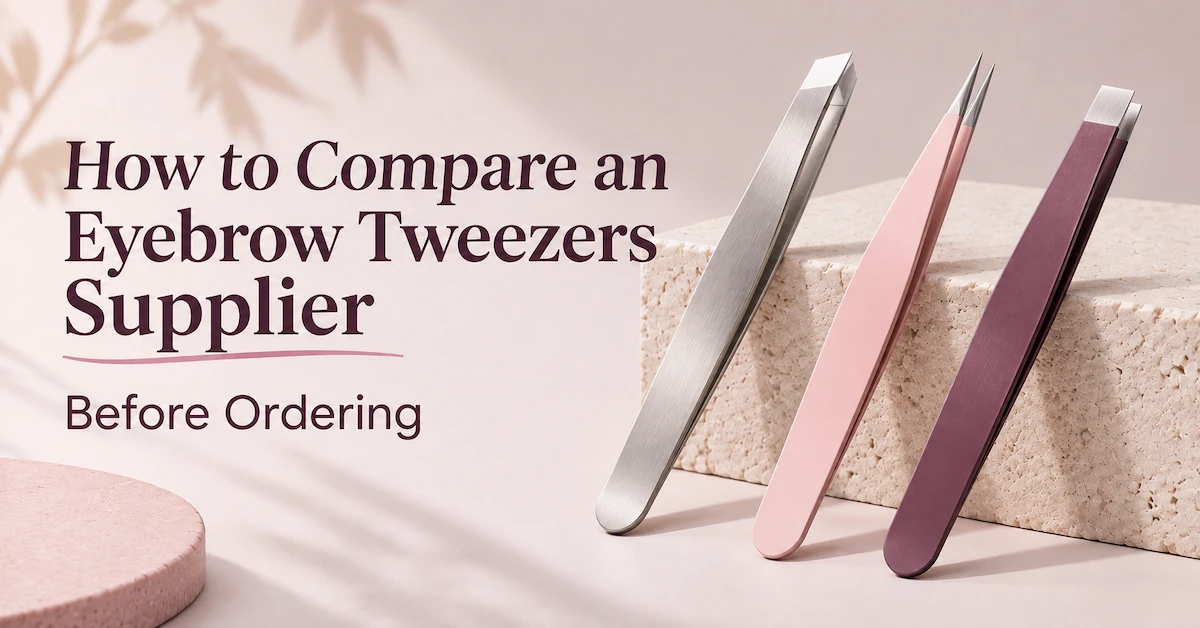
Tip shape determines the working edge presented to the user. It also affects how a product should be described in a catalogue or online listing.
The following comparison covers common eyebrow tweezer styles. Confirm which versions are available from your supplier before including them in your purchasing plan.
| Tip Type | Design Characteristics | Buyer Evaluation Focus |
|---|---|---|
| Slant tip | Angled working edge with a narrower corner | Contact across the angled edge, corner finish, and closing alignment |
| Pointed tip | Narrow tips that meet at a small contact area | Point alignment, symmetry, and protective packaging |
| Flat tip | Broad, straight working edge | Even contact across the width and smooth corner finishing |
| Pointed-slant tip | Angled edge combined with a more pronounced point | Contact along the edge and consistency at the pointed end |
The tip name alone does not define the finished product. Two tools described as slant tip tweezers may have different edge widths, angles, thicknesses, and body shapes.
Slant Tip Tweezers for a Focused Starting Range
Slant tip tweezers provide an angled edge and a narrower corner within the same design. For buyers developing a focused eyebrow grooming assortment, this gives a clear product feature to explain and compare.
During sampling, examine the complete angled edge. Check whether the two sides meet evenly and whether the corner is finished consistently.
If you plan to offer more than one slanted version, define the differences clearly. Dimensions, grip design, finish, and packaging should distinguish the products rather than relying only on different colors.
Pointed and Flat Styles Need Separate Specifications
Pointed tips require close attention to how the ends meet and how they are protected in the package. A small mismatch can be difficult to assess from a product photograph.
Flat tips should be reviewed across their full working width. Check the corners as well as the center of the edge.
Avoid approving several tip styles under a single general requirement such as “standard tweezer quality.” Each design needs acceptance criteria that match its working geometry.
Inspect Tip Alignment and Closing Contact
Alignment is one of the most useful areas to examine when reviewing samples. The tips should meet in the intended position without an obvious sideways offset.
Look at the Tips from Several Angles
Inspect the sample from the front, side, and along the working edge. A tool may appear aligned in one view while showing a gap or offset in another.
Close the tweezers gently and observe where contact begins. Record whether the meeting surfaces align as expected for that design.
Use consistent lighting and the same inspection method when comparing several samples. Magnification can help clarify details that are difficult to see unaided.
Agree on a Practical Grip Evaluation
Appearance alone does not establish gripping performance. Ask the supplier how it evaluates the selected model and agree on a repeatable method suitable for your order.
If your team uses a test material, keep that material and the evaluation steps consistent across samples. Record the conditions so that different reviewers are not judging the product in unrelated ways.
Avoid treating one successful demonstration as proof of performance across a full production batch. Confirm how the agreed checks will be applied during order inspection.
Document Specific Problems
Useful sample comments identify the issue and its location. Examples include:
-
A visible gap at one end of the working edge.
-
One tip extending beyond the other.
-
Uneven contact when the arms are closed.
-
A rough corner on the working tip.
-
Different closing resistance between samples.
These observations give the supplier a clearer basis for review than a general request to make the product “more precise.”
Evaluate Body Tension, Grip, and Handling
The body of the tweezer affects how easily the user can control the tips. Review its dimensions and movement alongside the working edge.
Check Closing Resistance and Return
Compress and release the arms through their intended movement. Observe whether the action feels consistent and whether the tips return to their resting position.
A tool that feels unusually stiff or loose may not match your intended customer experience. Instead of relying on subjective descriptions alone, discuss how the desired feel can be represented by an approved sample or an agreed measurement.
Where several samples are available, compare them using the same reviewer and method.
Review Grip Surface Details
Grip areas may be smooth, textured, or ribbed. Examine whether the selected design provides comfortable finger contact and whether its edges are finished cleanly.
For ribbed grip areas, look for consistent machining or forming and inspect the transitions between textured and smooth surfaces.
Do not assume that deeper texture automatically means better handling. Evaluate the complete tool in the intended grip position.
Confirm Overall Dimensions
Record the dimensions relevant to your product, such as overall length, body width, and tip width.
These measurements help distinguish similar models and support accurate product listings. They also provide a reference if a later shipment appears different from the approved sample.
Confirm Materials and Finishes in Writing
A silver appearance does not identify a material grade. Likewise, a colored surface may be a coating rather than the color of the underlying material.
Ask your eyebrow tweezer supplier to state the material and finish proposed for the exact item you are ordering.
Separate Material Claims from Appearance Descriptions
Descriptions such as “silver finish,” “matte surface,” and “polished appearance” describe visual characteristics. They should not be used as substitutes for a material specification.
If a particular material is required, include it in the quotation and purchasing documents. Agree on any supporting information needed to substantiate that specification.
Avoid adding claims such as corrosion-proof or suitable for a particular treatment method unless they are supported for the selected product.
Inspect the Surface Around the Working Area
Look for rough areas, uneven polishing, visible residues, or inconsistent coating around the tips and body.
If a coating is proposed, ask whether it covers the working surfaces and how the finished tool will be checked. The approved sample should represent the actual finish planned for the order.
Request Appropriate Care Information
Ask for cleaning, drying, and storage guidance suited to the material and construction.
Use that confirmed information when preparing packaging or product-page instructions. Do not assume that care instructions from another tool apply to your selected tweezers.
Build a Clear Specification for Wholesale Orders
A written specification helps buyers compare quotations and reduces uncertainty during production.
The following table can serve as a discussion checklist.
| Specification Item | Details to Confirm |
|---|---|
| Product reference | Model code and approved version |
| Tip style | Slant, pointed, flat, or another agreed design |
| Dimensions | Overall length, body width, and relevant tip measurements |
| Material | Specified material for the selected model |
| Surface finish | Polished, matte, coated, or another confirmed treatment |
| Grip design | Smooth, ribbed, or textured area |
| Tip contact | Agreed alignment and contact requirements |
| Body tension | Reference sample or agreed evaluation method |
| Packaging | Tip protection, individual pack, and carton arrangement |
| Marking | Any required product or packaging identification |
| Inspection | Checks, sampling approach, and acceptance criteria |
| Order quantity | Quantity for each model and finish |
Treat undecided details as open questions rather than leaving them hidden in the order. If the supplier proposes an alternative, review and approve it before production begins.
Review Packaging for Protection and Presentation
Packaging should protect the working ends and present the product accurately.
For wholesale eyebrow tweezers, inspect the packed sample rather than approving the tool and packaging as unrelated items.
Protect the Working Tips
If a protective cap, sleeve, or insert is included, check whether it fits securely and can be removed without interfering with the tip alignment.
For pointed designs, pay particular attention to whether the tips can contact or penetrate the surrounding pack during normal handling.
Agree on a suitable protection arrangement for the actual product and distribution method.
Check Product Movement Inside the Pack
Confirm that the tool stays in its intended position. Loose movement may affect presentation or allow the working ends to contact the packaging.
For sets containing multiple tools, check that the items remain separated as intended.
Match Packaging Text to the Approved Tool
Product names, tip descriptions, materials, and included quantities should reflect the approved specification.
If the package describes the item as slant tip tweezers, the product image and supplied tool should match that description. Review barcodes, item codes, and artwork versions before approval.
Compare Supplier Quotations on the Same Basis
Quotations are easier to compare when every supplier receives the same product brief.
One offer may cover a basic tool in bulk packing, while another includes an individual retail pack and tip protection. Differences in material, finish, dimensions, or inspection scope may also affect price.
Confirm the Minimum Quantity for Each Version
Ask whether the minimum order quantity applies to the model, finish, color, or packaging format.
If you are considering several versions, request a quantity breakdown for each. Do not assume that a combined order quantity satisfies every individual minimum.
Identify What the Price Includes
Confirm whether the quote includes samples, protective accessories, individual packaging, labels, and any agreed inspections.
Request separate identification of additional charges where applicable. This makes it easier to compare the total proposed scope.
Separate Approval Time from Production Time
Ask what must be finalized before production starts. Sample revisions, finish confirmation, and packaging artwork may all affect the schedule.
Build your purchasing plan around confirmed milestones rather than treating a general production estimate as the complete delivery timeline.
Approve Samples with Repeat Orders in Mind
An approved sample should be supported by a record that can be used beyond the first order.
Keep the item code, photographs, dimensions, material specification, finish, and packaging version together. Record any requested changes and identify the final approved version.
Confirm How Changes Will Be Communicated
Ask the supplier to notify you before changing the material, tip geometry, body dimensions, finish, or packaging.
Where a proposed change affects the approved product, decide whether a revised sample or additional inspection is required.
Use Receiving Feedback to Improve the Next Order
When goods arrive, compare them with the agreed specification and document any recurring concerns.
Share specific findings with the supplier before reordering. This creates a practical basis for refining inspection criteria and maintaining consistency.
Frequently Asked Questions About Wholesale Eyebrow Tweezers
What is the most important feature to check in eyebrow tweezers?
Tip alignment and closing contact deserve close attention, but they should be evaluated together with body tension, material, surface finish, and handling. The complete tool needs to match the intended specification.
Are all slant tip tweezers the same?
No. Models may differ in tip angle, working-edge width, body dimensions, tension, and grip design. Compare samples and written specifications rather than relying on the tip-style name alone.
How can I compare samples from different suppliers?
Use the same checklist, lighting, inspection method, and grip evaluation process. Record measurable differences and keep photographs of the working tips and overall product.
Can I identify the material from the product color?
No. Color and finish do not establish material composition. Request the material specification for the exact model and confirm any supporting information required for your order.
What should I send to an eyebrow tweezer supplier for a quotation?
Provide the preferred tip style, product reference, quantities, dimensions, material requirements, finish, packaging, destination market, and target delivery window. Identify any details that are still open for discussion.
Can multiple tip styles be purchased in one order?
Ask whether mixed-model orders are supported and confirm the minimum quantity for each version. Packaging and scheduling requirements may also differ between models.
Should tip protection be included in the packaging?
Review this with the supplier based on the selected design and distribution method. The packaging should protect the working ends and keep the product secure during handling.
Discuss Your Eyebrow Tweezer Requirements with OLIMOR
A useful wholesale inquiry starts with a clear description of the tool you need. Specify the tip style, review alignment and handling, and confirm the material and packaging before approving the order.
Explore OLIMOR’s tweezer category to review the available options. Then contact the OLIMOR team with your preferred product reference, estimated quantity, finish, and packaging requirements to discuss your next purchase.