










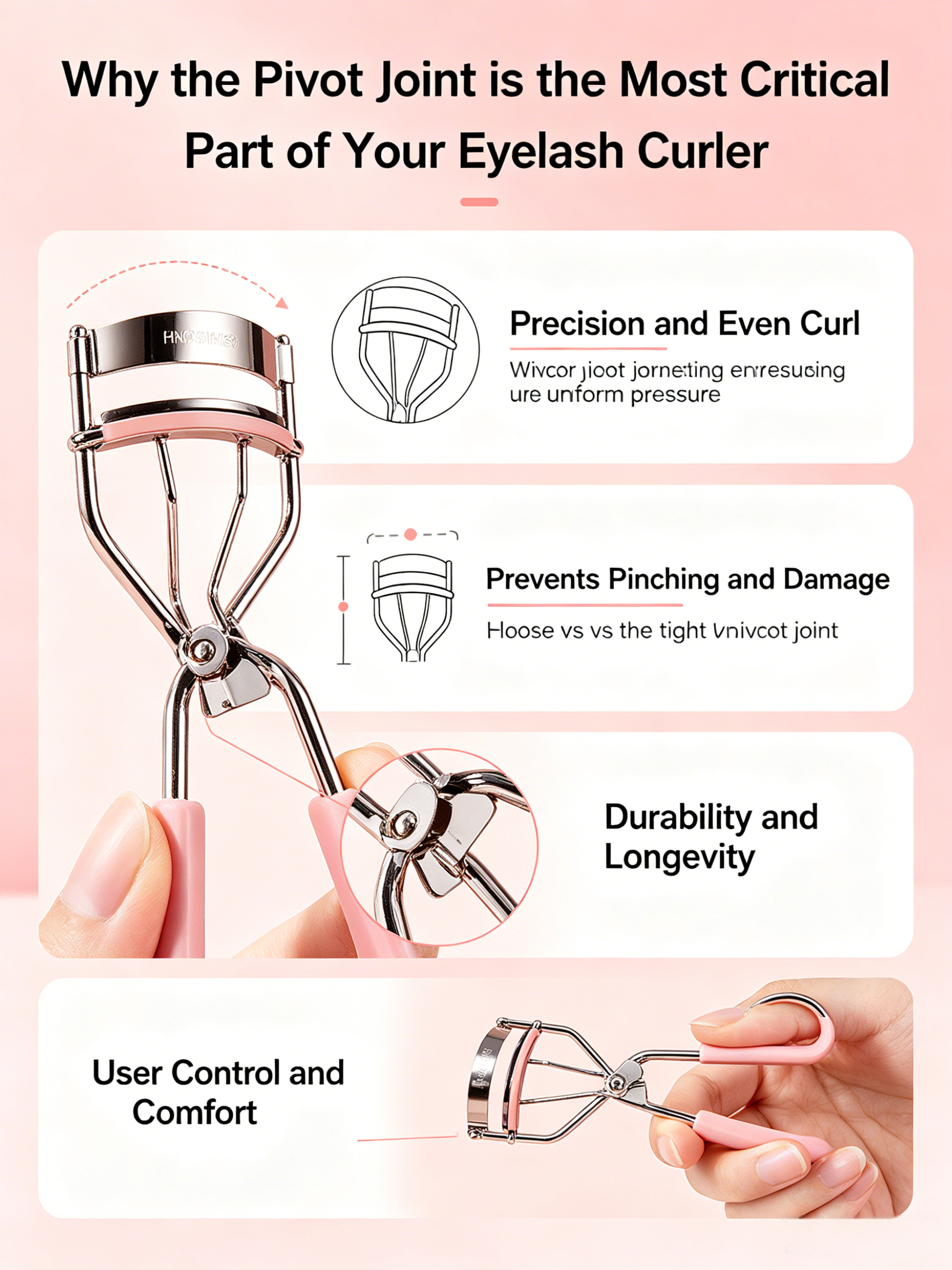
The pivot joint, often called the hinge, is the small moving connection that determines how an eyelash curler closes, how evenly it applies pressure, and how predictable it feels near the lash line. For everyday users, it affects comfort and curl shape. For retailers, distributors, salons and private-label buyers, it is a practical quality indicator that should be checked before placing an order.
An eyelash curler may look simple: handles, a curved frame, a cushioned pad, a top pressing bar and a hinge. In use, however, every squeeze of the handles passes through the pivot joint before the lashes are shaped. If the joint is stable and aligned, the upper bar can meet the pad evenly. If it is loose, gritty, stiff or poorly matched to the frame, the tool may pinch skin, crimp lashes, close unevenly or feel difficult to control.
This guide explains what the hinge does, how to inspect it, how it compares with other parts, what problems to watch for, and what B2B buyers should ask when evaluating samples. To compare related beauty tool options, buyers can review Olimor Beauty beauty tool products alongside sample inspection findings instead of judging by appearance alone.
What the Pivot Joint Does in an Eyelash Curler
The pivot joint converts hand pressure into a controlled closing motion. When a user squeezes the handles, the hinge guides the movement of the upper frame toward the lower pad. This motion determines whether the pressing bar contacts the pad evenly across the lash line or arrives at an angle.
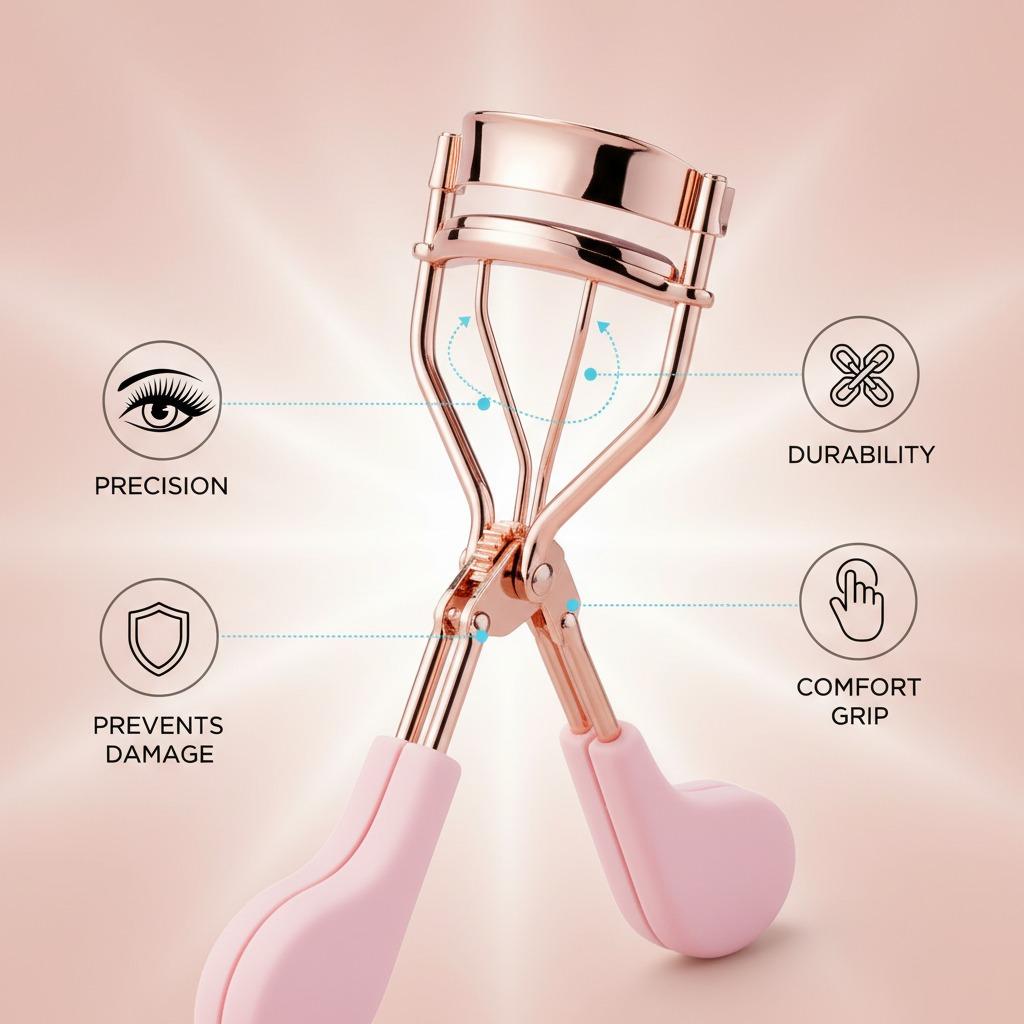
A good hinge supports three functions at the same time. It keeps the upper and lower sections aligned, creates controlled resistance during squeezing, and allows the tool to reopen smoothly after pressure is released. These functions are especially important because the curler is used close to the eyelid, where small movements can affect comfort and user confidence.
Two eyelash curlers can have similar frame shapes and still feel very different. One may close smoothly and predictably; another may shift sideways or snap shut too quickly. The difference is often found in the pivot area rather than in the visible handle shape. For buyers comparing samples, the hinge should be handled, opened and closed repeatedly, not only viewed in product photos.
How Hinge Quality Affects Curl Shape, Comfort and Safety
The most common user complaints about eyelash curlers are uneven curl, a sharp bend instead of a soft lift, pinching near the eyelid, or inconsistent results from one use to the next. The pivot joint can contribute to each of these problems because it controls how pressure travels from the hand to the lash pad.
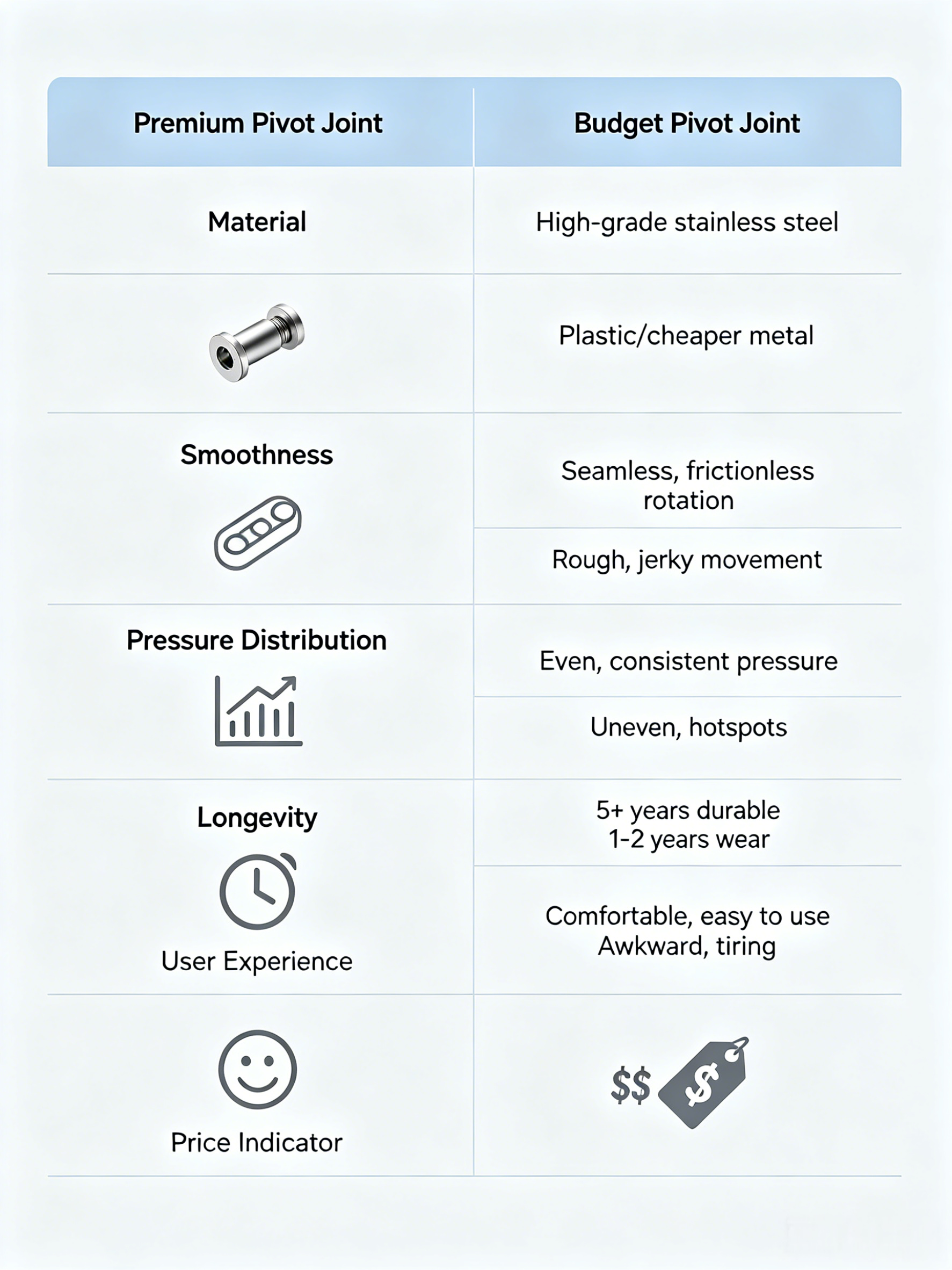
When the hinge is stable, pressure is distributed more evenly along the pad. This helps the user apply light pulses or controlled pressure near the lash base without over-compressing one section. A smoother joint also helps the tool close gradually, giving the user time to stop before the pad contacts skin or catches lashes at an uncomfortable angle.
When the hinge is loose, the pressing bar may meet the pad unevenly. The center lashes may curl differently from the outer lashes, or one side of the pad may compress more than the other. When the hinge is too stiff, the user may squeeze harder than intended, which can increase the risk of crimping or discomfort. When it is too loose, the closing point becomes difficult to predict.
Users with smaller eyes, deep-set eyes, hooded lids or very straight lashes may notice hinge problems more quickly because they often need to position the curler carefully at the lash base. For retail and salon channels, this matters because a tool that feels unsafe or unpredictable can lead to returns, poor reviews and reduced repeat purchase confidence.
Pivot Joint Versus Other Eyelash Curler Components
The hinge is not the only important part of an eyelash curler, but it coordinates how the other components work. A soft pad protects lashes from hard contact. A suitable frame curve helps the tool sit against the eyelid. Comfortable handles improve grip. Yet each of these parts depends on controlled hinge movement to perform properly.
| Component | Primary Role | What to Check | Why the Pivot Joint Matters |
|---|---|---|---|
| Pivot joint or hinge | Guides movement and transfers force | Side play, smoothness, closing alignment and return motion | It determines whether pressure reaches the pad evenly. |
| Cushioned pad | Supports lashes during curling | Secure seating, surface condition, cracking, flattening or shifting | Even a good pad cannot compensate for a hinge that closes at an angle. |
| Curved frame | Fits the eyelid and lash line | Frame symmetry, edge finish and fit for target eye shapes | A suitable curve performs poorly if hinge movement pulls the bar off line. |
| Top pressing bar | Contacts the pad to form the curl | Straightness, smooth finish and full-length pad contact | The hinge controls whether the bar meets the pad from end to end. |
| Handles | Provide grip and leverage | Comfort, opening width and control during squeezing | Good handles still need a stable hinge to deliver predictable pressure. |
This comparison is useful for buyers building a beauty assortment. A product can look polished in packaging but still underperform if the hinge is imprecise. Sample testing should therefore include movement checks, not only cosmetic inspection.
Inspection Checklist Before Selecting an Eyelash Curler
Whether selecting a single tool, building a salon kit or sourcing a private-label item, inspect the pivot joint before making a final decision. The following checklist can be used during sample review, retail quality checks or supplier comparison.
- Side-to-side movement: Hold the handles and gently move them. The hinge should not rattle or shift noticeably.
- Slow closing alignment: Close the curler gradually and check whether the top pressing bar meets the pad evenly from one end to the other.
- Normal-use closing: Squeeze with realistic hand pressure to confirm that alignment remains stable during actual use, not only during slow inspection.
- Resistance: Movement should feel controlled. Avoid gritty, sticky, overly stiff or overly loose action.
- Return motion: After releasing pressure, the tool should reopen smoothly without dragging or catching.
- Visible assembly: Look around the hinge for clean joining, obvious gaps, sharp edges or uneven construction.
- Pad seating: Confirm that the cushion sits securely in its channel and does not slide when the curler closes.
- Frame stability: Watch for bending, twisting or flexing when the handles are squeezed.
- Consistency across samples: Compare several units when possible. One good sample is less meaningful than consistent hinge feel across units.
For B2B sourcing, these checks help separate attractive product presentation from functional quality. Buyers can also align inspection notes with packaging, market positioning and customer expectations before submitting an eyelash curler inquiry.
Manufacturing and Assembly Details Buyers Should Discuss
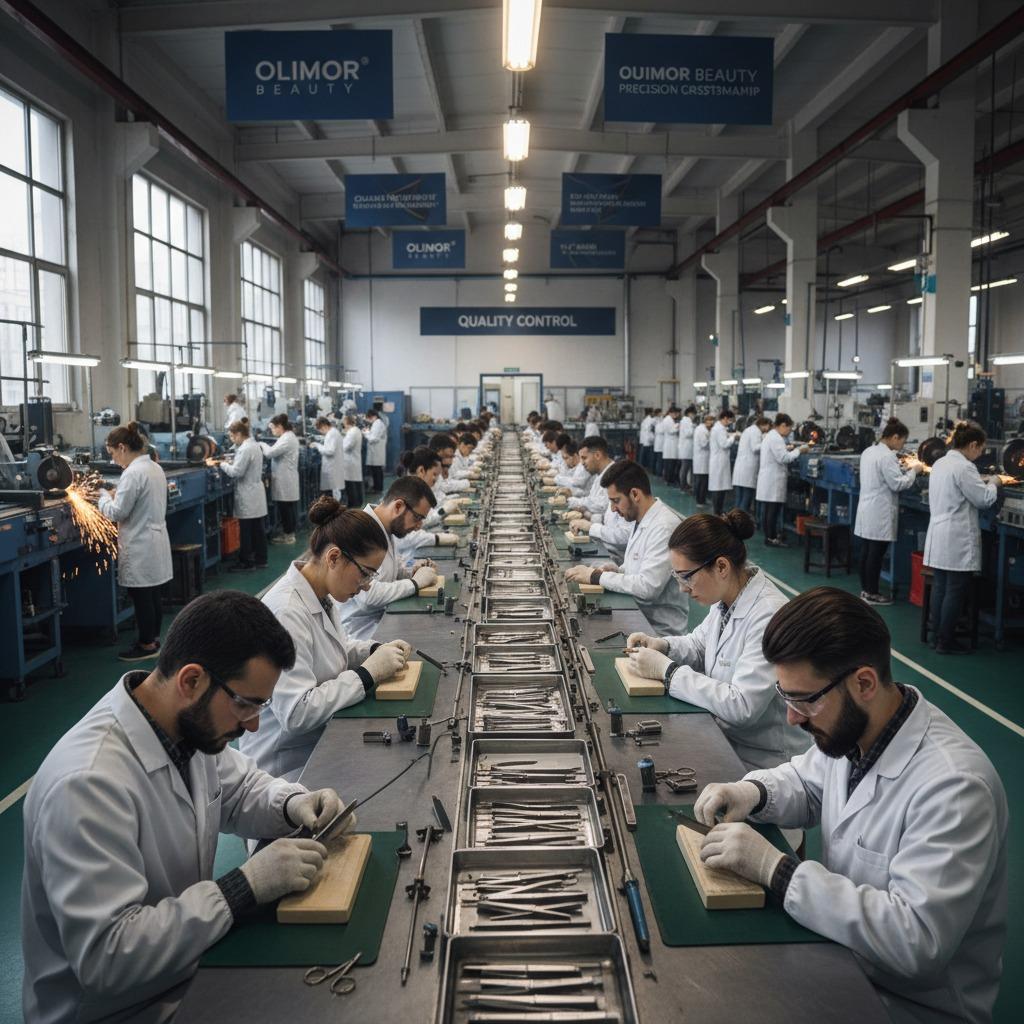
The pivot joint is affected by how the frame parts are formed, joined and finished. Buyers do not need to specify technical manufacturing details for every project, but they should ask suppliers how hinge assembly is controlled and how finished tools are inspected before shipment.
Important discussion points include whether the moving arms are aligned during assembly, whether the hinge area is checked for visible gaps or sharp edges, and whether the pad channel is reviewed together with the pressing bar. The goal is not to request unsupported performance claims. The goal is to understand whether the supplier has a repeatable process for producing a tool that opens and closes consistently.
For private-label or retail programs, sample review should include functional handling. Open and close each sample many times by hand, check that the pressing bar remains centered on the pad, and inspect whether the hinge loosens after handling. Avoid approving a sample only because the finish, color or packaging looks attractive.
If documentation is required for a market or retail channel, buyers should ask the supplier for current, product-relevant documents and verify them independently. Depending on the destination market and product classification, general consumer product safety expectations may involve regulators or rules such as the U.S. Consumer Product Safety Commission or the EU General Product Safety Regulation. Requirements can change, and applicability depends on the product and market, so buyers should verify current versions and supplier documents rather than relying on assumptions.
Cost Factors Linked to Pivot Joint Quality
Hinge quality can influence cost, but it should not be evaluated only by unit price. A low-cost eyelash curler that feels loose, pinches, or produces inconsistent curl may create higher downstream costs through returns, complaints, replacement requests or weak repeat orders.
Several factors may affect commercial discussions. These include material and finish choices, assembly complexity, pad quality, packaging requirements, inspection expectations, order volume, customization needs and the level of consistency required across units. Buyers should avoid treating all eyelash curlers with a similar silhouette as interchangeable because hinge feel and closing alignment can differ significantly.
For assortments, it can be useful to define the intended channel before comparing quotations. A promotional item, salon-use tool and premium retail product may require different expectations for finish, packaging and sample approval. The pivot joint should be considered part of the functional value, not only a hidden hardware detail.
Common Hinge Problems and How to Troubleshoot Them
Many eyelash curler problems appear gradually. A tool may work well at first but later feel less smooth, close unevenly or produce a less consistent curl. Before assuming the entire design is unsuitable, inspect the pivot area, pad and frame together.
Uneven curl on one side
Check whether the pressing bar meets the pad evenly. If one side contacts first, the hinge or frame may be misaligned. Also inspect whether the pad is seated correctly and whether one end of the cushion is more compressed than the other.
Pinching near the eyelid
Pinching can result from poor positioning, but a loose hinge may also allow the frame to shift during squeezing. Close the tool slowly without lashes to confirm whether the upper and lower sections stay aligned.
Gritty or sticky movement
Residue from mascara, skincare, dust or lash products can collect around the pad and frame. If buildup reaches the hinge area, motion may feel rough. Clean gently and dry fully before storage. Do not force sharp objects into the joint.
Hard bend instead of soft lift
A flattened pad, excessive hand pressure or abrupt hinge movement can create a crimped result. Replace worn pads when needed and choose a curler with controlled resistance rather than a snap-like closing feel.
Tool no longer opens smoothly
Inspect for trapped residue, visible deformation or looseness at the joint. If alignment is no longer stable, replacing only the pad may not restore performance because the hinge controls the closing path.
Cleaning, Maintenance and Storage for Longer Usability
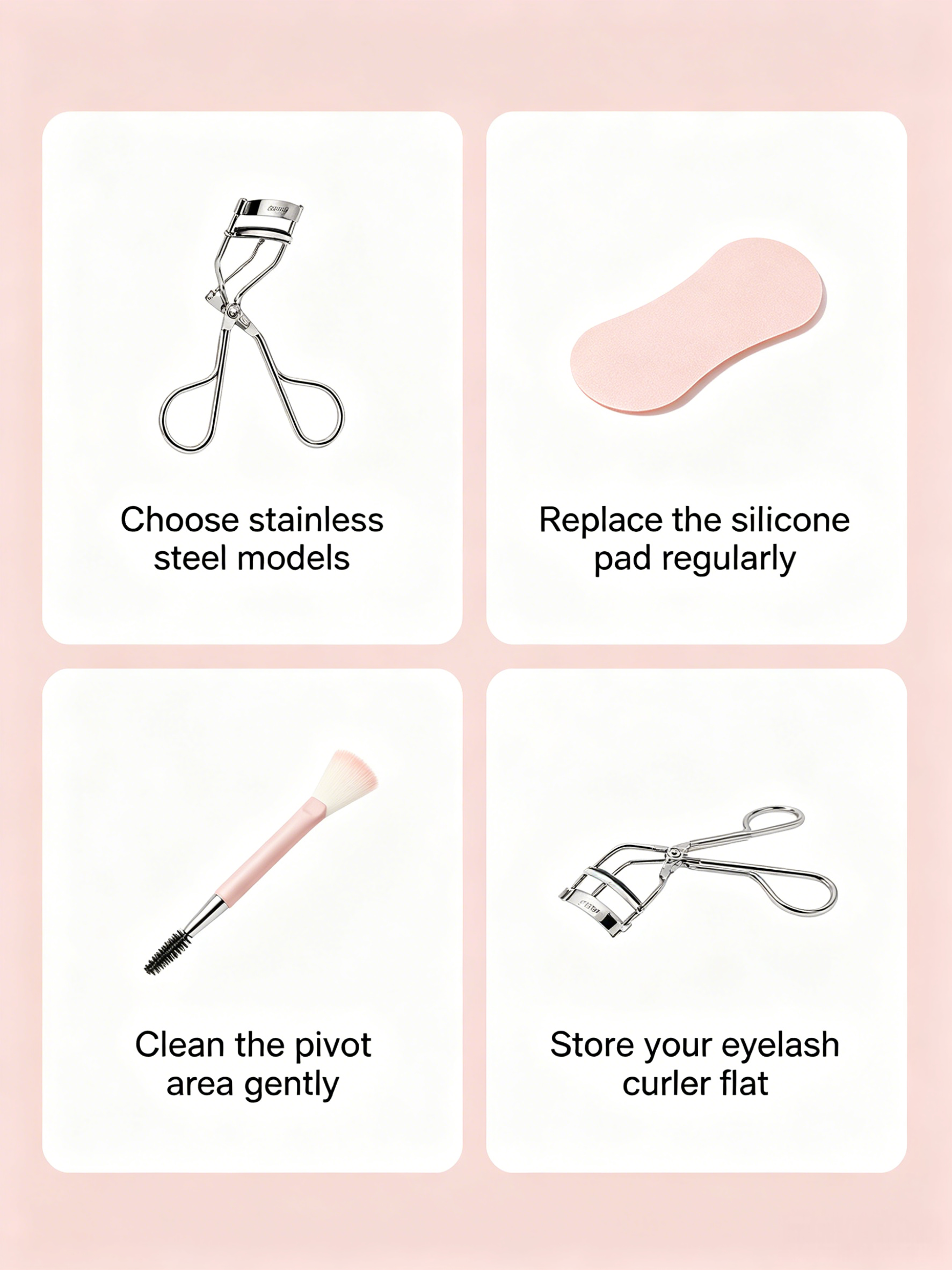
Regular care helps protect hinge movement and supports more hygienic use around the eye area. Cleaning should be gentle and practical. Aggressive scraping, soaking without need or storing the tool while wet can create avoidable problems.
- Wipe after use: Remove visible mascara and cosmetic residue from the pad, frame and pressing bar with a soft cloth or suitable cosmetic tool wipe.
- Clean the hinge area carefully: Remove surface buildup around the pivot without forcing hard or sharp items into the joint.
- Dry before storage: Moisture left around moving metal parts can contribute to wear, especially inside a closed makeup bag.
- Replace worn pads: A cracked, flattened or loose cushion changes pressure distribution and can make a good hinge seem inaccurate.
- Store without compression: Avoid keeping the curler squeezed shut under heavy items, as unnecessary pressure can affect alignment.
- Inspect before professional use: Salons and makeup artists should check smooth movement, pad condition and cleanliness before using the tool near a client’s eyes.
Maintenance does not turn a poorly assembled hinge into a high-quality one, but it helps preserve the movement of a well-made tool. For retail education, simple care instructions can also reduce misuse and improve customer satisfaction.
Supplier Evaluation for Retail, Salon and Private-Label Buyers
For commercial buyers, the pivot joint should be part of supplier evaluation. A reliable supplier should be able to discuss product construction, sample review, packaging options, customization scope and quality checks clearly without making unsupported claims.
Useful questions include: Can the supplier provide samples for hands-on hinge evaluation? Can they explain which parts are customizable and which elements should remain unchanged for function? How is visual and functional inspection handled before shipping? Are replacement pads, packaging formats or product assortments available? What documents are available for the intended market or retail channel?
Customization can involve appearance, packaging and assortment planning, but functional changes should be reviewed carefully. Changing finish, handle style, pad type or packaging presentation may affect user perception. Changing frame geometry or hinge construction can affect actual performance, so samples should be checked again after any modification.
Buyers comparing multiple beauty tools can browse Olimor Beauty product collections to consider how an eyelash curler fits with tweezers, grooming tools or other accessories. For project-specific communication, use the contact page to discuss intended channel, packaging direction and sample review needs.
FAQ for Eyelash Curler Sourcing
Can I request samples before confirming an order?
Sample availability should be discussed directly with the supplier. For eyelash curlers, sample review is especially useful because hinge feel, closing alignment and pad seating are best evaluated by hand.
Is there a fixed MOQ for customized eyelash curlers?
MOQ can depend on the product, customization scope, packaging and production arrangement. Buyers should confirm current requirements through an inquiry rather than assuming one quantity applies to every project.
What customization options should be reviewed carefully?
Packaging, finish and branding may be considered, but any change that affects the frame, pad or pivot joint should be sampled and tested for smooth movement and alignment before approval.
How should quality be checked before shipment?
Quality review should include visual inspection and functional checks: hinge stability, smooth opening and closing, even pad contact, secure cushion seating and clean assembly around the joint.
How is lead time determined?
Lead time may vary by product availability, customization, packaging and order requirements. Buyers should confirm the current schedule with the supplier and align it with sample approval and shipping plans.
Bottom Line: Judge the Curl by the Joint
The pivot joint is small, but it has a major effect on eyelash curler performance. It controls alignment, pressure transfer, closing resistance, comfort and long-term usability. A soft pad and well-shaped frame are important, but they work properly only when the hinge guides the motion consistently.
Before choosing an eyelash curler for personal use, retail sale, salon work or private-label sourcing, close it slowly, check full pad contact, feel the resistance and look for unwanted wobble. These simple checks reveal more about real quality than appearance alone. For commercial buyers, adding hinge inspection to the approval process is a practical way to select beauty tools that feel safer, work more consistently and better match customer expectations.