










An eyelash curler is a small beauty tool, but it works through repeated mechanical pressure close to a sensitive area of the face. The frame, hinge, clamp, handles and cushion pad must work together. If one part becomes loose, misaligned, compressed or difficult to clean, the user may experience weak curl, sharp crimping, pinched eyelid skin or damaged lashes.
For retailers, salons, private-label teams and beauty accessory buyers, the right question is not simply whether the tool looks polished. The more useful question is whether the curler closes evenly, cushions pressure properly, fits the intended eye shape and can be maintained through normal use. This guide explains the failure points to inspect before selection, during sample review and after the product reaches users.
If you are comparing beauty accessories across a broader range, start with the product type and user group first. Olimor’s beauty tool products can be reviewed with these same inspection principles in mind: function, comfort, cleanability, replaceable parts and supplier communication.
What Usually Goes Wrong With Eyelash Curlers?
Most eyelash curler problems come from uneven pressure. The user squeezes the handles, the hinge transfers force to the upper clamp, and the clamp presses lashes against a silicone or rubber pad. If that force is not distributed evenly, the tool may curl one side better than the other, leave a harsh bend, catch skin or pull lashes during release.
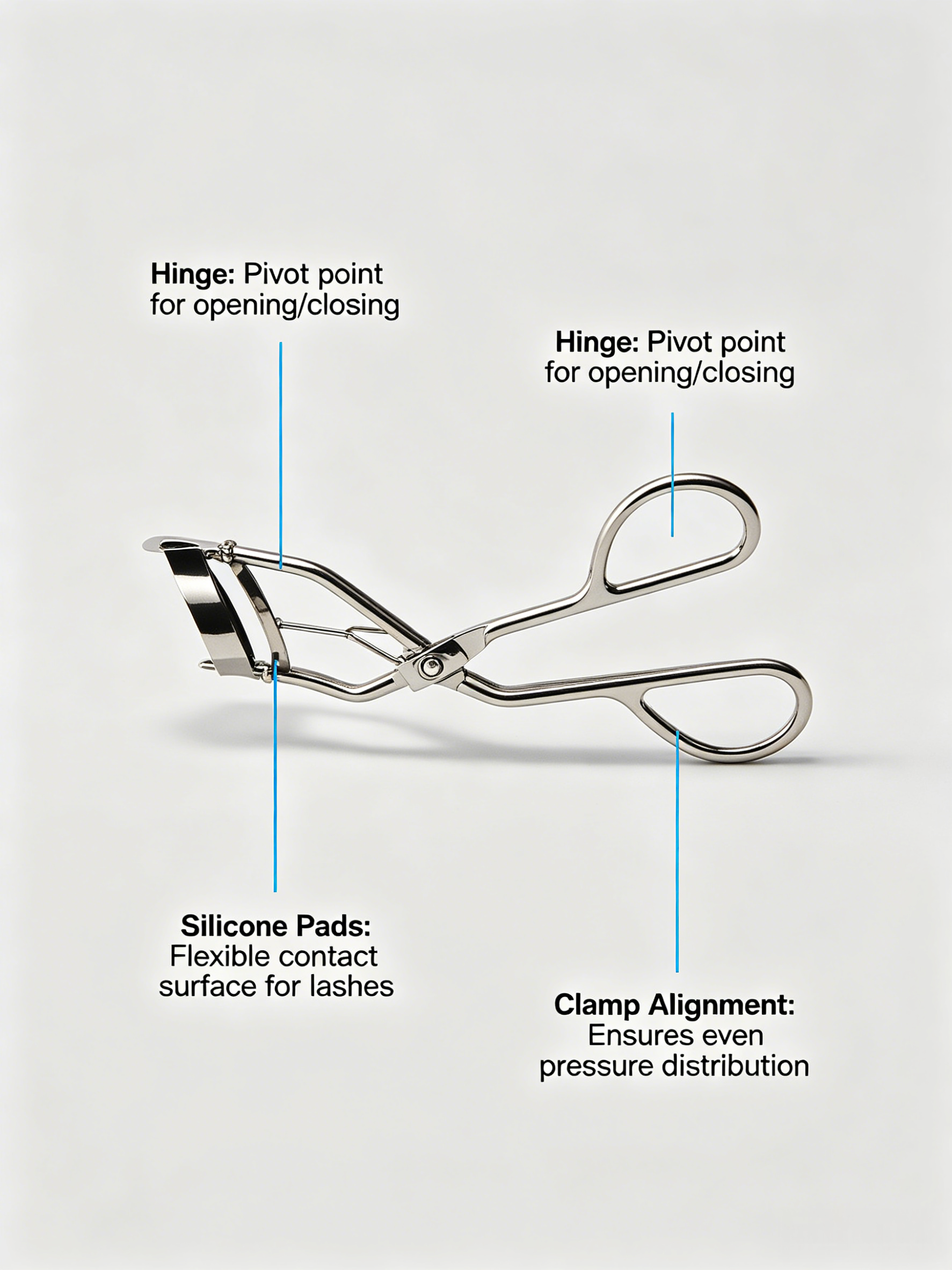
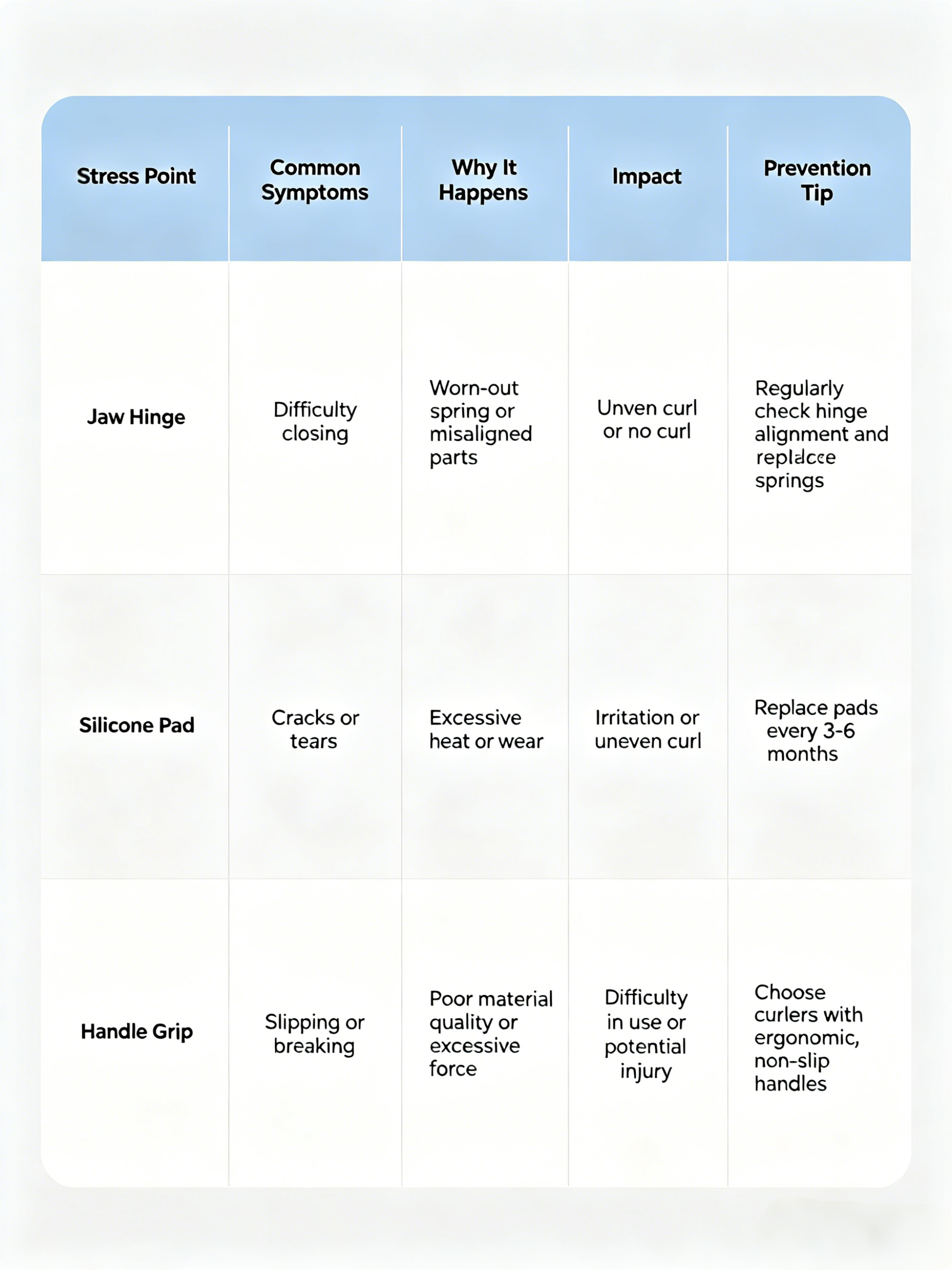
The most common weak points are the hinge and pivot, the cushion pad, clamp alignment, frame curvature, handle stability and surface cleanliness. These parts should be evaluated together. A fresh pad will not solve a bent frame. A comfortable handle will not compensate for a stiff hinge. A shiny finish does not guarantee a smooth closing action.
For B2B buyers, these checks are commercially important because eyelash curlers are often judged by first use. A user may not know whether the issue is curvature, pad compression or alignment, but they will notice pinching, discomfort or poor lift immediately. Reducing those complaints starts with practical inspection before purchase.
Hinge and Pivot: The First Mechanical Stress Point
The hinge is the main moving point of an eyelash curler. Every squeeze of the handles places stress on the pivot area and determines how the upper clamp travels toward the pad. A reliable hinge should move smoothly, return cleanly and hold the clamp squarely over the cushion.
Warning signs include squeaking, stiffness, delayed opening, side-to-side wobble or a clamp that closes at an angle. These signs may develop after repeated use, but they can also appear during sample inspection if assembly is inconsistent. Buyers should not rely only on the feel of one squeeze. Open and close the tool several times and observe the clamp from the front, not just from the side.
How to check hinge alignment during sample review
- Open and close slowly: the upper clamp should travel evenly without jumping, scraping or twisting.
- Watch both corners: one corner should not touch the pad significantly before the other.
- Check return action: the tool should reopen smoothly when pressure is released.
- Feel for lateral movement: excessive side play may signal loose assembly or early wear risk.
- Repeat the motion: a single smooth squeeze is less informative than repeated cycles during inspection.
A hinge does not need to feel heavy to be dependable. In fact, a tool that feels overly stiff may encourage users to squeeze harder than necessary. The goal is controlled movement with moderate hand pressure.
Pad Compression: Why Cushion Quality Changes the Curl
The silicone or rubber pad is not only a comfort component. It is the buffer between the metal clamp and the lashes. When the pad is resilient and securely seated, it helps create a smoother lift. When it flattens, hardens, cracks or develops a deep groove, the same hand pressure becomes harsher on the lash line.
A worn pad can cause sharp crimping instead of a rounded curl. It can also collect mascara, eyeliner, eyeshadow and skin oils. Residue reduces grip, makes the surface less predictable and may transfer contamination near the eye area. Users often continue using a frame long after the pad has stopped providing real cushioning, so replaceable pads are a practical value point for retailers and repeat-use customers.
Pad inspection checklist
| Check point | What to look for | Why it matters |
|---|---|---|
| Surface condition | Cracks, grooves, cuts, stickiness or hardened areas | Damaged pads can create sharp pressure on lashes. |
| Rebound | Light fingertip pressure should not leave a permanent dent | Poor rebound means reduced cushioning. |
| Fit in channel | Pad should sit securely without lifting at the ends | Loose pads can shift during curling. |
| Cleanability | Residue should wipe away without excessive effort | Clean pads support safer use near the eyes. |
| Replacement support | Confirm whether compatible replacement pads are available | The frame may last longer than the cushion. |
When reviewing suppliers, ask how replacement pads are supplied, whether they are included with the retail pack, and whether the pad design is specific to that frame. Do not assume that pads from one curler will fit another. A pad that is too loose, too short or too tall can change clamp pressure and comfort.
Clamp Alignment and Curvature: Fit Matters More Than Appearance
Clamp geometry determines how close the curler can sit to the lash line and how evenly it reaches the inner, center and outer lashes. A curler that is too flat for a rounded eye may press mainly in the center and miss the corners. A curler that is too curved for a flatter eye shape may pinch at the corners or fail to sit comfortably at the base of the lashes.
This is why a single universal shape may not satisfy every market. Users with small, deep-set, hooded, monolid or very round eyes may need different opening depths and curvature. A wider frame may seem efficient, but if it extends beyond the natural lash line, it can catch skin. A narrow frame may feel controlled but may require repositioning to reach the full lash line.
For assortment planning, buyers should compare the side profile, clamp width, opening depth and curvature rather than choosing only by finish or packaging. If you are building a multi-SKU beauty accessory range, compare options within Olimor product collections according to intended users, sales channel and packaging position.
Curvature comparison for buyer selection
| Design factor | Potential advantage | Possible issue if mismatched | Buyer question |
|---|---|---|---|
| Flatter clamp curve | May suit flatter lash lines and some monolid users | May miss corners on rounded eyes | Which user group is the main target? |
| More pronounced curve | May follow rounded eye shapes more closely | May pinch corners on flatter eyes | Has the sample been checked on different eye shapes? |
| Wider clamp | Can cover more lashes in one placement | May extend beyond smaller lash lines | Is the width appropriate for the retail market? |
| Deeper opening | Can help position lashes into the curler | May feel bulky for some users | Does the opening improve control or reduce it? |
The best curler is not necessarily the most dramatic-looking one. A controlled, even closure is more important than a visually impressive curve.
Handle Design and User Pressure: Preventing Over-Squeezing
Many eyelash curler failures are accelerated by excessive force. If handles are slippery, finger loops are awkward or the mechanism feels stiff, users naturally squeeze harder. Excess pressure compresses the pad faster, stresses the hinge and increases the chance of pulling lashes during release.
A good handle should support stable control with moderate pressure. It should not twist in the hand. It should not require rapid pumping to create lift. Repeated pumping on the same lash section can create sharp bends and may increase stress on both the lashes and the tool.
For professional or salon environments, ergonomics become more important because the tool may be used frequently. A design that feels acceptable for one personal use may feel tiring when repeated throughout a workday. During sample review, ask multiple people to handle the tool if possible. Differences in finger size, grip strength and technique can reveal practical issues that are not obvious from product photos.
Manufacturing and Inspection Details Buyers Should Discuss
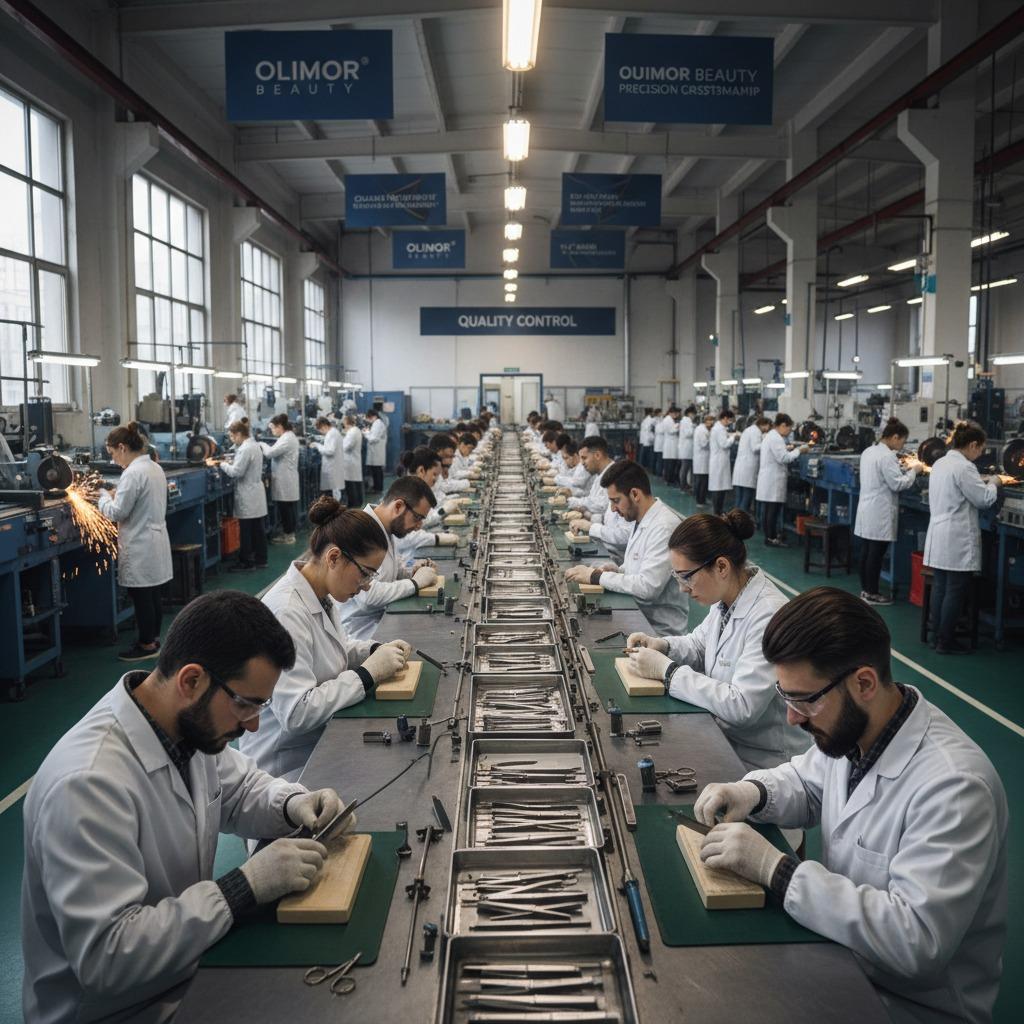
Eyelash curler sourcing should include more than color, surface finish and packaging. Mechanical consistency matters because small variations can affect comfort. During supplier communication, focus on the parts that influence function: frame symmetry, hinge assembly, pad fit, clamp alignment and final inspection process.
Useful questions include how the supplier checks that the upper clamp meets the pad evenly, how pad fit is verified, how finished tools are protected from bending during packing, and whether replacement pads are available for the selected model. These are practical inspection topics rather than marketing claims. Buyers should request actual sample evaluation and supplier documents instead of relying on appearance alone.
If selling into regulated consumer markets, buyers should also verify current product safety obligations for the destination market. For example, the European Union’s General Product Safety Regulation applies broadly to consumer products, and the U.S. Food and Drug Administration provides public guidance on eye-area cosmetic safety that is relevant to hygiene practices around mascara and makeup use. Always confirm current versions, market-specific requirements and supplier documentation; do not treat general guidance as proof of certification for a beauty tool.
Incoming inspection checklist for retail or wholesale buyers
- Confirm the frame is not bent or twisted after transport.
- Open and close each reviewed sample several times to feel hinge movement.
- Check that the upper clamp contacts the pad evenly from end to end.
- Inspect pad surface, rebound and seating in the lower channel.
- Confirm handles do not slip, scrape or feel unstable.
- Review cleaning access around the pad channel and hinge area.
- Check packaging protection so the clamp is not compressed or distorted in storage.
- Ask whether spare pads, packaging options or customization are available for the chosen product.
For custom projects or sourcing comparisons, send functional requirements through the inquiry page, including intended market, packaging style, target user group and any inspection concerns you want addressed.
Correct Use: Reducing Complaints After Purchase
Even a well-made eyelash curler can cause problems if used incorrectly. One common mistake is curling after mascara has dried. Mascara can make lashes stiff or sticky, so clamping may pull or break them. In normal beauty routines, curling is generally done on clean, dry lashes before mascara application.
Another issue is clamping too close to the eyelid. The pad should support the lashes, not the skin. Users should position the curler carefully, look downward into a mirror if helpful, squeeze gently and release fully before moving the tool away. If there is pinching, the tool should be released and repositioned rather than forced.
- Start with clean lashes and a clean curler pad.
- Align the curler with the natural lash line without catching eyelid skin.
- Squeeze gently and hold briefly instead of pumping aggressively.
- Release the handles completely before pulling the tool away.
- Apply mascara after curling if mascara is part of the routine.
Retailers can reduce after-sale confusion by including simple use and care instructions. Clear instructions are especially useful when selling to first-time users or through online channels where staff cannot demonstrate the product.
Maintenance: Cleaning, Storage and Replacement Decisions
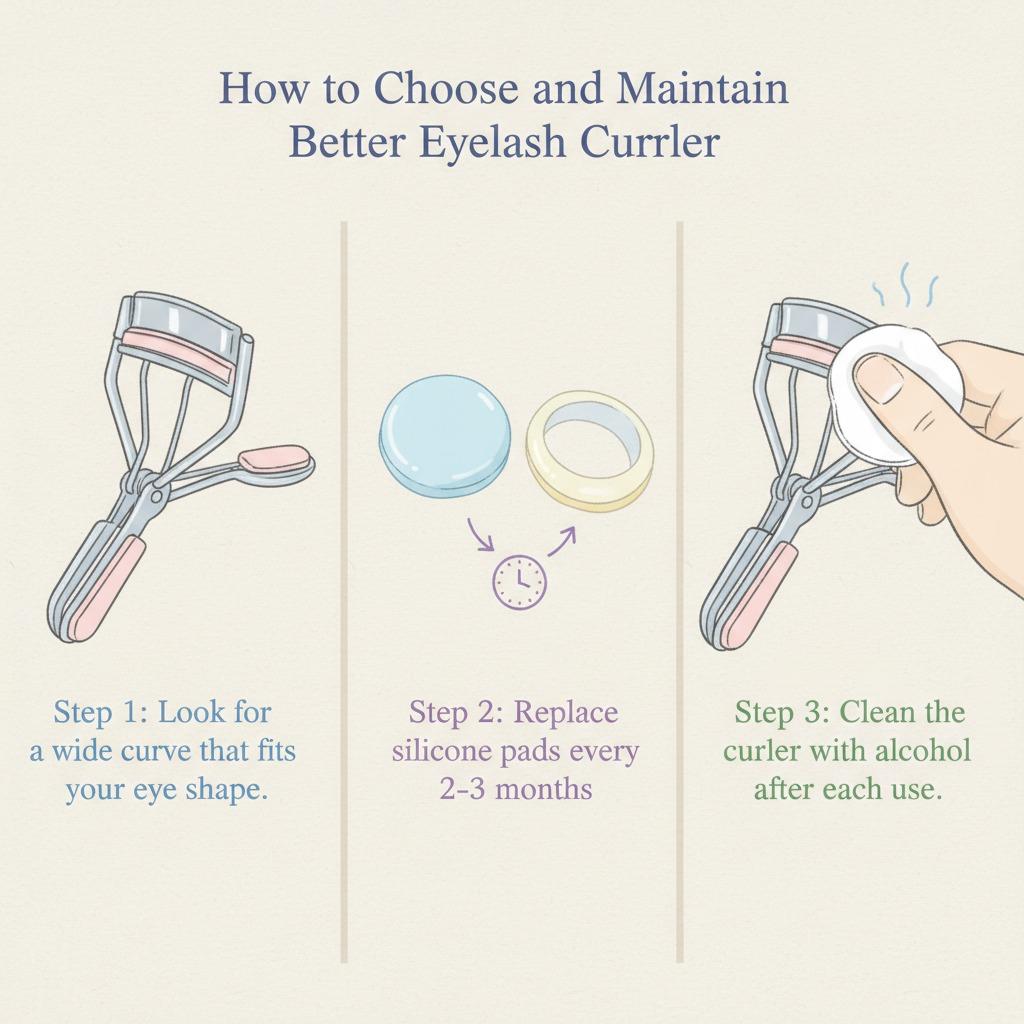
Maintenance is simple, but it must be consistent. After use, wipe the pad and metal contact areas to remove cosmetic residue and skin oils. Do not allow moisture to sit in the hinge area after cleaning. Store the tool where it will not be crushed by heavier items, because a slight frame warp can change clamp alignment.
Pad replacement should be based on condition and frequency of use. Replace the pad when it has a deep groove, visible cracking, poor rebound, hardening or residue that cannot be cleaned away. If the hinge becomes loose or the clamp no longer closes evenly, replacing the pad alone may not solve the problem. At that point, the full curler should be reviewed for replacement.
For B2B programs, maintenance support is part of product value. A curler with replaceable pads, easy-to-wipe surfaces and straightforward care instructions can support a better customer experience than a design chosen only for visual appeal.
Cost Factors and Supplier Evaluation
Eyelash curler cost is influenced by more than the frame itself. Factors can include material and finish choices, hinge construction, pad design, spare pad inclusion, packaging, customization, inspection requirements and order structure. Because these details vary by project, buyers should request quotations based on the exact product configuration rather than assuming a single standard cost.
When evaluating suppliers, compare communication quality as well as unit presentation. A capable supplier should be able to discuss sample review, packaging needs, customization options, replacement components and quality expectations without making unsupported claims. Ask for product details that can be verified on samples and documents.
For private-label or retail development, useful supplier questions include:
- Which curler shapes or models are available for the intended market?
- Can replacement pads be supplied with the product or separately?
- What customization options are available for color, finish or packaging?
- How are hinge movement, clamp alignment and pad seating checked before shipment?
- What information is needed to quote the project accurately?
If you need help narrowing product direction, you can contact Olimor with your target market, channel and inspection priorities.
FAQ for Eyelash Curler Buyers
Can I request samples before placing a larger order?
Sample availability depends on the product and project requirements. Buyers should request samples for hands-on checks of hinge movement, clamp alignment, pad fit, finish and packaging before confirming a larger purchase.
Is there a fixed MOQ for eyelash curlers?
MOQ can vary by product type, customization, packaging and production arrangement. Confirm the current MOQ directly with the supplier for the exact model and order specification.
Can eyelash curlers be customized?
Customization may be available depending on the selected product and project scope. Common discussion points include color, finish, packaging and branding requirements. Confirm feasibility with supplier documents and approved samples.
How should quality be checked before shipment?
Quality checks should include visual review, hinge movement, even clamp closure, pad seating, pad surface condition, handle stability and packaging protection. Buyers should agree inspection expectations before production.
How long does production or delivery take?
Lead time depends on product availability, customization, packaging, order quantity and shipping arrangement. Ask for a current schedule based on your confirmed specifications rather than relying on a general estimate.
Final Selection Guidance
A reliable eyelash curler should feel controlled before it touches the lashes. Prioritize smooth hinge action, even clamp alignment, suitable curvature, resilient replaceable pads, comfortable handles and easy maintenance. These practical details matter more than surface shine alone.
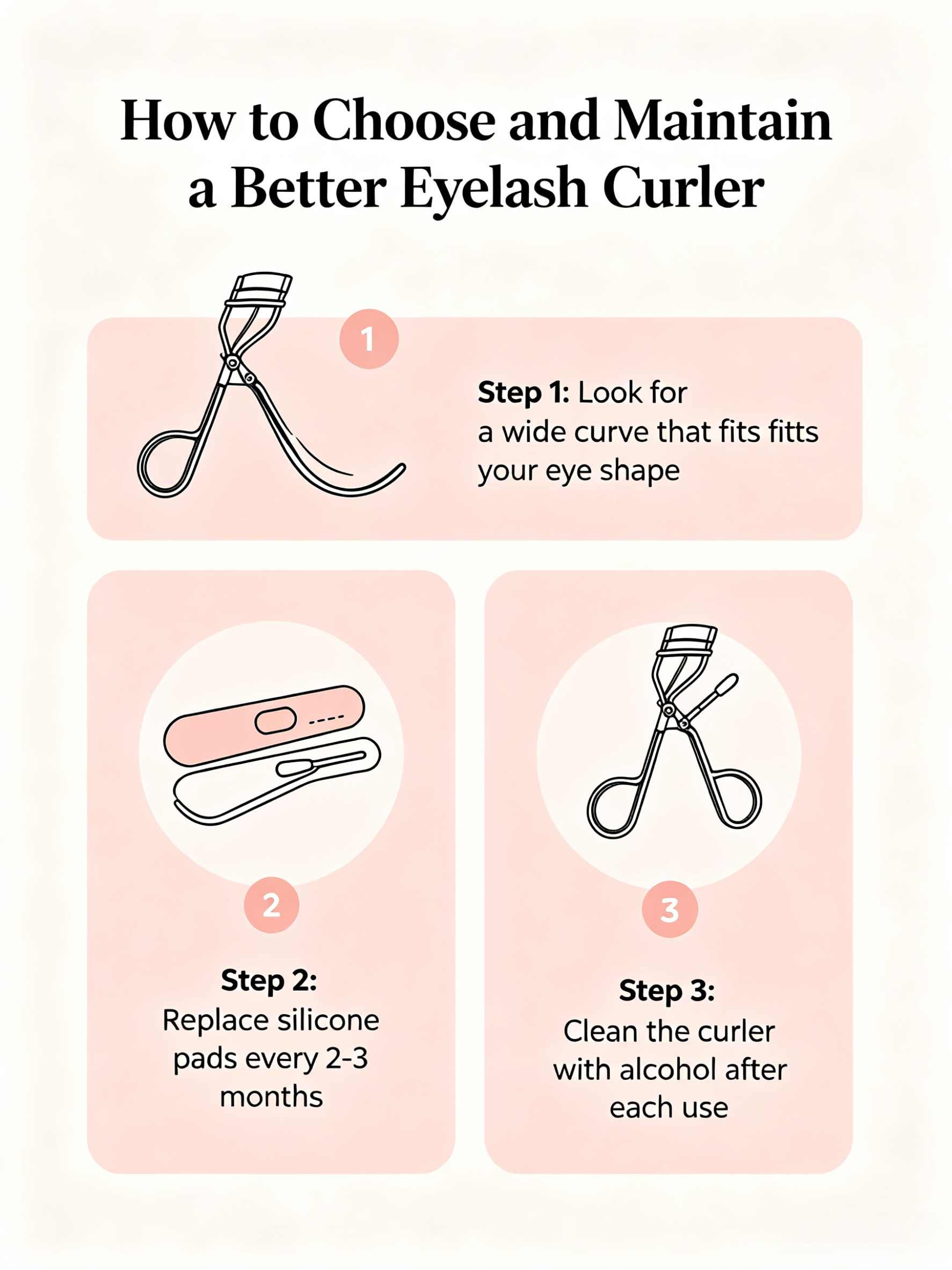
For buyers, the strongest sourcing decision comes from combining sample inspection with clear supplier questions. Check how the tool moves, how the pad performs, how the shape fits the intended user and how the product will be cleaned, stored and supported after sale. That approach helps reduce complaints and creates a more useful beauty tool assortment.